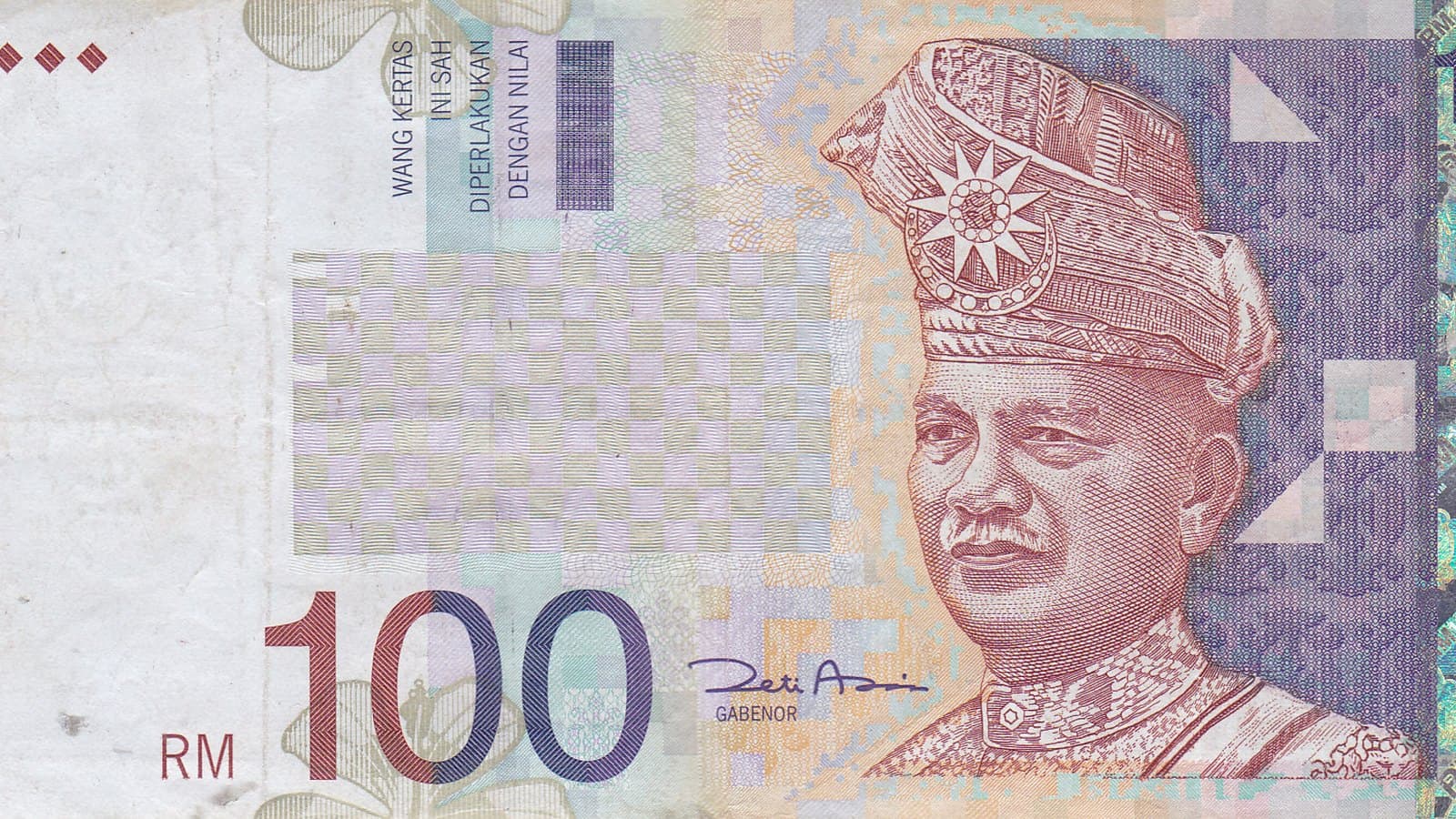
> Quick view: Bank Negara Malaysia's official ringgit (MYR) reference rates, as of 1 September 2026, 5:00pm session. BNM publishes four sets a day and this page uses the 5:00pm interbank close as the headline benchmark — plus the 11:30am set, which is the one that actually tells you what a bank counter will pay you.
Today's ringgit exchange rates
The table below carries all 27 currencies BNM publishes, at the 5:00pm interbank middle rate on 1 September 2026, with the change since this page's previous snapshot on 12 August. Read the "per" column carefully: yen, baht, won and rupiah are quoted per 100 units because a single unit is worth a fraction of a sen.
See the comparison table below for the full list.
What has moved since mid-August
Comparing the 1 September close against the 12 August close on the 21 currencies this page tracked previously, the ringgit is stronger against 18 of them.
- The US dollar broke below RM4.05. USD went from RM4.0870 to RM4.0400, a 1.15% ringgit gain in three weeks. USD 1,000 now costs RM4,040 instead of RM4,087 — RM47 less on the same thousand dollars.
- Travel currencies moved the traveller's way. Thai baht is down 1.68% (100 THB now RM12.1463), yen down 1.53% (100 JPY now RM2.5261), Hong Kong dollar down 1.06%. A ¥100,000 Japan trip that cost RM2,565 in mid-August costs RM2,526 today.
- The biggest single move is the Philippine peso, down 3.12% to RM6.4695 per 100.
- Three went the other way. The Korean won gained 1.98% against the ringgit (100 KRW now RM0.2942, up from RM0.2885), the Taiwan dollar 0.45%, and the Australian dollar was flat at +0.03%. If you are buying won, mid-August was the better day.
- The Gulf currencies track the dollar exactly. Saudi riyal and UAE dirham both fell 1.15%, the same figure as USD, because both are pegged to it. SAR 1,000 is now RM1,076.04.
The 11:30am rate almost nobody uses
Every guide quotes BNM's interbank rate, then tells you it is "not what you'll get". BNM also publishes the number that is closer to what you'll get, and it sits on the same page.
In Bank Negara's own words, rates at 0900, 1200 and 1700 come from the Interbank Foreign Exchange Market in Kuala Lumpur, while rates at 1130 are the best counter rates offered by selected commercial banks. That is a retail number, not an interbank one — and BNM only publishes it for seven currencies.
Here is 1 September's 11:30am counter set. Each line gives what the bank buys at, what it sells at, then the 12:00pm interbank middle rate from half an hour later, and the two spreads side by side.
- US dollar (1 USD): bank buys RM4.0160, sells RM4.0410; interbank mid RM4.0353. Counter spread 0.62%, interbank 0.14%
- Singapore dollar (1 SGD): buys RM3.1485, sells RM3.1905; mid RM3.1731. Counter spread 1.32%, interbank 0.15%
- Euro (1 EUR): buys RM4.6574, sells RM4.7024; mid RM4.6833. Counter spread 0.96%, interbank 0.15%
- British pound (1 GBP): buys RM5.4312, sells RM5.4812; mid RM5.4643. Counter spread 0.92%, interbank 0.16%
- Australian dollar (1 AUD): buys RM2.8644, sells RM2.9094; mid RM2.8921. Counter spread 1.56%, interbank 0.16%
- Canadian dollar (1 CAD): buys RM2.8832, sells RM2.9282; mid RM2.9098. Counter spread 1.55%, interbank 0.16%
- Japanese yen (100 JPY): buys RM2.4977, sells RM2.5427; mid RM2.5251. Counter spread 1.78%, interbank 0.15%
Two things fall out of that list. First, the interbank spread is about 0.15% on everything, while the best bank counter spread runs 0.6% to 1.8% — four to twelve times wider, and that gap is the cost of being a retail customer. Second, the spread is not the same across currencies: buying US dollars over a bank counter costs you 0.62% in spread, buying yen costs 1.78%. On RM5,000 of yen that difference is roughly RM58 against the same trade in dollars.
And this is the best counter rate BNM could find among selected banks. A branch that is not one of them, an airport counter, or a mall money changer can be wider still — which is why the mid-rate is a benchmark to check quotes against, not a price.
How to convert quickly
- Foreign to ringgit: multiply by the RM rate, adjusting for the per-100 currencies. 500 THB is 500 × (12.1463 ÷ 100) = RM60.73.
- Ringgit to foreign: divide. RM100 ÷ 3.1730 = SGD 31.52.
- For the actual amount, check your bank's or changer's live board — the spread above is what sits between the two numbers.
Popular conversions at today's rate
Worked from the 1 September 2026 interbank middle rates, before any counter margin:
- RM100 = SGD 31.52, and SGD 100 = RM317.30
- RM100 = USD 24.75, and USD 1,000 = RM4,040.00
- RM1,000 = about ¥39,587, and ¥10,000 = RM252.61
- RM500 = about ฿4,116, and ฿1,000 = RM121.46
- CNY 1,000 = RM601.00
- SAR 1,000 = RM1,076.04 (useful when budgeting for umrah)
- INR 10,000 = RM425.52
The remittance currencies most rate pages leave out
BNM publishes rates for several currencies that general "MYR exchange rate" pages skip, and they happen to be the corridors Malaysia's migrant workforce sends money down. At 1 September's close:
- Pakistani rupee (PKR): 100 PKR = RM1.4565, so RM1,000 is about PKR 68,658
- Nepalese rupee (NPR): 100 NPR = RM2.6595, so RM1,000 is about NPR 37,601
- Myanmar kyat (MMK): 100 MMK = RM0.1930, so RM1,000 is about MMK 518,000
- Cambodian riel (KHR): 100 KHR = RM0.0993, so RM1,000 is about KHR 1,007,000
- Indonesian rupiah (IDR): 100 IDR = RM0.0228, so RM1,000 is about IDR 4,386,000
- Egyptian pound (EGP): 1 EGP = RM0.0793
Note the gap: BNM does not publish a Bangladeshi taka rate at all, despite Bangladesh being one of Malaysia's largest remittance corridors. For BDT there is no official reference number to check your remittance provider against — you are comparing providers to each other.
The list also includes the Special Drawing Right (SDR) at RM5.5303, which is not a currency you can buy. It is the IMF unit that international treaties are written in — including the airline liability limits that decide what you are owed for a lost bag. The 1,288 SDR baggage cap works out to RM7,123 at today's rate.
When Bank Negara publishes these rates
BNM publishes on business days only, in four sets: 0900, 1200 and 1700 from the Kuala Lumpur interbank market, and 1130 as the best commercial-bank counter rates. The 5:00pm set is the one treated as the day's closing benchmark, and it is the one this page leads with.
Nothing is published on weekends or public holidays, so a Saturday or Sunday lookup returns the previous Friday's figures. The next federal no-publication day is Wednesday 16 September 2026 (Malaysia Day) — a Wednesday, so that week has a gap in the middle rather than a long weekend.
Checking it yourself, any day
You do not have to wait for a page like this one to refresh. BNM's Kijang Portal exposes the same rates through a free, public API that needs no key — the exchange-rate endpoint at `api.bnm.gov.my` returns every currency for a given session as JSON, and honours a `session` parameter of `0900`, `1130`, `1200` or `1700`. The human-readable version, with a date picker going back to 1997, is on Bank Negara Malaysia's exchange rates page.
Rates move every business day. Treat every figure above as a 1 September 2026 snapshot, and confirm the live number before you transact.
Related reads
- Air passenger rights in Malaysia — where that 1,288 SDR baggage limit turns into ringgit
- Duty-free shopping in Labuan — where the ringgit stretches furthest on spirits, chocolate and perfume
- JB food spots worth crossing for — how far a Singapore dollar goes across the Causeway
*Rates source: Bank Negara Malaysia, 1 September 2026 sessions, retrieved via the BNM Kijang Portal open API. Figures are reference rates that change every business day — always confirm the live rate with your bank or money changer before transacting. This is informational only, not financial advice.*