> Everything below comes from the Civil Aviation Authority of Malaysia's own consumer pages at caam.gov.my and flysmart.my, read on 29 August and re-checked on 3 September and 13 October 2026, from the Malaysian Aviation Consumer Protection Code 2016 as amended in 2024, and from CAAM's own Consumer Reports for January to June 2025 and July to December 2025. The ringgit conversion uses Bank Negara Malaysia's published Special Drawing Rights rate.
First, the change nobody announced loudly enough
For years the answer to "who do I complain to about an airline in Malaysia" was MAVCOM, the Malaysian Aviation Commission. That is no longer the answer, and the clearest proof is that mavcom.my no longer resolves at all. Consumer protection now sits with the Civil Aviation Authority of Malaysia (CAAM), which runs the same FlySmart consumer portal at flysmart.my, complete with a merger announcement of its own.
The rules themselves did not weaken in the handover. The Malaysian Aviation Consumer Protection Code 2016 (MACPC) still applies to all airlines operating in Malaysia, local and foreign alike, for incidents that happen in Malaysia. What changed is the letterhead you address.
The handover has a statute and a date, which is worth knowing if you ever have to write it down. MAVCOM was wound up by the Malaysian Aviation Commission (Dissolution) Act 2024 [Act 856], which came into force on 1 August 2025 and moved consumer protection, compliance, enforcement and service-quality oversight to CAAM under the Civil Aviation Authority of Malaysia Act 2017 [Act 788]. The Code itself was not rewritten in the move: every reference to MAVCOM inside it now reads as CAAM.
Does the Code even apply to your flight?
Two questions decide it, and the Code answers both itself rather than leaving it to an airline's own terms.
Which airlines. The Code's definition of "airline" reaches well past Malaysian carriers. Alongside holders of an air service licence or permit, it covers any operator permitted to run a scheduled or non-scheduled journey to or from a place in Malaysia under a government agreement. So Emirates, Qatar Airways, Singapore Airlines and the rest are bound by it on flights touching Malaysia, not just Malaysia Airlines, AirAsia, Batik Air and Firefly. CAAM accepts complaints against foreign airlines as long as the incident happened in Malaysia.
Which passengers. You can claim if you hold a confirmed reservation and — except where the flight was cancelled — present yourself for check-in at the time the airline stipulated. Miss the check-in cut-off and the entitlement falls away. The Code also settles something airlines stay vague about: a ticket issued under a frequent flyer programme or other commercial programme counts. A seat booked with Enrich points or AirAsia points carries the same delay care, refund rights and baggage cover as a cash fare.
One more definition matters on connections. A "contract of carriage" expressly includes a journey made up of two or more flights operated by the same or different airlines, and on directly connecting flights your "final destination" is the destination of the last flight — not the city you are stuck in.
What a delay is worth
The Code sets two thresholds, and neither of them pays you cash for the inconvenience.
At 2 hours, the airline must provide meals, phone calls and internet access. At 5 hours, that extends to hotel accommodation where an overnight stay becomes necessary, plus transport between the hotel and the airport. At any point you may decide not to travel at all, in which case you are entitled to a refund of the full ticket cost including taxes and fees, in the original mode of payment, within 30 days.
Note the phrase "original mode of payment". It appears throughout the Code and it is the sentence to quote at a counter that offers you a travel voucher instead.
Cancellations, and the extraordinary-circumstances trap
If your flight is cancelled you choose between a full refund within 30 days and rerouting on comparable transport at no additional cost. Airlines are also required to remove cancelled flights from booking platforms, including online and offline agents, so nobody can sell a seat on a flight that will not operate.
The part most travellers get wrong is what happens in extraordinary circumstances, such as severe weather or air traffic control restrictions. The airline is not excused from refunding you. Under the amended Code it must first offer a refund of the full cost, inclusive of taxes and fees, in the original payment method, within 30 days. It may additionally offer vouchers or credit shells, and you have the right to decide which you accept. A credit shell is a choice offered to you, not a default the airline may impose.
If the airline simply moves your departure time by 3 hours or more, you are entitled to rerouting or, if you would rather not go, the same full refund within 30 days. It must notify you as soon as practicable and at least 24 hours before the scheduled time of departure, and since January 2025 it must give at least two weeks' notice of a change to the scheduled departure time, unless extraordinary circumstances or unavoidable technical problems intervene. If a route is being discontinued altogether, that notice runs to one month.
Denied boarding
Overbooking is legal. Handling it after you have boarded is not. Under the Code the airline must inform you at the check-in counter or the departure gate that there are insufficient seats, and it cannot remove you once you are on the aircraft.
From there you are entitled to a refund of the full cost of the ticket, inclusive of taxes and fees, in the original mode of payment, within 30 days, or rerouting to your destination under comparable transport conditions. If you take the rerouting, the airline must provide meals, phone calls, internet access and, where necessary, hotel accommodation and transport between hotel and airport.
Arriving late at the gate is a different matter and the Code does not protect you. Most airlines require passengers at the gate at least 20 minutes before departure, and once the airline begins reconciling baggage to boarded passengers it is entitled to stop you boarding.
Baggage: the number and the deadline
Delayed, lost or damaged baggage is covered up to 1,288 Special Drawing Rights per passenger. The SDR is a unit set by the International Monetary Fund and its value moves daily, which is why the Code does not print a ringgit figure. Bank Negara Malaysia published an SDR rate of RM5.5294 for 13 October 2026, which puts the ceiling at approximately RM7,120 on that day. It was RM5.5282 on 3 September, so the ringgit ceiling has barely moved in six weeks.
Two deadlines decide whether you get anything at all. For damaged baggage, the report must be made on arrival or within 7 days of receiving your bags. For delayed baggage, on arrival or within 21 days. Ask for a copy of the Property Irregularity Report (PIR) and keep it, because the airline needs it to investigate and your insurer will ask for it.
Understand what the limit actually covers. A delayed-baggage claim is for necessary purchases such as toiletries and clothing, reasonable in relation to how long the bag was missing, and supported by receipts. It is not a payout equal to the value of the suitcase.
One entitlement worth knowing separately: if mobility equipment or an assistive device is damaged or lost, compensation is based on the prevailing market price of that equipment.
The letter your insurer will ask for
For a cancellation or a delay of 30 minutes or more, the airline must provide a verification letter within 7 working days of your request. Ask for it before you leave the airport if you can, because it is far easier to obtain while your case is fresh, and most travel policies will not pay without it.
The refund nobody asks for: airport tax on a flight you never took
This is the entitlement Malaysians leave on the table most often, and it survives even the cheapest fare.
CAAM's consumer pages are explicit. For both refundable and non-refundable tickets, airlines must refund all mandatory charges on a ticket you did not use. Those charges are the Passenger Service Charge — the airport tax — plus taxes, fees and charges imposed by the Government and prescribed by written law, the fuel surcharge, and any other fee the airline itself imposes, with the carbon fee given as CAAM's own example. Only the fare dies with a non-refundable ticket: in CAAM's words the ticket will lose its value with the exception of the airport tax or government-imposed taxes.
Malaysia Airports says the same thing on its own PSC page, in one sentence: unused flight tickets are eligible for a full refund of the PSC from the respective airline. The reason is mechanical. The airline collects the charge when you buy the ticket and only pays it to the airport once the flight is actually completed, so an unflown ticket leaves the airline holding money that was never its own.
It is worth real ringgit. On the rates in force since 1 June 2024, the departure PSC is RM73 for an international departure from KLIA Terminal 1, RM50 from KLIA Terminal 2 and all other airports, and RM11 for a domestic departure. Transfer passengers pay RM42, RM29 and RM7 on the same three bands. Senai is priced separately. These rates belong to the first regulatory period, which runs from 1 June 2024 to 31 December 2026, and no rates for 2027 had been announced by 13 October 2026, so check the figure again for a ticket that departs after New Year. A family of four who miss an international flight out of KLIA Terminal 1 on non-refundable fares are owed RM292 in airport tax alone, before the fuel surcharge is counted.
The mechanics match the rest of the Code. The money goes back in the original mode of payment, and it must reach you within 30 days of the request. One deduction is allowed and it is capped: an airline may charge a processing fee of up to 5 per cent of the mandatory charges, and only on a non-refundable ticket. On a refundable ticket CAAM states airlines are not allowed to charge that five per cent at all. Read what the percentage applies to — the mandatory charges, not the fare. Five per cent of an RM73 PSC is RM3.65.
Nothing happens automatically. You have to ask, and asking is where it goes wrong: refunds were the third-largest complaint category CAAM recorded in the first half of 2025, at 553 cases.
Two booking-stage rules travel with this one, and both are enforced. Airlines may not pre-tick optional add-ons: CAAM's position is that an airline should not automatically add any additional service to your fare, and you must be told and given the chance to opt in. And before the purchase completes, the airline — or its appointed travel agent — must communicate five key terms: cancellation fees, refund and rebooking policies, no-show policies, baggage allowance policies, and travel document validity requirements.
How to complain, in the right order
Go to the airline or airport first and give them 30 days to resolve it. Any complaint channel the company makes available should be accepted, including its official social media page. If you are unsatisfied with the response, or you get no response within 30 days, submit the complaint and the airline's reply to CAAM through the FlySmart online form. You will receive an acknowledgement email with a case reference number, which you use to track progress on FlySmart's status page. CAAM's own guidance is that it sends an initial response within seven days of your submission and asks you to allow up to 30 calendar days for resolution. FlySmart is a mobile app as well as a website — it is on the Apple App Store and Google Play — so the whole process can be run from a phone at the gate.
The consumer hotline is 1800-18-6966 within Malaysia and +603-7651 2777 from outside. Complaints against foreign airlines are accepted, so long as the incident happened in Malaysia. If you are flying from an EU airport or on an EU carrier, EU261 may also apply and is claimed directly with the airline.
Two deadlines sit inside that process and neither gets advertised. The airline or airport must acknowledge receipt of your complaint within 24 hours, then send a substantive written response and a resolution within 30 days — so silence at the 24-hour mark is itself a breach worth citing when you escalate. And the route eventually closes, though later than most guides say. The Malaysian Aviation Consumer Protection (Amendment) Code 2024, in force since 1 September 2024, doubled that window from one year to two years from the date the cause of complaint arose. Anything still printing the one-year figure is quoting the un-amended 2016 Code. Two years is generous, but it does run out, and a dispute you let simmer with an airline for three years is no longer escalatable however strong it was.
The regulator can refuse a complaint, but the grounds are narrow: it is frivolous or vexatious, it is not about the civil aviation industry, it is already the subject of court proceedings between the same parties, or a court has already decided it. If that court claim is withdrawn, abandoned or struck out, you can bring the complaint back.
What the regulator's own numbers say about your odds
CAAM publishes a Consumer Report, and the January to June 2025 edition — the first issued under CAAM's name rather than MAVCOM's — is the most useful thing a Malaysian passenger can read before deciding whether complaining is worth the afternoon.
The newest edition, July to December 2025, came out in May 2026. Volumes eased but stayed high: 4,922 submissions, down from 5,876 in the first half, of which 3,821 were complaints and 3,126 were actionable. Disruption dominated. Delays (758), cancellations (570) and rescheduling (392) made up 57 per cent of complaints, followed by online booking problems (278), mishandled baggage (249) and refunds (170). The airline order by raw count held: AirAsia 1,276, Batik Air 740, Malaysia Airlines 563, then AirAsia X 205, Firefly 196 and MASwings 15. CAAM closed all 3,126 actionable cases. Malaysian carriers and airports cleared more than 90 per cent within 30 days, while foreign carriers cleared about 59 per cent. The report's own diagnosis is the useful part: most of the frustration was not about slow resolution. It came from unclear information on refund eligibility and entitlements, which is exactly what the sections above spell out. The per-million-passenger figures it prints are the same as in the earlier edition, so the detailed breakdown below still uses the January to June 2025 numbers.
Complaining is now normal. CAAM received 5,876 submissions in the first half of 2025, up from 3,347 in the same period of 2024, a 76 per cent rise. Of those, 4,531 were complaints and 1,330 were requests for assistance. The share classed as actionable rose from 73.0 per cent to 83.8 per cent, which is a polite way of saying people are getting better at filing something CAAM can act on.
What people complain about. Cancellations (851), delays (612) and refunds (553) — together 53 per cent of all airline complaints — then rescheduling (459) and mishandled baggage (324). Every one of those categories is covered by the entitlements above.
Which airline, and the number that reverses the ranking. By raw volume: AirAsia 1,272, Batik Air 1,108, Malaysia Airlines 806, AirAsia X 271, Firefly 212, MASwings 17, plus 103 spread across 31 foreign carriers. Per million passengers carried, the order changes completely: Batik Air 564, Firefly 371, AirAsia X 284, Malaysia Airlines 204, AirAsia 178, MASwings 79. AirAsia draws the most complaints in absolute terms and the second-fewest relative to how many people it flies; Batik Air draws roughly three times AirAsia's rate. Read a raw complaint count in a news story with that in mind.
The number that should change your expectations. Malaysian carriers closed 97 to 100 per cent of complaints inside the 30-day rule — Malaysia Airlines, Firefly and MASwings at 100 per cent, AirAsia and Batik Air at 98, AirAsia X at 97, and airports at 88. Foreign airlines closed 49 per cent. Overall, 97 per cent of actionable complaints were resolved on time. So if your dispute is with a foreign carrier, plan on the 30 days lapsing and on having to escalate. It happens about half the time.
The Code has teeth and they have been used. Cumulative penalties collected under the MACPC since 2018 total RM4.85 million, imposed on AirAsia Berhad, AirAsia X Berhad and Batik Air for failing to disclose the final price of airfares, failing to communicate changes in flight status, and failing to give consumers a resolution within 30 days. A separate RM4.50 million has been collected from airport operators under the Quality of Service Directives, where a shortfall can cost up to 5 per cent of an airport's aeronautical revenue. Airlines are also required to report every complaint they settle in-house, and the volumes there dwarf the regulator's: Malaysia Airlines handled 13,383 internally in that half-year and AirAsia 10,907. Most cases never reach CAAM at all, which is exactly how the 30-day first step is meant to work.
Three things people learn too late
Two separate tickets are two separate contracts. If you book Kuala Lumpur to Dubai with one airline and Dubai to London with another, a delay on the first leg does not oblige that airline to do anything about the second ticket. On a single conjunction ticket, the airline must get you to your final destination at no extra charge.
Wheelchair assistance is free with an OKU card, and the advice is to tell the airline at least 48 hours before the flight.
Unclaimed refunds do not vanish. Money an airline fails to refund must be submitted to the Registrar of Unclaimed Moneys, and you can claim it from the Registrar directly.
Related reads
- KLIA to KL City 2026: Every Way In, Honestly Compared is the next decision you make after a delayed arrival, with the fares laid out.
- Renewing Your Malaysian Passport in 2026 covers the other document deadline that quietly ruins trips.
- Firefly Flights Pay 4% Cashback in TNG eWallet is what to stack on the next booking, running to 31 December 2026.
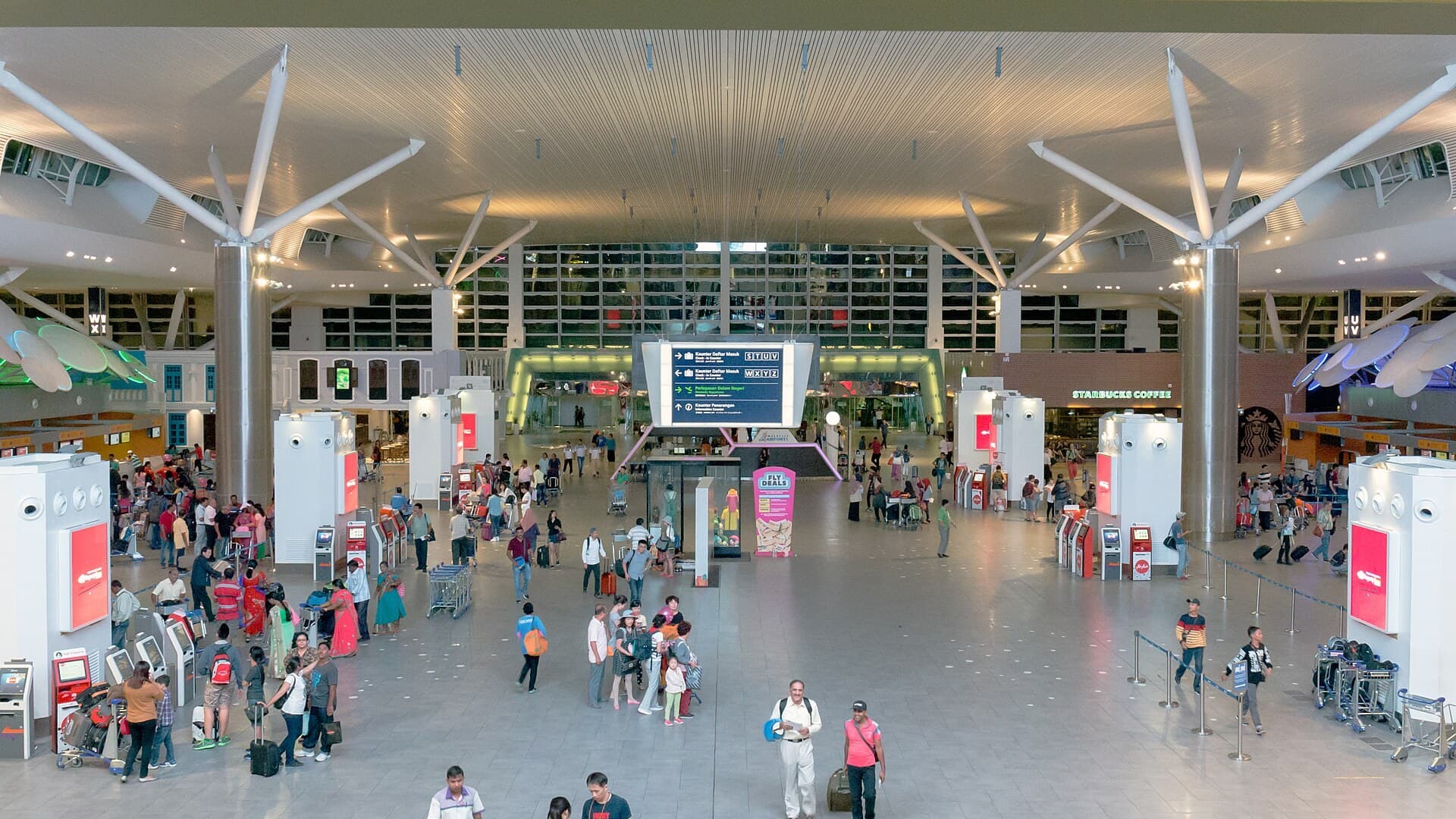
*Cover image: the KLIA2 departure hall, photo by Morio via Wikimedia Commons (CC BY-SA 4.0).*