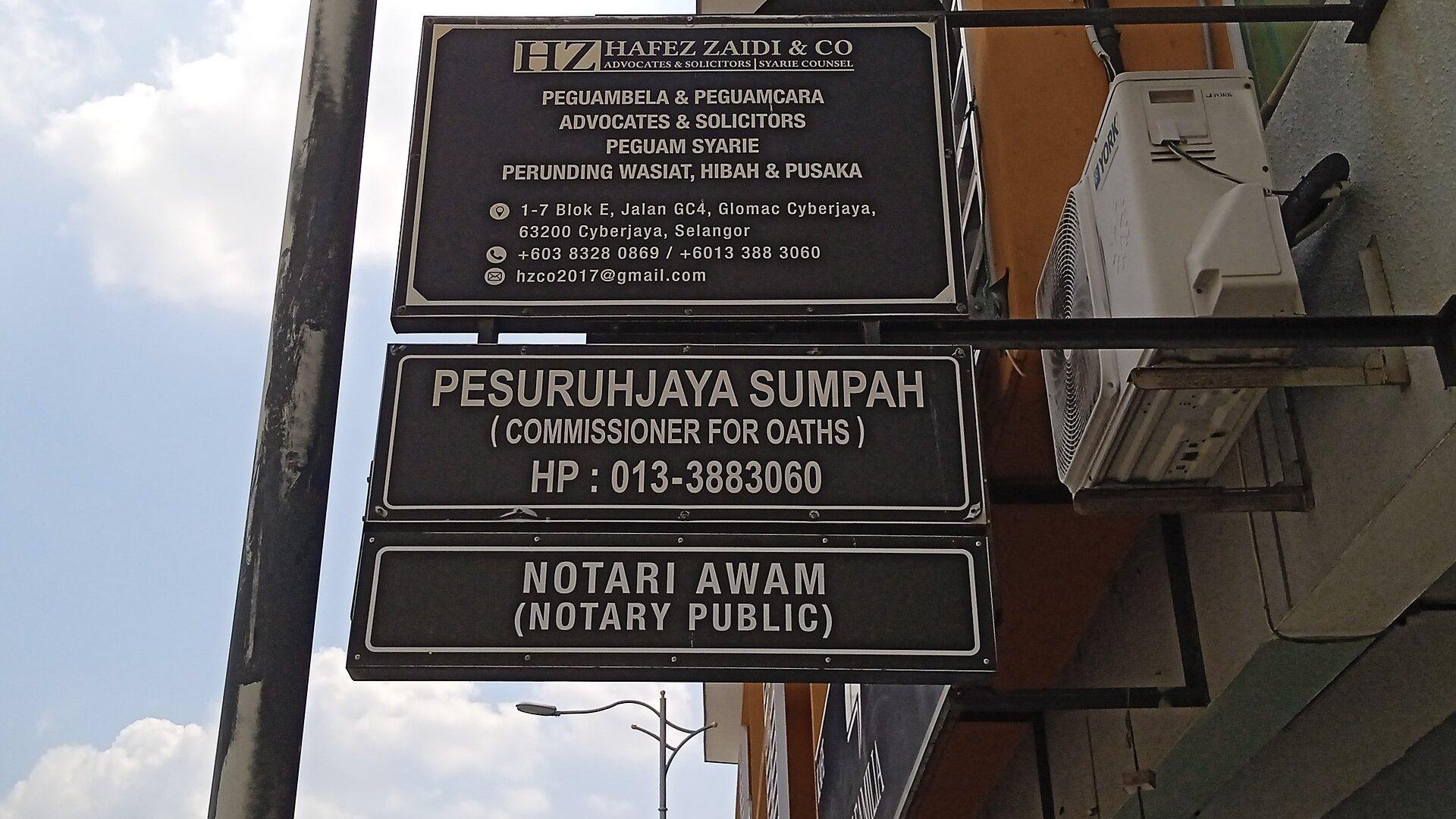
*Cover image: a Commissioner for Oaths and notary public sign outside a law office in Cyberjaya, Selangor, by Wiki Farazi via Wikimedia Commons (CC0).*
> Quick answer: write out your declaration yourself, take it with your MyKad (or another official photo ID) to any current Commissioner for Oaths, sign it in front of them and pay RM10, plus RM10 for each exhibit you attach. Check that the commissioner is listed as current on the Judiciary's e-Pesuruhjaya Sumpah directory before you go.
Sooner or later most Malaysians need a statutory declaration. It might be for an aid form that asks you to confirm you have no income, a land form that several siblings must sign, or an agency that wants you to swear to a fact because the original document is gone. The process is simple, but a few rules catch people out at the counter. Everything below comes from the law itself and from the official FAQ of the Commissioners for Oaths Unit at the Office of the Chief Registrar of the Federal Court.
What a statutory declaration is
Under section 2 of the Statutory Declarations Act 1960 (Act 783), a person may voluntarily make a declaration in Malay or English, in the form set out in the Act's Schedule, before a magistrate, a Sessions Court judge, a Commissioner for Oaths or a notary public. The form ends with the words "conscientiously believing the same to be true" and the place and date you made it. The Chief Registrar told commissioners in a 3 November 2015 directive that an SD must follow the Act's format.
Commissioners for Oaths are appointed by the Chief Justice under section 11 of the Courts of Judicature Act 1964 and the Commissioners for Oaths Rules 2018, for terms of up to three years. They come from four groups: lawyers with at least seven years in practice, confirmed civil servants, statutory body officers, and other suitable people.
What it costs
The fee is set by the Statutory Declarations (Fees) Order 1968, last changed by P.U.(A) 13/2023. From 16 January 2023, the old RM4 for a declaration and RM2 for an exhibit were both replaced with RM10. So:
- an SD with no attachments costs RM10;
- an SD that refers to two exhibits (say, a copy of your IC and a utility bill) costs RM30;
- there is no cheaper "copy" rate for an SD.
Affidavits and other documents follow a different scale under Rule 17 of the 2018 Rules: RM10 for an original affidavit per deponent, RM5 per copy, RM5 per original exhibit and RM2 per exhibit copy, and RM10 for other documents a commissioner is allowed to sign, such as a power of attorney.
Extra charges: a commissioner may charge a reasonable amount for a blank form, but only if you agree first. Charging you to draft the declaration is not allowed, because commissioners are not allowed to help prepare it at all. Non-government commissioners must display a board showing the fees at their premises.
Before you go
- Write the declaration yourself. The Unit's FAQ says an SD must be prepared by the declarant. A commissioner cannot fill in standard lines such as "I am a housewife" or "I have no income" for you.
- Bring official photo ID. MyKad is the obvious one, but any official ID showing your photo, full name, ID number and address can be accepted, including a driving licence, a foreign identity card or a UNHCR card.
- Everyone signs together. If several people must sign one declaration, all of them must attend at the same time. A sibling cannot sign on behalf of the others, and a power of attorney does not let someone sign a declaration in another person's name.
- Bring your exhibits. Each attachment the SD refers to is an exhibit, and each one costs RM10.
- Keep corrections minimal. Any change must be initialled by you and the commissioner, who also adds a small seal. If there are many changes, the FAQ suggests starting a fresh SD.
Where to find a Commissioner for Oaths
The FAQ lists courts, some government offices, statutory bodies, law firms, and private commissioners appointed for particular areas. The Judiciary's e-Pesuruhjaya Sumpah directory lets you search current appointments by name, category, state and town. It also lists expired, suspended and cancelled appointments, which is a quick way to check the person stamping your document is still authorised.
Commissioners at courts and government offices keep government office hours, depending on the finance counter. Others work normal office hours. Working nights, weekends or public holidays needs the Chief Justice's approval, so do not count on a Saturday visit. If the person making the SD is in hospital, bedridden or detained, a family member can ask a commissioner to attend. The commissioner must then apply to the Unit at least three working days in advance.
What a commissioner cannot do
- sign their own declaration, or one they prepared;
- act on documents in court proceedings where their own law firm acts for a party (lawyer commissioners);
- sign for close family such as a spouse or child, which the Unit says should be avoided;
- sign Syariah Court documents unless they are Muslim, because the Syariah Courts set that condition.
Does an SD expire, and can I use it overseas?
An SD has no expiry date, but it proves a fact as of the date you made it, so an agency may want a recent one. It is meant for use in Malaysia. Another country may still accept it if its own law allows.
Why you must tell the truth
Section 3 of Act 783 says a declaration under the Act counts as a declaration for sections 199 and 200 of the Penal Code. Making a false statement in one, or knowingly using a false one, is punished as if you had given false evidence. It is a criminal offence, not a technicality.
To complain about a commissioner, contact the Commissioners for Oaths Unit at the Office of the Chief Registrar of the Federal Court, Putrajaya, on 03-8880 9503.
*Sources: Statutory Declarations Act 1960, ss.2-4 and Schedule; Statutory Declarations (Fees) (Amendment) Order 2023, P.U.(A) 13/2023; media statement of the Minister in the Prime Minister's Department (Law and Institutional Reform), 13 January 2023; the FAQ and directory on the Judiciary's e-Pesuruhjaya Sumpah portal, read on 16 November 2026.*