October is when leave balances start to matter. The year-end school holidays are coming, HR sends the "please clear your leave" email, and a lot of people discover they do not actually know how many days the law gives them, or whether unused days simply vanish on 31 December.
The answer sits in one section of the Employment Act 1955 (Act 265): section 60E. We read it in the updated text published by the Labour Department (JTKSM), alongside sections 7, 60I and 69 and the First Schedule. It is shorter than most company leave policies, and in a few places it is more generous than them.
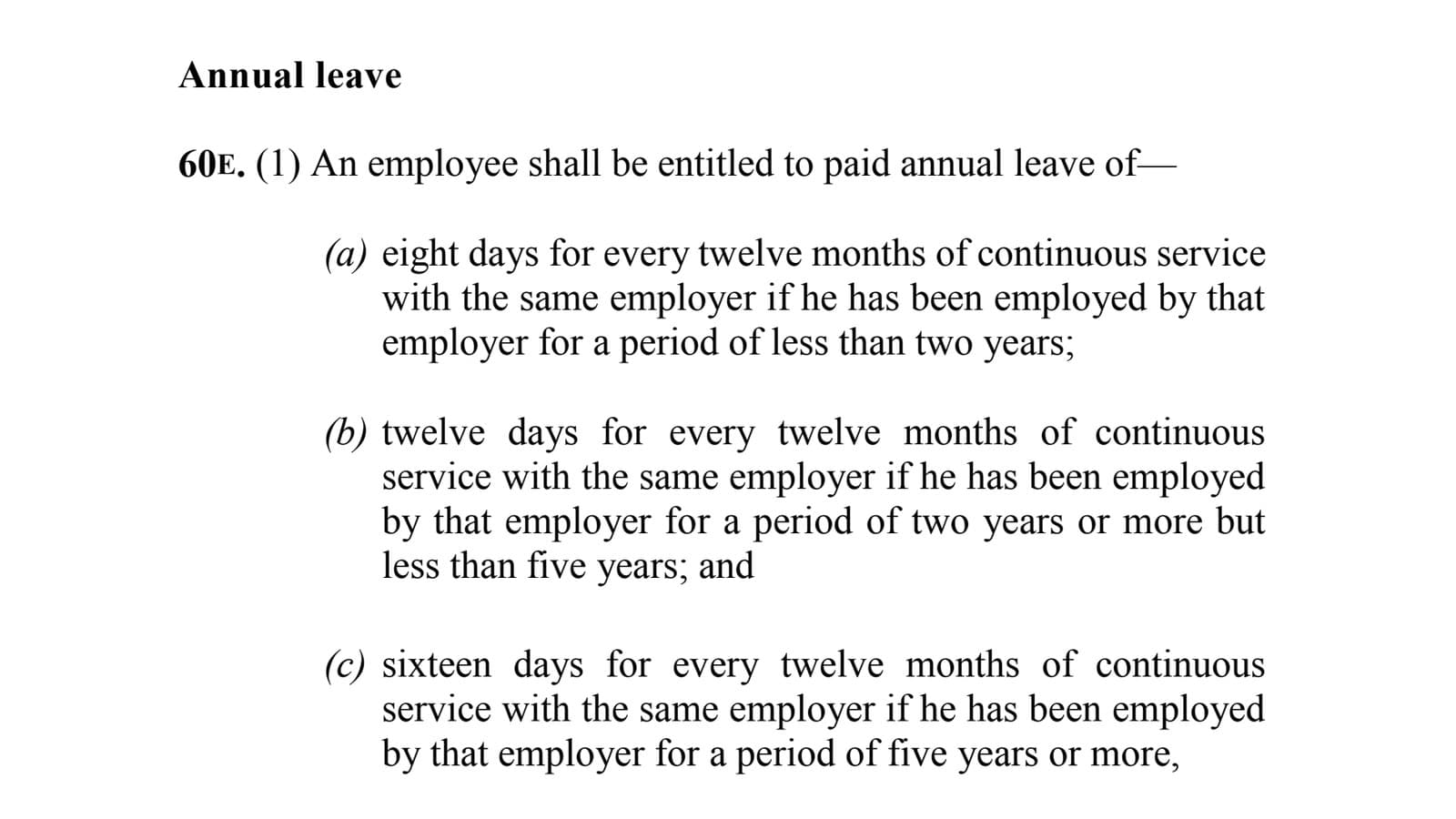
*Image: Employment Act 1955 (Act 265), section 60E, from the updated text hosted by JTKSM.*
How many days the law gives you
Section 60E(1) sets three tiers, based on how long you have worked for the same employer:
- Under 2 years: 8 days for every 12 months of continuous service
- 2 years to under 5 years: 12 days
- 5 years or more: 16 days
These are floors. Section 7 says any contract term less favourable than the Act is void and the Act's term applies instead, so a contract offering 14 days is fine and one offering 6 days is not.
Three details change the count. Annual leave is in addition to rest days and paid public holidays (section 60E(1A)), so a week off from Monday to Friday uses five days of leave, not seven, and a public holiday inside that week is not deducted at all. If you fall ill or start maternity leave while on annual leave, those days are converted to sick or maternity leave and your annual leave for them is treated as not taken (section 60E(1B)). And unpaid leave totalling more than 30 days in a 12-month period is ignored when your length of service is counted (section 60E(3B)), which can push back the date you move up a tier.
There is also a penalty clause. If you are absent without permission and without reasonable excuse for more than 10% of working days in a service year, you lose that year's annual leave entitlement.
The 12-month window, and why 31 December is not in the Act
Section 60E(2) is the use-it-or-lose-it rule. The employer shall grant and the employee shall take the leave "not later than twelve months after the end of every twelve months continuous service". Leave not taken by then lapses.
Read literally, that means leave earned in one service year can be taken any time in the following 12 months. Many company policies are stricter: leave must be used by 31 December of the same year, or only five days may be carried forward. Section 60E does not mention 31 December or a carry-forward cap. If your policy forfeits leave sooner than the Act's window, that is a point to raise with HR first and, if needed, with JTKSM.
The duty also runs both ways. The wording puts an obligation on the employer to grant the leave, so leave that lapses because requests were refused is a different situation from leave you simply did not apply for. Keep written records of leave applications that were turned down.
When unused leave can be paid out
There are only two routes to cash.
While you are still employed: the proviso to section 60E(2) allows payment in lieu only when the employer asks you to give up the leave and you agree in writing. You cannot insist on cashing out, and the employer cannot impose it without your signature.
When the contract ends: under section 60E(3A), if your employment ends before you have taken the leave owed to you, the employer must pay your ordinary rate for every untaken day. It does not matter whether you resigned, were retrenched or reached the end of a fixed term. The only exception is dismissal for misconduct under section 14(1)(a), after a due inquiry. Section 60E(2A) also lets you choose to take the leave before your last day instead.
For monthly-paid staff, the ordinary rate for one day is your monthly salary divided by 26 (section 60I(1A)). Weekly-paid staff divide by 6.
A worked example
Aisyah earns RM3,900 a month and has worked for her employer for just over a year and a half, so she is on the 8-day tier. She resigns, and in her final year of service she has completed 7 months.
- Pro-rated leave for the final year: 8 × 7 ÷ 12 = 4.67 days. Section 60E(1) rounds a fraction of half a day or more up, so this becomes 5 days.
- She has already taken 2 days, so 3 days remain.
- Daily rate: RM3,900 ÷ 26 = RM150.
- Payout with her final salary: 3 × RM150 = RM450, plus any leave still unused from her previous service year that is inside its 12-month window.
Who is covered
Since 1 January 2023 the Act applies to anyone with a contract of service in Peninsular Malaysia and Labuan, whatever the salary. The First Schedule switches off some rights above RM4,000 a month (overtime pay and certain rest day and holiday payments), but section 60E is not on that list, so annual leave applies at every salary. Domestic employees are excluded from section 60E.
Other groups have separate rules. Workers in Sabah and Sarawak are covered by the Sabah and Sarawak Labour Ordinances rather than the Act. Part-time employees have their own leave entitlements under the Employment (Part-Time Employees) Regulations 2010. Civil servants follow public service leave circulars, not the Employment Act.
If leave pay goes missing
Unpaid leave money is a wage claim. Under section 69, the Director General of Labour can inquire into disputes over wages or other payments due under a contract or under the Act and order the employer to pay. In practice that means a complaint at your nearest JTKSM office, with your contract, payslips, leave records and resignation or termination letter.
Related reads
- Overtime pay in Malaysia: 1.5x, 2x or 3x your hourly rate
- Sick leave and MC rules under the Employment Act
- Resigning or retrenched: notice periods and final pay
- Maternity and paternity leave in Malaysia
- Public holidays left in 2026
*Sources: Employment Act 1955 (Act 265), updated text as at 1 January 2023 hosted by JTKSM, read 19 October 2026: sections 7, 14(1), 60E, 60I(1A) and (1B), 69 and the First Schedule. This is a factual explainer, not legal advice.*