Overtime is one of the few parts of a Malaysian payslip where the law hands you an exact formula, and one of the parts most often paid wrong. The reason is simple: the rate is built from an hourly figure that almost no payslip prints. Once you can work that number out, you can check any overtime line yourself.
Everything below is read from the Employment Act 1955 (Act 265), using the Attorney General's Chambers reprint as at 1 August 2023, which includes the 2022 amendments that took effect on 1 January 2023. The Act covers Peninsular Malaysia and Labuan. Sabah and Sarawak have their own Labour Ordinances, so the section numbers here do not apply there.
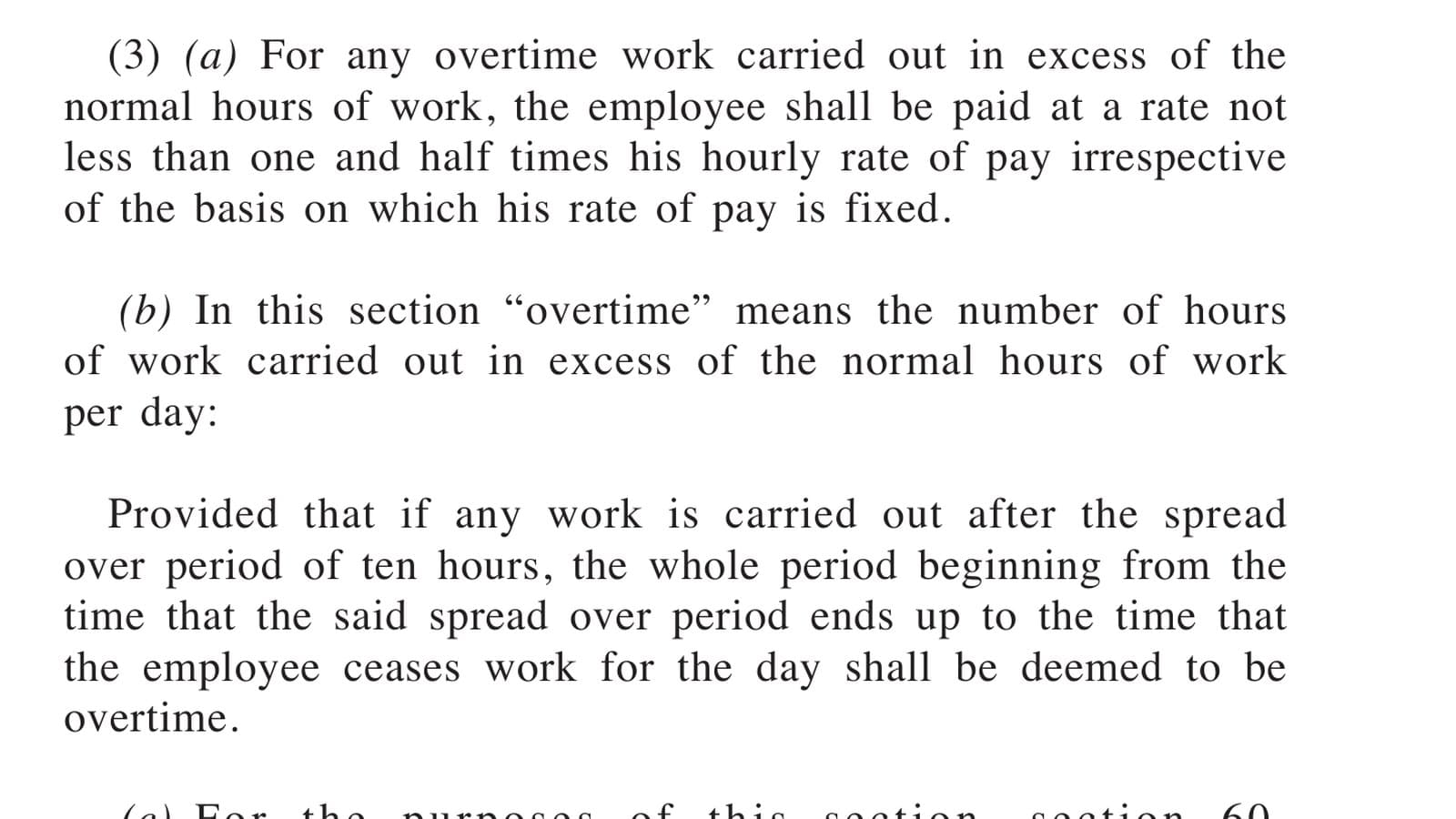
*Image: Employment Act 1955 (Act 265), section 60A(3), from the Attorney General's Chambers reprint.*
Step 1: find your hourly rate
The Act calls your pay for one normal working day the ordinary rate of pay. For a monthly-rated employee, section 60I(1A) fixes it as monthly rate of pay ÷ 26, whether you work five days a week or six. Weekly-rated workers divide by 6. Daily, hourly and piece-rate workers use their total wages for the previous wage period divided by the days actually worked.
The hourly rate of pay is that daily figure divided by your normal hours of work, which section 60A(3)(c) defines as the usual daily hours agreed in your contract. An employer may use a different formula, but only if it does not produce a lower rate (s.60I(2)).
Worked example: a salary of RM2,600 on an 8-hour day.
- Daily rate: RM2,600 ÷ 26 = RM100
- Hourly rate: RM100 ÷ 8 = RM12.50
The same salary on a 9-hour, five-day week gives RM100 ÷ 9 = about RM11.11 an hour, which is why your contract's normal hours matter as much as your salary.
Step 2: apply the right multiplier
Normal working day. Section 60A(3)(a): any work beyond your normal hours is paid at not less than 1.5 times the hourly rate. In the example, that is at least RM18.75 an hour, so three hours past closing time is worth at least RM56.25. There is a second trigger many people miss. Your working day may not spread over more than 10 hours from start to finish, breaks included. If you keep working after that 10-hour spread ends, the whole period after it counts as overtime (s.60A(3)(b)).
Rest day. For a monthly-paid employee, section 60(3)(b) pays half a day's wages for work up to half your normal hours and one full day's wages for anything more, up to your normal hours. Hours beyond your normal hours on a rest day are at least 2 times the hourly rate (s.60(3)(c)). In the example: RM50 for a 4-hour shift, RM100 for a full day, then at least RM25 for every extra hour. Daily-rated workers get one or two days' wages instead (s.60(3)(a)).
Paid public holiday. On top of the holiday pay already in your salary, working the holiday earns two days' wages, even if you only work an hour, and hours beyond your normal hours are at least 3 times the hourly rate (s.60D(3)). In the example: RM200 extra for the day, then at least RM37.50 an hour.
Rest-day and public-holiday hours are not counted as overtime for the monthly limit (proviso to s.60A(4)).
Who gets it, and who does not
The Act covers anyone with a contract of service. But the First Schedule switches off the statutory overtime rate, the rest-day rates and the public-holiday work pay for anyone whose wages exceed RM4,000 a month. Wages for that test exclude commissions, subsistence allowance and overtime, so a busy month cannot push you over the line.
Five groups keep these protections whatever they earn: people doing manual labour (including artisans and apprentices), anyone operating or maintaining a commercial or passenger vehicle, supervisors who oversee manual workers throughout their work, certain crew on Malaysian-registered vessels, and domestic employees, who have their own separate exclusion list. If you earn above RM4,000 and are not in those groups, overtime depends on what your contract says.
The limits on hours
- Normal hours: at most 8 hours a day and 45 hours a week, with a 30-minute break after five consecutive hours (s.60A(1)). If some days are shorter by agreement, others can run to 9 hours.
- Daily ceiling: no employer may require more than 12 hours of work in a day, except in emergencies such as accidents or essential services (s.60A(7)).
- Monthly overtime cap: the Employment (Limitation of Overtime Work) Regulations 1980, made under s.60A(4), set it at 104 hours a month. The Director General of Labour can approve more on written application.
- Refusing: section 60A(2) lets an employer require work beyond normal hours only in listed situations (accidents, essential community work, defence, urgent machinery repairs, unforeseeable interruptions, essential industries). Outside those, overtime is by agreement in your contract.
When it must be paid, and what to do if it is not
Ordinary wages are due within 7 days after the wage period ends. Overtime, rest-day and public-holiday pay can come later, but no later than the last day of the next wage period (s.19(2)). So October's overtime must be in your hands by the end of November at the latest.
If it is unpaid or underpaid, keep your own record of hours (timesheets, clock-in screenshots, messages asking you to stay). Under section 69, the Director General of Labour can inquire into wage disputes and order the employer to pay, with no cap on the amount. That means a complaint at your nearest Labour Department (JTKSM) office, not a court case.
The minimum wage, and why today matters
The minimum wage is RM1,700 a month (RM8.72 an hour for hourly-paid work) under the Minimum Wages Order 2024, in force for all employers since 1 August 2025. On an 8-hour day that puts the minimum hourly rate for a monthly worker at RM1,700 ÷ 26 ÷ 8, about RM8.17, and minimum weekday overtime at about RM12.26 an hour. A review of the rate ran through 2026, and on 30 September government spokesman Fahmi Fadzil said the Cabinet had not decided a new rate, adding that an announcement could come at the earliest with Budget 2027 on 9 October (as reported by RinggitPlus). If the rate changes, the formula above does not. Only the starting salary does.
Related reads
- Working on a public holiday: what the Act pays
- Sick leave and MC rules in Malaysia
- Resigning or retrenched: notice periods and final pay
- Budget 2027: what to watch on 9 October
*Sources: Employment Act 1955 (Act 265), AGC reprint as at 1 August 2023, sections 19, 60, 60A, 60D, 60I, 69 and the First Schedule; Minimum Wages Order 2024 [P.U. (A) 376/2024]; RinggitPlus, 2 October 2026. This is a factual explainer, not legal advice.*