Labuan's Real Draw Is Underwater
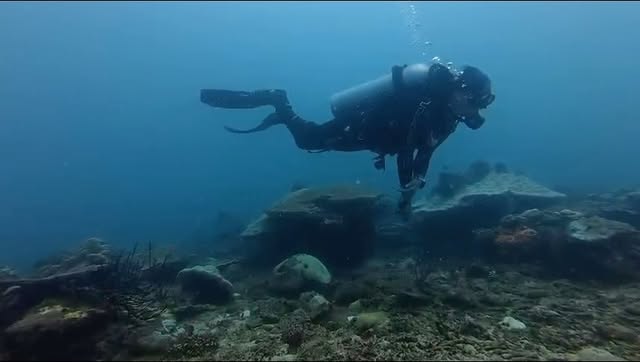
Most Malaysians who've heard of Labuan know it as a duty-free stopover between Kota Kinabalu and Brunei. Divers know it differently — Labuan Marine Park, a cluster of three small islands roughly 20-40 minutes by boat from Labuan Marina, sits close to four separate shipwrecks that are all diveable within a single, compact radius. That combination — a gazetted marine park for snorkelling and reef diving, plus genuine multi-wreck diving nearby — is rare anywhere in Malaysia, and it's the reason this list exists as its own piece rather than a line item in a general things-to-do roundup.
This list separates what you can actually book: the PADI dive centre you can walk into on Labuan island itself, the resort dive base actually sited inside the Marine Park, the operator running non-diving snorkelling day trips, and the local dive community worth knowing about. It does not re-cover general water-sports rental (jet skis, banana boats) at the Labuan International Sea Sports Complex — our family-friendly Labuan guide linked below already handles that.
Updated 7 September 2026. This re-check changed the list. The marina dive shop we previously led with has gone quiet, a PADI centre we had missed is very much open, and the operator we described as "quote on request" turns out to publish a full rate card — details in each section below.
Labuan Marine Park, in Brief
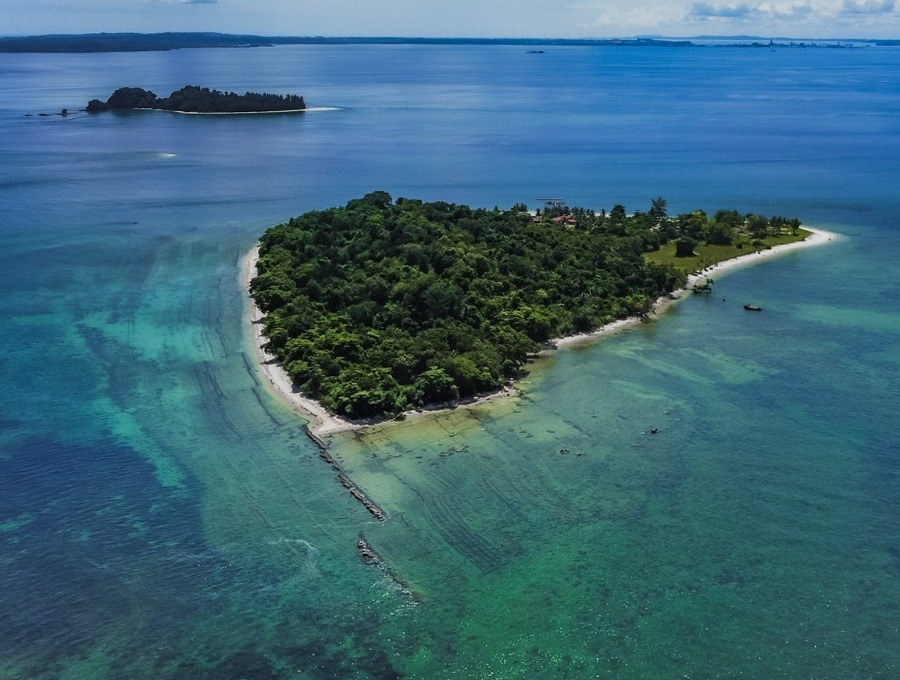
Gazetted after 1994, Labuan Marine Park covers three islands — Pulau Kuraman, Pulau Rusukan Besar and Pulau Rusukan Kecil — around 20-40 minutes by speedboat southwest of Labuan Marina Jetty, depending on sea conditions and which island you're heading to. Unlike most Malaysian marine parks, which are zoned two nautical miles from the low-water mark, Labuan's is zoned at just one nautical mile, covering roughly 9,288 hectares of protected water managed by the Department of Fisheries.
Rusukan Besar has a Turtle Conservation Centre and is the only island with a resort actually sited inside the park; it also holds the Labuan Geosite tessellated pavement, a shelf of fractured rock the resort's own itinerary bills as the largest of its kind in Malaysia. Kuraman is known for a long sand spit and shallow reef snorkelling; Rusukan Kecil, the smallest of the three, is used for reef diving and as the table-coral snorkelling stop on island-hopping day trips.
What the Marine Park Itself Costs
This is the part almost no Labuan guide states plainly, and it matters because divers arriving from Kota Kinabalu routinely assume Sabah Parks rates apply. They don't. Labuan Marine Park is federal, not a Sabah park. It is gazetted under the federal Fisheries Act and its conservation charge is set by the Fees Act 1951 and the Fees (Marine Parks Malaysia) Order 2017 — the same instrument that covers Tioman, Redang and Pulau Payar. The Department of Fisheries Malaysia publishes the rates:
- Malaysian adult (MyKad holder): RM5
- Malaysian child aged 6-12, or senior aged 60 and above: RM2
- Non-Malaysian adult: RM30
- Non-Malaysian child aged 6-12, or senior aged 60 and above: RM15
- Registered disabled visitors: free, either nationality
- Residents of islands inside the marine park area: exempt
Two things follow from that table. First, for a Malaysian the government's cut of a Labuan Marine Park trip is five ringgit. Everything above it is the operator's price, not a fee you can shop around. Second, that RM30 line is exactly the non-Malaysian surcharge Labuan operators quote — when a booking page adds "RM30 per person for non-Malaysians," it is passing through the statutory charge, not marking it up.
One more line in the same order gets misread often: the RM150 "scuba diving" charge is a monthly permit paid by the dive operator, not a per-diver fee. You will not be billed it. The order's other rates cover camping (RM10 per night per site, maximum four people), commercial filming (RM100 per day), research (RM200 plus a RM500 deposit) and cruise vessel entry (RM100).
Separately, non-Malaysians staying overnight on the island pay Tourism Tax of RM10 per room per night under the Tourism Tax Act 2017. Operators state this on their overnight packages. Because it is charged per room rather than per person, twin-sharing halves it per head — which is why the non-Malaysian add-on on a one-night package is RM35 (RM30 park fee plus RM5) rather than RM40.
The Big Four Wrecks
Labuan's headline draw for certified divers is four wrecks sitting within a small offshore radius: the Australian Wreck (also called the ex-Imabari Maru, sunk 1944), the American Wreck (the WWII minesweeper USS Salute, sunk June 1945), and two 1980s wrecks, the Cement Wreck (1980) and the Blue Water Wreck (1981).
The Labuan wreck guide published by Asia Dive Holidays — the licensed agency that now runs the divelabuan.com domain — puts the four on the seabed at roughly 30 to 35 metres. The practical number for planning, though, is the shallowest point of each wreck rather than the bottom: the Cement Wreck's superstructure rises to about 19 metres, which is why it is the one most operators use as a first wreck and for wreck-diving training, while the Blue Water Wreck sits furthest offshore and generally gets the clearest water. That depth profile is also why every operator here gates the wreck trips at Advanced Open Water and above — a Labuan wreck day is a deep dive day, not an Open Water one.
The annual Labuan Diving Festival — its 4th edition ran 25-28 June 2026 — is built specifically around diving all four wrecks in one trip, and is organised by the Rusukan Besar resort.
What You'll Actually Pay
One operator publishes a complete, current rate card on its own site, and it covers both the diving and the snorkelling side of the group. These are its listed 2026 rates, all departing Labuan Marina Jetty.
Diving, run as Dive Rusukan Labuan:
- Refresher dive or Try Scuba (age 10 and above): RM750 per person, minimum 2 to go. This is the only package with everything in it — return boat transfer, lunch cooked on the island, a full equipment set, and both the Marine Park fee and the resort entrance fee.
- Day trip, 3 reef dives (Open Water certified): RM600 per diver at four divers and above. Tank, weight and lunch included; equipment is not.
- Day trip, 2 wreck dives (experienced Advanced-certified divers only): RM750 per diver at four divers and above. Tank, weight and lunch included; equipment is not.
- 3D2N "Labuan Big 4" (four wreck dives over two diving days, Advanced and above): RM2,400 per diver, minimum 4 and maximum 8 divers. Full board, twin or triple share, six meals, tank and weight. Equipment is RM150 per set per day on top, and non-Malaysians add the RM30 park fee.
- Open Water Diver course, 3D2N full board on Pulau Rusukan Besar: RM2,488 per person at the two-person minimum, dropping to RM1,800 per person at four and above.
- Open Water Diver course, Labuan classroom and pool with the final day on the island: RM1,750 per person at two, RM1,500 per person at four and above.
- Advanced Open Water course (2D1N full board, or two day-return trips): RM1,700 per person at two, RM1,450 per person at four and above.
Snorkelling and island-hopping, run as Labuan Rusukan Besar Tour and Travel:
- Day trip, weekday outside public holidays: RM800 lump sum for 1-2 people, RM1,050 lump sum for 3.
- Day trip, 5 people and above — and all weekends and public holidays: RM300 per adult, RM180 per child aged 4-12.
- 2D1N: RM1,500 lump sum for 1-2 people, RM1,800 for 3, RM2,200 for 4, RM2,500 for 5, RM2,700 for 6, RM3,080 for 7, RM3,440 for 8, up to RM5,040 for 12. Children 4-12 are RM320. Non-Malaysians add RM35 per person.
- 3D2N: RM2,400 lump sum for 1-2 people, RM2,550 for 3, RM3,360 for 4, RM4,150 for 5, rising to RM8,880 for 12. Children 4-12 are RM500. Non-Malaysians add RM40 per person.
- 4D3N: RM6,880 lump sum for four adults, or RM8,800 with the seafood upgrade. On weekends and public holidays with a four-person minimum it is priced per head — RM1,720 per Malaysian adult, RM1,780 per non-Malaysian adult, RM940 and RM990 respectively per child aged 4-12.
Three things worth doing the arithmetic on before you book:
- Small groups pay a weekday penalty, not a weekday discount. Two people on a weekday snorkelling day trip pay RM800 between them, which is RM400 each — a third more than the RM300 per head charged at five people or on a weekend. Three people pay RM350 each. Below five people, the weekend rate is the cheaper rate.
- Reef dives are the value dive. Four divers doing the three-reef-dive day pay RM600 each, or RM200 a dive. The two-wreck day is RM750 each, or RM375 a dive. The wrecks are the reason to come, but the reef day is where the ringgit stretches.
- Overnight snorkelling packages scale hard with group size. A couple on the 2D1N pay RM750 each; eight people pay RM430 each and twelve pay RM420. Filling the boat is worth roughly RM330 a head.
Note that a figure widely quoted for Labuan — around RM250 to RM400 for a two-dive day trip — no longer matches anything published. The only current published Labuan wreck-dive day rate is RM750 per diver, and even the reef-dive day is RM600. Budget from the published rates, not from the old range.
Dive Centres & Trip Operators Actually Running in Labuan
Labuan's dive scene is small — genuinely so, not just under-reported. General web searches for Labuan dive shops are also repeatedly swamped by results for Labuan Bajo, Indonesia's much bigger dive hub near Komodo, a completely different place that happens to share part of the name. We verified four real, currently-active outfits serving Labuan Marine Park specifically, each checked against at least two independent sources; see "What We Left Out" below for the names we found but couldn't confirm.
What We Left Out
Dive Labuan led this list until this update, and no longer does. Its Facebook page has not posted since 6 November 2018 — a prospective customer asking about dive packages for a 2024 trip on that same post went unanswered. The domain we previously cited as its "own booking site," divelabuan.com, now 301-redirects to a Labuan wreck-diving guide page on sipadan.com, run by Asia Dive Holidays Sdn Bhd (Malaysia tourism licence KPK/LN 8399), whose Labuan booking route is an enquiry form with no published rates. And a Google Maps search for the business at Labuan Public Marina returns the marina itself, not a dive shop. That is the same evidence pattern we used to remove Borneo Star Dive, so we have applied it consistently and moved Dive Labuan here. If it reopens under its own name, it goes back in.
N5° Diving Center we previously left out for the wrong reason. We had read PADI's directory heading — which files it under "Tunku Abdul Rahman National Park" — as evidence it wasn't really in Labuan. That heading is a directory template artefact: PADI applies the same regional heading to Labuan centres generally, and PADI's own listing text says plainly that N5° is "based in Labuan." The correct reason to leave it out is simpler and harder: its Google Maps listing, at Jalan Batu Manikar next to the swimming pool, is now marked permanently closed, with its last owner activity around two years ago.
Borneo Star Dive Sdn Bhd — long cited as Labuan's original and longest-running dive shop, and still listed in older dive directories and guidebooks — remains out. Its Google Maps listing is marked permanently closed with a visitor review confirming it, a Maps search for the name in Labuan returns no such business, its Lonely Planet activity page 404s, and we found no website or social presence.
Like Scuba Center, an SSI Diamond Center based in Kota Kinabalu, does market a Labuan wreck-diving trip on its own site, priced at MYR1,300 per diver for four dives over two days, with the Labuan Marine Park fee and diving permit included and a MYR650 deposit. We left it out of the numbered list for one reason: that rate card carries its own validity date of 30 June 2023, so it is a published price that is more than three years past its stated expiry. It is a genuine option for divers starting from KK — treat the RM1,300 as a starting point for a quote, not a bookable price.
Co.Co. Dive was mentioned in a 2016 Labuan forum thread as having a "Labuan branch," but the only current, verifiable Co.Co. Dive presence is in Miri, Sarawak. Tiara Labuan Hotel is sometimes cited as arranging diving for guests, but we found no current dive package on its own listings. Finally, AMI Travel & Tours and SabahTravel both sell Rusukan Besar snorkelling packages under their own branding and pricing — but both are Malaysia-wide agencies reselling the same underlying resort trip, and now that the resort publishes its own full rate card, booking direct is straightforwardly the better-informed route.
Visibility, Water Temperature & When to Go
Water stays a fairly constant 27-30°C year-round and Labuan doesn't sit in a real monsoon belt, but visibility swings hard by season: expect anywhere from around 5m on a murky day up to roughly 25m during the March-to-May window most operators treat as peak season, with the broader March-to-October stretch generally calmer and clearer than November-to-February, when rain and rougher seas pick up. Morning dive and snorkel slots also tend to have better visibility than afternoon ones, since afternoon sun and boat traffic stir up more particulates.
Day trips run early. The resort's own island-hopping itinerary has you meeting at Marina Jetty at 8.30am for pre-departure registration and boat insurance, departing at 8.50am, lunch at 12.30pm and leaving the island at 3.30pm — so a Labuan Marine Park day trip is effectively a full day, not a half-day add-on to a duty-free shopping run.
How to Pick
- Never dived before: the Try Scuba / refresher at RM750 is the low-commitment option and the only package with the Marine Park fee, equipment and lunch already inside the price. If you want the certification, the Labuan classroom Open Water course at RM1,500-RM1,750 is cheaper than the island full-board version.
- Certified but not Advanced: you can do the three-reef-dive day at RM600, but not the wrecks. Every Labuan wreck trip we found gates at Advanced Open Water and above, and some ask for logged-dive counts on top.
- Here for the Big Four: budget RM750 for a two-wreck day, or RM2,400 for the 3D2N package that does all four across two diving days. Bring or budget RM150 a day for equipment on the package — it is not included.
- Not a diver at all: the snorkelling day trip is the answer, and go either at five-plus people or on a weekend, when it is RM300 a head instead of RM350-RM400.
- Want a shop you can walk into on Labuan island: that is Aquaholics, at Palm Beach Resort & Spa on Jalan Batu Manikar. Check the day first — it opens 9am to 5pm but is closed on Tuesdays.
- Travelling on a foreign passport: add RM30 for the Marine Park conservation charge, and RM10 per room per night of Tourism Tax if you are staying over on the island.
Related reads
For the fuller wreck-and-heritage overview of the island, see our 8 Things To Do (And Eat) in Labuan guide, and pair a Marine Park day with our Family-Friendly Things To Do in Labuan guide for the Marine Museum and Sea Sports Complex closer to town. For where to eat after a day on the water, see our Best Seafood Restaurants in Labuan list. If you're arriving on a foreign passport, our Tourism Tax Malaysia 2026 guide explains the RM10 per room per night charge.
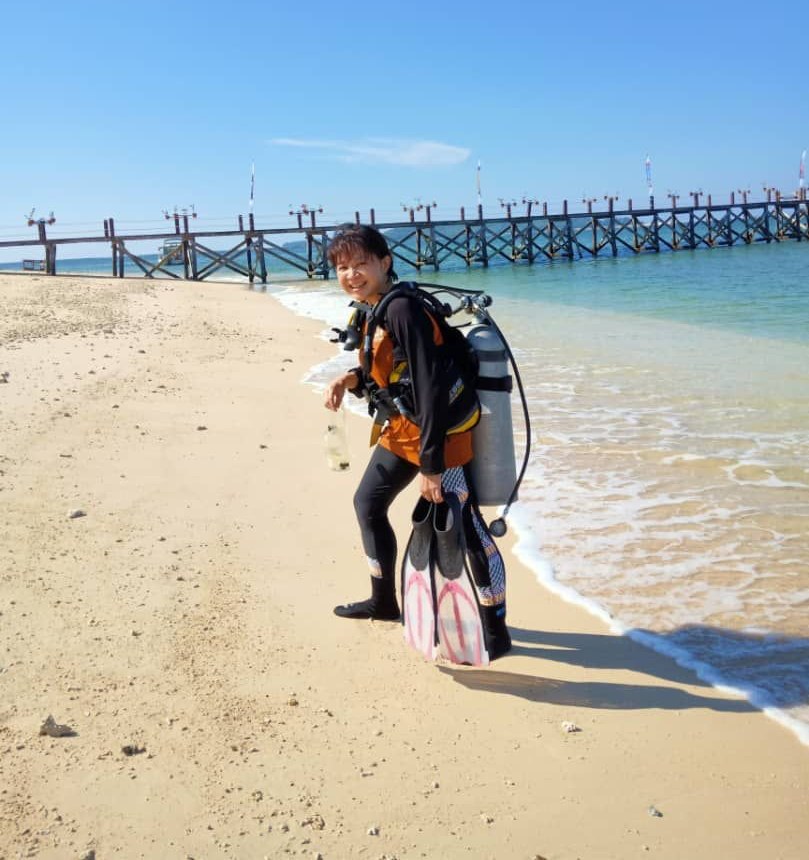
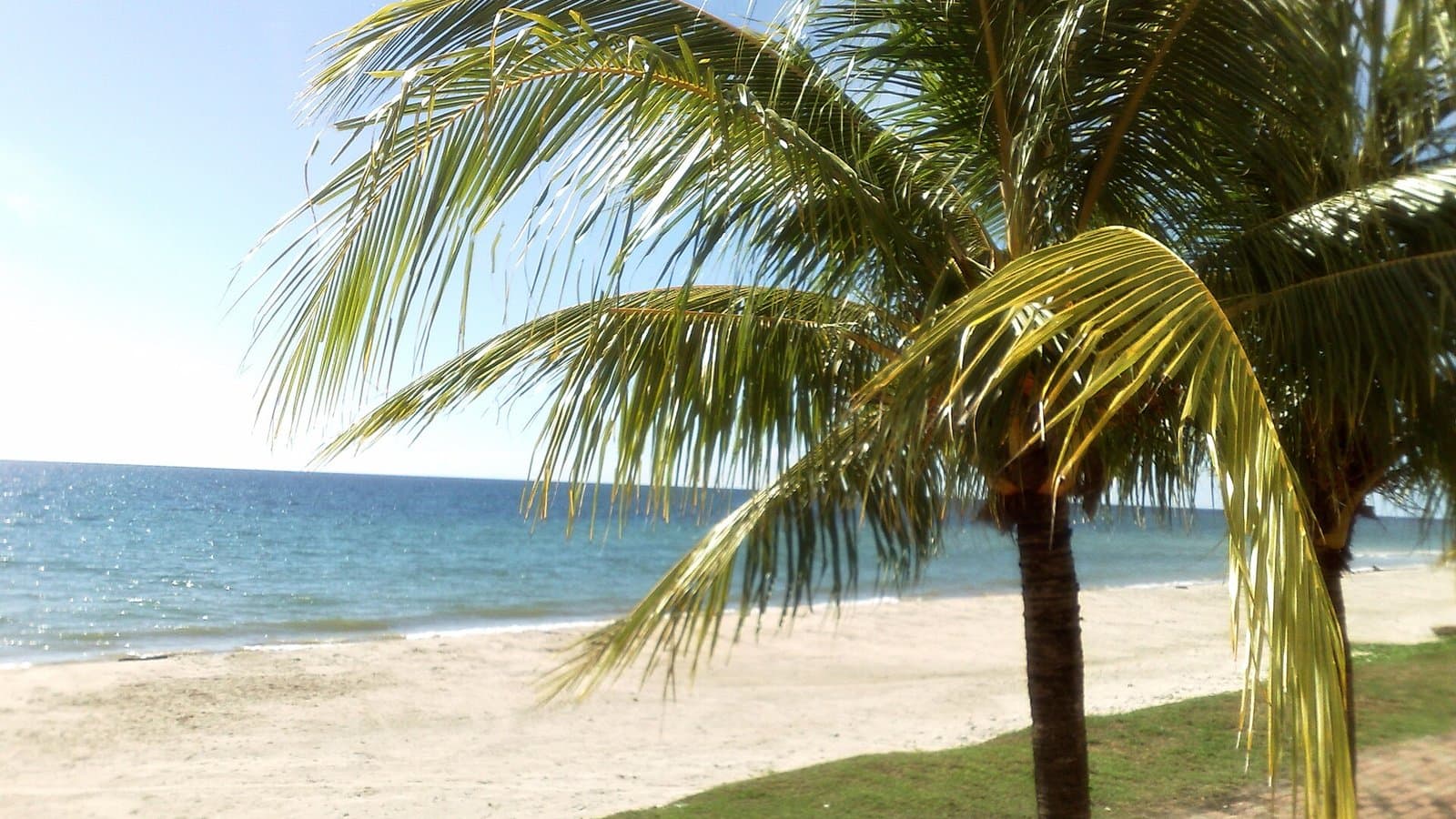
*Cover image: Beach on Labuan island — black panther, CC BY 2.0, via Wikimedia Commons. Illustrative of Labuan's coastline, not of the Marine Park islands themselves.*