> Quick view: Malaysia's tourism tax is RM10 per room per night and Malaysians do not pay it. A regulation that came into force on 1 September 2026 moved Johor's tourism tax offices onto a Monday-to-Friday week, finally aligning a federal tax rule with a state weekend change made twenty months earlier.
Nothing about tourism tax has been simple since it started in 2017, and the confusion is mostly about who pays. So before the new rule, the basics, all of them taken from the Royal Malaysian Customs Department's own MyTTx portal and the gazetted instruments it publishes there.
The rate: RM10, and it is newer than you think
The current rate is set by P.U. (A) 423, the Tourism Tax (Rate of Tax) Order 2025. The Minister of Finance II, Datuk Seri Amir Hamzah Azizan, made it on 28 November 2025 with the concurrence of the Minister of Tourism, Arts and Culture, Dato Sri Tiong King Sing, given on 4 December 2025. It was gazetted on 9 December 2025 and came into operation on 15 December 2025.
The order does two things. Paragraph 2(1) fixes tourism tax at ten ringgit per night for each room for a tourist staying at any accommodation premises, charged under section 6 of the Tourism Tax Act 2017. Paragraph 2(2) fixes the same ten ringgit per night for each room where the stay was booked online through a registered digital platform service provider, charged under section 20A.
That second limb matters. It closes the gap that used to exist between booking a hotel at the front desk and booking it through an online platform, and it is why an overseas booking site now shows the tax on Malaysian hotel bookings.
Who pays it, and who does not
This is the part almost everyone gets wrong, so here it is in the government's own words.
The Tourism Tax (Exemption) Order 2017, P.U. (A) 240, came into operation on 23 August 2017. Paragraph 2 exempts from the whole of the tourism tax "a tourist who is a Malaysian national" and "a tourist who is a permanent resident of Malaysia".
That is the entire test. It is not about residence, IC colour, where you booked, or which state you are in. If you are a Malaysian citizen or a Malaysian PR, tourism tax should never appear on your hotel bill. If it does, ask the operator to remove it and point them at P.U. (A) 240.
Paragraph 3 of the same order, as amended in 2019, exempts certain operators from collecting it at all:
- homestay operators under the Pengalaman Homestay Malaysia Programme, registered with the tourism ministry
- kampungstay operators under the Visit My Kampung Programme, likewise registered
- Federal or State Government bodies, statutory bodies, local authorities and private higher educational institutions registered under Act 555, where the accommodation is a facility for education, training or welfare
- an employer providing accommodation to its own employees
- religious or welfare bodies approved by the Minister, operating non-commercial accommodation and registered with the Registrar of Societies or under the relevant written law
- private educational institutions registered under the Education Act 1996, housing their own pupils
- any operator with four accommodation rooms or fewer
That last one is the practical exemption. A great many small guesthouses, budget inns and family-run chalets in Malaysia sit under it, which is why the tax appears on some bills and not others in the same town.
What actually changed on 1 September 2026
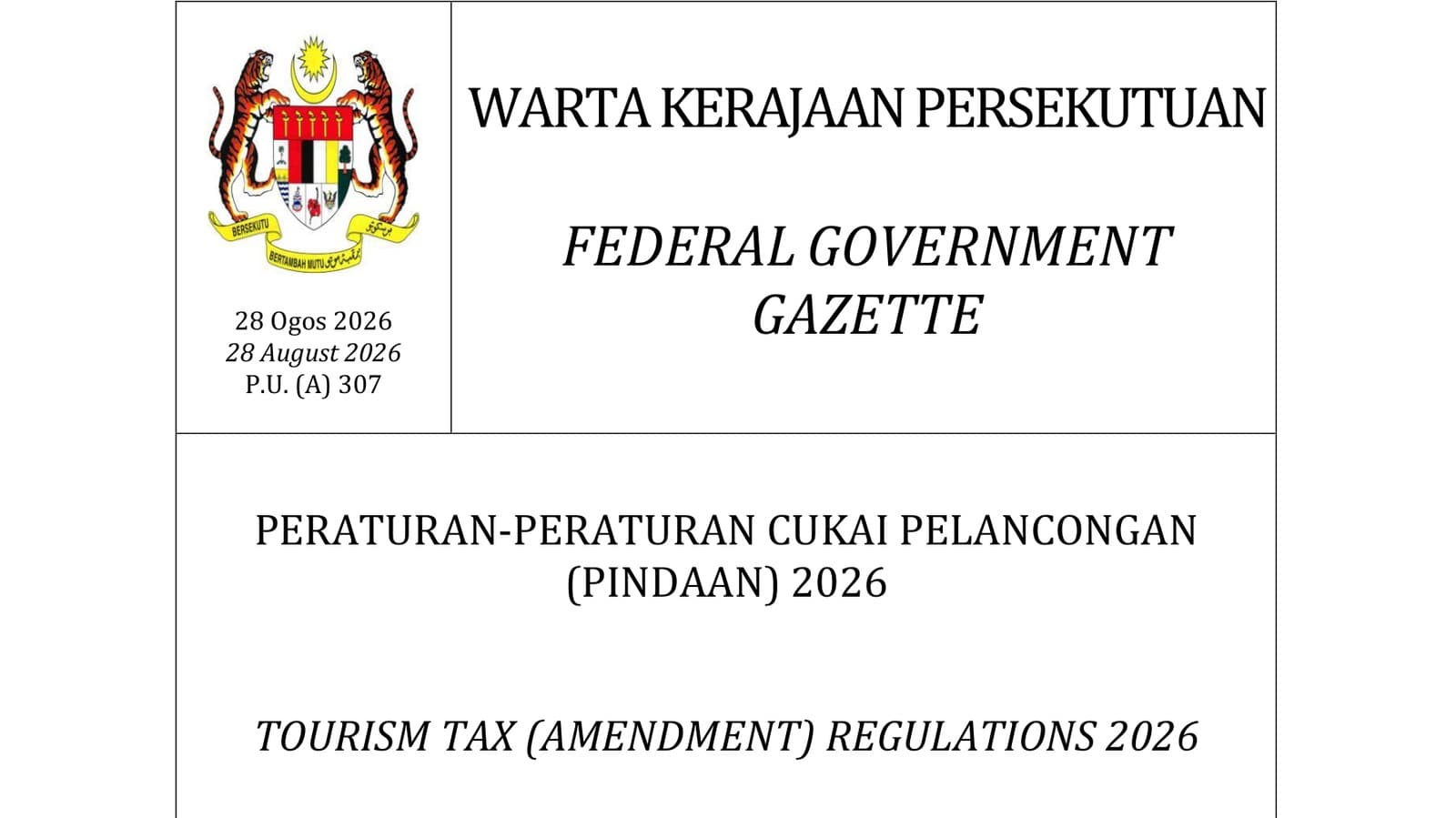
P.U. (A) 307, the Tourism Tax (Amendment) Regulations 2026, was made on 27 August 2026, gazetted the following day and came into operation on 1 September 2026. It is three sentences long and it amends exactly one provision: regulation 19 of the Tourism Tax Regulations 2017.
Regulation 19 is titled "Office hours and payment hours", and its first subregulation splits Malaysia into two groups by weekend:
- paragraph (a) covered the states whose weekly holiday is Saturday and Sunday, where the offices open 7.30am to 4pm, Monday to Friday
- paragraph (b) covered the states whose weekly holiday is Friday and Saturday, where the offices open 8am to 4pm, Sunday to Thursday
The amendment substitutes the words "in the State of Melaka" in paragraph (a) with "in the State of Johor, Melaka", and deletes "Johor" from paragraph (b). Nothing else in the tourism tax regime moves.
Why it took twenty months
Johor stopped being a Friday-Saturday state on 1 January 2025, when it reverted to a Saturday-Sunday weekend. The federal tourism tax regulation kept listing Johor in the Friday-Saturday group for another twenty months. P.U. (A) 307 is the catch-up.
For most travellers this changes nothing at all, because tourism tax returns and payments are filed electronically and regulation 19(2) already allows that at any time except during system maintenance. It matters if you need to walk into a tourism tax office in Johor Bahru, or if you are an accommodation operator working out when a filing deadline actually falls, because regulation 19(3) pushes a deadline that lands on a federal weekly holiday or federal public holiday to the next working day.
The three states still on the Sunday-to-Thursday schedule under this regulation are Kedah, Kelantan and Terengganu.
One more thing operators had to absorb
Separately, Public Ruling No. 1/2025 on the liability of operators and digital platform service providers to account for tourism tax received took effect on 1 December 2025. It replaced TTx Policy No. 2/2023, which had extended the collection obligation to online bookings and was due to expire on 31 December 2025. Operators and platforms should be working to the public ruling now, not the old policy.
The charge that is not tourism tax
If you are Malaysian and a per-night charge still appears on your bill, it is almost certainly a local levy rather than tourism tax, and those are collected by councils rather than Customs.
The clearest example is Langkawi. Hotel booking terms on the island state a municipal fee of RM5 to RM10 per room per night collected by the Municipal Council of Langkawi, and the operators are explicit that it applies to all nationalities, Malaysians included. Tanjung Rhu Resort's terms put it at RM10 nett per room per night "applicable for all nationalities". Casa del Mar's booking engine states RM5 per room per night rising to RM10 during a designated major event. Port Dickson runs a comparable district-wide levy. None of these are tourism tax and none of them are affected by anything in this article.
The practical test is simple. Tourism tax is RM10, federal, and Malaysians never pay it. A levy of RM5 or RM10 charged to a Malaysian is a local council fee. If a line item calls itself tourism tax and you are Malaysian, query it.
The 8% on your bill is a different tax entirely
Tourism tax is not the only per-night charge on a Malaysian hotel folio, and for a Malaysian it is not the one that actually costs money. That one is service tax, charged under a separate Act with separate rules.
Accommodation sits in Group A of the First Schedule to the Service Tax Regulations 2018. The Royal Malaysian Customs Department's own Panduan Penginapan, version 4, dated 26 February 2024, sets out where it stands now. Under subsection 10(2) of the Service Tax Act 2018 the Minister of Finance raised the rate from 6% to 8% with effect from 1 March 2024, and paragraph 9 of the guide applies that 8% to accommodation.
Three things in that guide catch people out.
The room is 8%, the restaurant is 6%. Food and beverage supplied by a hotel operator falls under a different group in the same First Schedule, and the guide's own FAQ puts it at 6%. Rent the hotel's sports facilities, a golf course or a driving range, and you are back to 8%. One stay can carry two different service tax rates.
The test is money, not rooms. Tourism tax lets an operator off if it has four rooms or fewer. Service tax does not count rooms at all. Asked by a hotelier with fewer than 25 rooms whether registration applies, the guide answers that you must register if the value of taxable services over 12 months exceeds RM500,000, "regardless of the number of rooms provided". A small property can sit outside tourism tax and inside service tax, or the reverse.
Malaysians pay this one. Service tax has no nationality exemption. The RM10 tourism tax is the line a Malaysian should never see. The 8% is the line they always will.
Why a Langkawi bill looks nothing like a KL bill
Paragraph 6 of the same Customs guide is the sentence that explains the difference: accommodation supplied inside a designated area is not subject to service tax.
The Service Tax Act 2018 names the designated areas as Labuan, Langkawi, Pangkor and Tioman. The Service Tax (Amendment) Act 2024, Act A1719, amends that definition to add Pulau 1.
Put the charges together on a RM300 room and the geography does all the work:
- KL, Malaysian guest. RM300 plus 8% service tax, RM24. No tourism tax, no council levy. RM324 a night.
- Langkawi, Malaysian guest. RM300 plus no service tax, because Langkawi is a designated area, plus the Municipal Council of Langkawi's RM5 to RM10 levy. RM305 to RM310 a night.
- Langkawi, foreign guest. The same again plus RM10 tourism tax. RM315 to RM320 a night.
So a Langkawi room and a KL room advertised at the same rate do not land at the same price, and the gap runs the opposite way to what most people assume. It also explains the thing that confuses Malaysians most on the island: the only per-night charge they do pay there is a council fee, not a federal tax.
And the 10% that is not a tax at all
The last number on the bill, the 10% service charge, is not a government charge in any sense. Customs does not collect it, no council collects it, and no gazetted order sets it. It is a contractual charge the operator adds and then keeps or distributes, which is why some hotels quote "++" and others quote nett.
The reading order on a Malaysian hotel bill, then, is: 10% service charge (not a tax), 8% service tax (a tax, everyone pays, and zero in Labuan, Langkawi, Pangkor and Tioman), RM10 tourism tax (a tax, foreigners only), and any local council levy (not tourism tax, all nationalities).
Not to be confused with the RM1,000 "tourism tax relief"
Search for tourism tax in 2026 and half the results are about something else: the RM1,000 income tax relief for Visit Malaysia Year 2026. It is not a tax and it has nothing to do with the RM10 a night. It runs the other way, reducing the income tax a Malaysian resident pays.
- What it covers: entrance fees to tourist attractions, and cultural and arts programmes, paid in 2026 and backed by a receipt. The Finance Act 2025 (Act 874) adds it as paragraph 46(1)(sa) of the Income Tax Act 1967, for the year of assessment 2026 only.
- What it does not cover: your hotel. The 2020-2022 domestic tourism relief included accommodation at registered premises. This one does not, so neither the room rate, the 8% service tax nor any levy on the folio counts towards it.
- When you claim it: in the income tax return filed in 2027, not the one filed this year.
- What it is worth: up to RM1,000 off chargeable income, so the cash value is RM1,000 times your marginal rate, not RM1,000.
Our six new tax reliefs for 2026 guide covers it clause by clause, including which attractions the Budget annex lists.
Related reads
- Six New Tax Reliefs Started Counting on 1 January 2026 - the RM1,000 attraction-fee relief that is often mistaken for tourism tax.
- 6 Hotel Buffets in KL and the Klang Valley 2026 - the same "nett versus ++" arithmetic, applied to a meal instead of a room.
- Best Beach Resorts for a Langkawi Getaway 2026 - where the council levy and the missing 8% actually land.
- 7 Best Hotels & Resorts in Labuan (2026) - the other designated area, and the other set of bills with no service tax on them.
*Cover image: Federal Government Gazette P.U. (A) 307, published by the Attorney General's Chambers.*
*Sources read on 7 September 2026: the Royal Malaysian Customs Department's MyTTx portal, and the gazetted texts of P.U. (A) 307 (Tourism Tax (Amendment) Regulations 2026), P.U. (A) 423 (Tourism Tax (Rate of Tax) Order 2025), P.U. (A) 228 (Tourism Tax Regulations 2017), P.U. (A) 240 (Tourism Tax (Exemption) Order 2017) and P.U. (A) 267 (its 2019 amendment), all published on myttx.customs.gov.my. Service tax section added 9 September 2026 from the Customs Department's MySST portal: the Panduan Penginapan industry guide version 4 dated 26 February 2024, the Guide on Special Area, and the text of the Service Tax (Amendment) Act 2024 (Act A1719).*
*Re-checked 25 September 2026: no new tourism tax instrument since P.U. (A) 307; the rate is still RM10 per room per night and the Malaysian and PR exemption stands.*