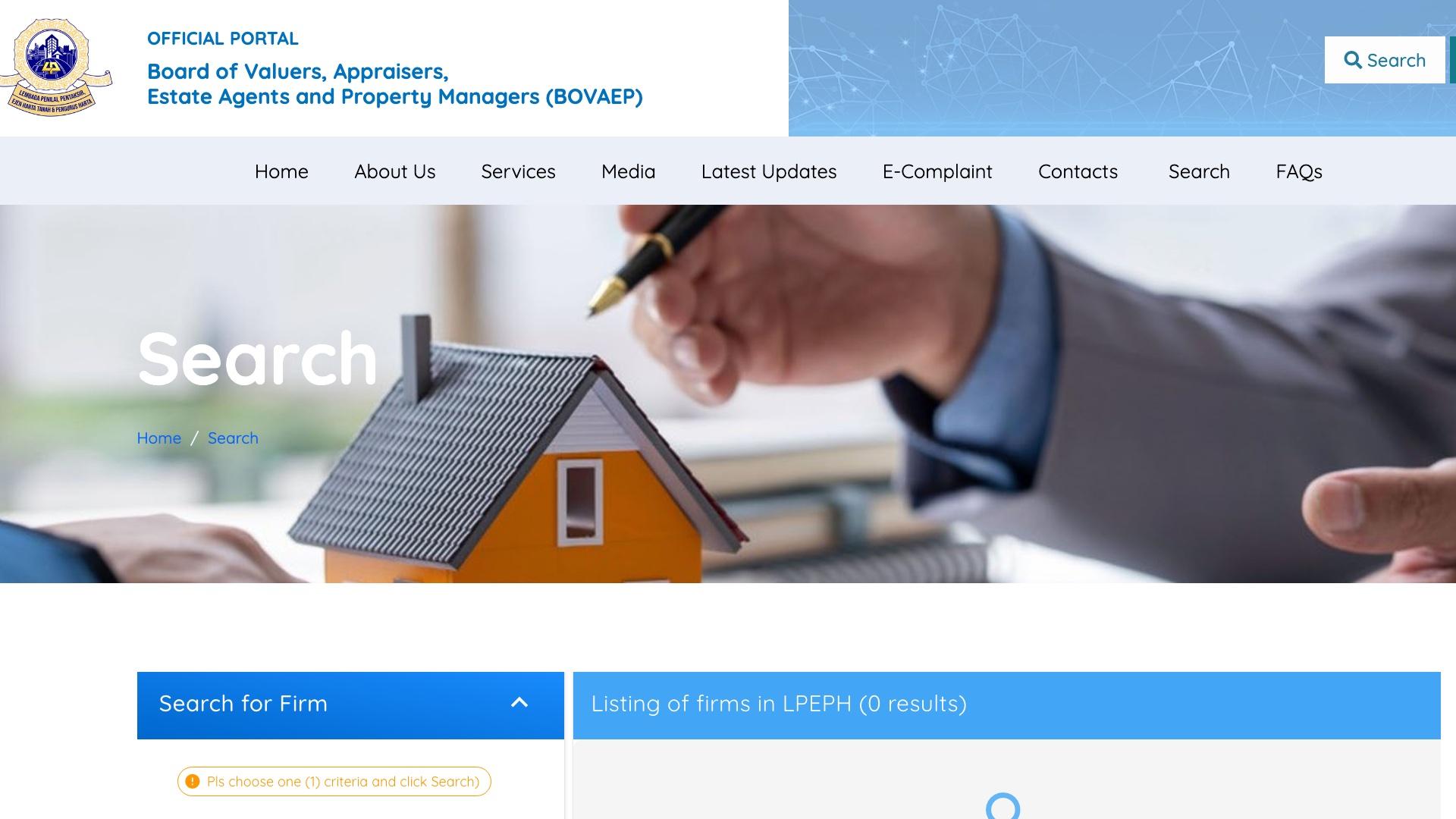
Before you hand anyone a booking fee for a room, a condo or a house, spend two minutes on the public register. Every legitimate estate agent and negotiator in Malaysia is on it, and the register shows enough detail to tell whether the person in front of you is the person on the tag.
The catch is that the address changed. The board that keeps the register is now called Lembaga Penilai, Pentaksir, Ejen Harta Tanah dan Pengurus Harta (LPEPH), or BOVAEP in English, since property managers were brought under the same law. When we checked on 11 November 2026, the old lppeh.gov.my site showed a maintenance notice saying it is "transitioning to a new domain" and pointing visitors to lpeph.gov.my. Plenty of rental guides and agent profiles still link the old search page, which no longer loads.
Who is allowed to act for you
The law is the Valuers, Appraisers, Estate Agents and Property Managers Act 1981 (Act 242). A registered estate agent (REA) runs a registered firm, and each firm has a number in the form E (1) 1234. A real estate negotiator (REN) is not a licensed agent in their own right; they work under a registered firm and carry a REN tag with a number and photo. Firms that also do valuation or property management carry longer prefixes, such as VEPM.
Acting as an agent without registration is a criminal offence. When the 2017 amendments took effect, the Malaysian Institute of Estate Agents (MIEA) said illegal agents could face a fine of up to RM300,000, up to three years' jail, or both, and that police could now act against them (StarProperty, 30 August 2017).
How to check an agent, step by step
- Go to lpeph.gov.my and click Search, or open bis.lpeph.gov.my/search directly.
- Open the Search for Negotiator panel. Fill in only one field: REN number, name, IC number, passport number or mobile number.
- Read the result card. Each one shows the negotiator's photo, REN number and full name, the firm with its registration number, a mobile number, and a status badge. In a test search on 11 November 2026, current negotiators showed Active (2026) and lapsed ones Expired (2024).
- Check four things: the photo is the person you met, the status is Active for the current year, the firm matches the name card or listing, and the phone number matches the one messaging you.
- Switch to Search for Firm and check the firm's registration number and address too.
The phone number check matters most. Scammers copy real REN numbers from genuine listings, so a REN printed on an ad proves nothing by itself. If the number you are chatting with does not come back as that negotiator, stop.
What an agent may legally charge
The board publishes its scale of fees, the Seventh Schedule (Rule 48), on its fees page. For estate agency it sets maximums, not fixed prices:
- Sale or purchase of land and buildings: up to 3% of the price, with a minimum of RM1,000 per property. Fees for selling a developer's project are agreed between agent and client, and the scale does not apply to foreign property.
- Tenancy of up to 3 years: up to 1.25 months' gross rent.
- More than 3 and up to 4 years: 1.50 months.
- More than 4 years: 1.75 months, plus 0.25 months for every extra year where there is a renewal option beyond five years.
- Minimum for any letting: one month's rent. A tenancy shorter than a year may be charged pro rata. The scale does not cover serviced apartments or serviced offices.
- Rent review: half the letting fee.
The board's own FAQ says the fee is due on signing the SPA for a sale and on signing the tenancy agreement for a rental. Extra claims such as advertising, or travel when the property is more than 40km from the agent's office, need the client's agreement first.
Two worked examples. A two-year tenancy at RM2,000 a month: the agent can charge its client between RM2,000 (the one-month minimum) and RM2,500 (1.25 months). A RM500,000 resale house: up to RM15,000. The cap applies to whoever appointed the agent, so read the appointment letter to see who that is.
Before you pay anything
Pay booking fees and deposits to the firm's account, in the firm's name as it appears on the register, and ask for an official receipt with the firm's registration number. A request to transfer to a personal account is the clearest warning sign there is.
If an agent misbehaves, the board takes complaints through its e-Complaint page on the same BIS portal, with a tracking number. If money has already gone to a scammer, call the National Scam Response Centre on 997 at once and lodge a police report.
*Sources: LPEPH official portal, including the Seventh Schedule fees page, the Estate Agent FAQ and the BIS register search, all read on 11 November 2026; StarProperty, "Stern warning issued to unlicensed real estate agents", 30 August 2017.*
*Image: LPEPH official portal (screenshot, 11 November 2026)*