The number almost every guide still gets wrong
If you have looked this up before, you have probably met the old rule: the first RM2,400 of annual rent is free, and above that you pay RM1, RM2 or RM4 for every RM250 depending on the term. That table has been out of date since 1 January 2025.
The Finance Act 2024 amended Item 49 of the First Schedule to the Stamp Act 1949. It removed the RM2,400 exemption and replaced the three term bands with four. The Inland Revenue Board's own *Guidelines on the Imposition of Stamp Duty on Instruments Subject to the First Schedule of the Stamp Act 1949*, dated 30 June 2026, print the current table with no threshold and no deduction anywhere in it. Duty now runs from the first ringgit of rent.
The rate table LHDN actually uses
Item 49(a) charges duty on the payment or average annual rent and other annual consideration, at these rates for every RM250 or part thereof:
- Term not exceeding 1 year: RM1.00
- Over 1 year and up to 3 years: RM3.00
- Over 3 years and up to 5 years: RM5.00
- Over 5 years: RM7.00
Two things follow from that. There is no free band any more, so a rent that used to be too small to tax is now taxable. And the term multiplier bites much harder than it did: the same rent on a five-year lease is seven times the one-year figure, where the old schedule topped out at four.
Separately, section 36CB — also in force from 1 January 2025 — sets a minimum of RM10 of duty on any instrument, cheques and contract notes aside. Small tenancies land on that floor.
Tenancy or lease? The three-year line
LHDN's guideline draws a line most rental advice skips. An agreement of three years or less is a *tenancy*. An agreement running more than three years is a *lease*, and under section 221 of the National Land Code it has to be perfected with a Lease Form (Borang 15A) and registered at the Land Office. Form 15A is then stamped at a fixed RM10 under sub-item 49(e), provided the lease agreement itself has already been duly stamped.
So the three-year mark moves three things at once: the rate band, the paperwork, and whether the Land Office is involved at all.
Five worked examples
Take the annual rent, divide by 250, round up to the next whole block, then multiply by the rate for the term.
A room at RM500 a month, one year. RM6,000 a year, divided by 250, is exactly 24 blocks, at RM1 each: RM24. Under the old rule it was RM15.
RM1,200 a month, one year. RM14,400 a year, divided by 250, is 57.6, rounded up to 58 blocks: RM58. Old rule: RM48.
RM1,500 a month. RM18,000 a year is exactly 72 blocks. On a one-year term that is RM72. On two years, 72 x RM3 = RM216. On four years, 72 x RM5 = RM360. On six years, 72 x RM7 = RM504. The old schedule charged RM63, RM126 and RM252 for the comparable terms.
RM2,800 a month, two years. RM33,600 a year, divided by 250, is 134.4, rounded up to 135 blocks, at RM3 each: RM405. Old rule: RM250.
A car park bay at RM150 a month, one year. RM1,800 a year, divided by 250, is 7.2, rounded up to 8 blocks, at RM1 each: RM8 — which section 36CB lifts to RM10. Under the old rule this instrument was free. LHDN's guideline lists "Car Park Tenancy Contract" among the instruments stamped under this item, so it is not a hypothetical.
The copy still costs RM10
Under subsection 4(3), where a transaction needs several instruments to complete it, only the principal instrument carries the full duty and every other instrument is RM10 each. The counterpart of a tenancy sits exactly there: sub-item 49(e) charges a fixed RM10 on a further lease instrument relating to an agreement already duly stamped, and Item 34 does the same for a counterpart or duplicate.
Who pays: the Third Schedule splits it
Ask around and the standard answer is that the tenant pays the stamp duty. The Act is more specific than that.
Section 33 makes the person named in the Third Schedule liable, and LHDN's guideline points at sub-item 8: for the main agreement the person liable is the lessee, the tenant; for the copy it is the lessor, the landlord.
So the law splits it. The tenant carries the ad valorem duty on the agreement and the landlord carries the RM10 on the copy the landlord keeps. In practice the tenant is routinely handed the whole bill, and that is a matter of bargaining rather than of law. It is worth knowing which line you are actually being asked to pay.
Two 30-day clocks, not one
Under section 47 an instrument must be stamped within 30 days of being executed in Malaysia, or within 30 days of first being received here if it was executed abroad. That clock has not changed.
Self-assessment adds a second one. Once you submit the return, paragraph 36(2)(b) gives you 30 days from the deemed assessment date to pay. If an instrument goes through formal assessment instead, section 40 gives you 14 days from the notice of assessment.
Late-stamping penalties under section 47A, in force since 1 January 2025, are measured from the date the instrument was signed:
- Stamped within 3 months of the deadline: RM50 or 10% of the deficient duty, whichever is higher.
- Stamped more than 3 months late: RM100 or 20% of the deficient duty, whichever is higher.
On the RM72 example, three months late costs RM50 on top, because 10% of RM72 is only RM7.20 and the fixed RM50 is higher. On a long commercial lease it is the percentage that hurts.
The amnesty that closed on 30 June 2026
If there is an old unstamped tenancy in a drawer somewhere, there was a window for it and the window has shut.
PKPS Stamp Duty 2026, a special voluntary disclosure programme, ran from 1 January to 30 June 2026. It waived the late penalty in full on any instrument executed between 1 January 2023 and 31 December 2025, provided the duty was paid inside that window. No appeal was needed: the waiver applied automatically during payment and appeared as a "Penalty Waived" figure that was left out of the total payable. LHDN also undertook not to audit the instruments stamped under it. Fraud cases were excluded, and it applied to citizens and non-citizens alike.
From 1 July 2026 the ordinary section 47A penalties apply again and audits resume under the Stamp Duty Audit Framework. An agreement signed in 2024 and stamped today attracts the full "more than 3 months" penalty.
The 2026 remission for getting your own sum wrong
Self-assessment moved the arithmetic onto you, and subsection 72D(2) lets the Collector charge a penalty equal to the duty you underpaid where the return is incorrect or the information given affects the duty charged. That subsection only came into force on 1 January 2026.
Alongside it, the Ministry of Finance announced a remission running 1 January to 31 December 2026, applying to stamping applications submitted in that period. If you realise your return understated the duty, you can correct it inside the window without the 72D(2) penalty — and LHDN's operational guideline says the penalty will not be raised even where an audit turns up the error, so long as the stamping was done during the remission period.
The limits are where people will get caught:
- It covers only the 72D(2) penalty. The underpaid duty is still payable under section 36CA, and the section 47A late-stamping penalty still applies if the instrument was also late.
- It covers only the Phase 1 self-assessed categories: lease and tenancy, securities, and general stamping. Formally assessed instruments — property, share and business transfers — are outside it.
- It ends on 31 December 2026.
For scale, the offences sitting behind that penalty: under subsection 72D(1) an incorrect return is punishable by a fine of RM1,000 to RM10,000 plus a special penalty equal to the deficient duty, and under subsection 72C(1) failing to submit the return and instrument at all draws a fine of up to RM10,000, or a Collector's penalty of RM200 to RM2,000.
Unstamped does not mean invalid
This is the most commonly mangled point in Malaysian rental advice, in both directions.
Section 52 provides that no instrument chargeable with duty shall be admitted in evidence for any purpose by any person having authority to receive evidence, or be acted upon, registered or authenticated, unless it is duly stamped, and section 51 lets a judge, magistrate or registrar impound one. That is why an unstamped tenancy agreement is a problem: the moment you need to rely on it, nobody official will look at it.
But the same section carries a proviso. Such an instrument shall be admitted in evidence on payment of the duty and the penalty, if any, chargeable in respect of it. The agreement is not torn up and it does not stop being a contract. It becomes usable again once the duty and any late penalty are paid. There are also carve-outs for criminal courts and for government instruments.
If you disagree with the assessment
Object to the Collector within 30 days of the notice of assessment or additional assessment, under section 38A. If the review still does not satisfy you, appeal in writing to the High Court within 21 days of that decision, under section 39. The assessed duty has to be paid while the objection or appeal runs. A refund claim is generally made within 24 months of the date the instrument was signed, though particular provisions of the Act set their own deadlines.
How to actually stamp it
Everything now runs through the e-Stamp Duty system.
- Get a TIN. Every duty payer and representative needs a Tax Identification Number, and LHDN's FAQ is explicit that this covers everyone party to the agreement, not only whoever does the filing.
- Log in at MyTax and follow *ezHASiL Services > Stamp Duty > e-Stamp Duty*, or go straight to stamps.hasil.gov.my with a STAMPS ID.
- Open Application Form > Stamping, choose the stamping type, complete the BNDS — the stamp duty declaration form — and upload the agreement. Digital and e-signed agreements count: LHDN treats electronic instruments the same as written ones.
- Check the calculation summary before submitting. Under self-assessment the return is deemed assessed by the Collector the moment it is submitted, so the review screen is the last chance to catch a wrong term band.
- Pay by FPX, eTT virtual account, or bill payment through Public Bank or CIMB, BizChannel only.
- Download and print the Stamp Certificate and attach it to the agreement — that is what makes the instrument duly stamped. The portal prints it once, so save the PDF before you close it.
- Keep the instrument and all related records for seven years.
Budget 2027 left tenancy duty alone
Budget 2027, tabled on 9 October 2026, carried a full page of stamp duty proposals, and none of them touches a tenancy. The measures are about buying and borrowing: a full exemption on the loan agreement and transfer for a first home up to RM500,000 (the first RM500,000 exempt and 50% off the balance up to RM750,000) for sale and purchase agreements signed 1 January 2027 to 31 December 2030, the return of the abandoned-housing revival exemption, RM10 caps on certain MSME and peer-to-peer financing, and RM2,000 or RM5,000 caps on foreign-currency and ship financing.
So for anyone signing or renewing a tenancy in 2027, the Item 49 rates above, the RM10 floor and the 30-day clock carry straight over. Two dates are still worth keeping in mind:
- 1 January 2027: STSDS Phase 2 begins for transfers of real property that do not need a JPPH valuation. LHDN's STSDS page still lists that date, and Phase 3, for everything else, on 1 January 2028. Tenancies have been self-assessed since Phase 1 and nothing changes for them.
- 31 December 2026: the 72D(2) penalty concession for an incorrect self-assessment ends with the year. If you suspect a return filed this year used the wrong term band, correct it before then.
Budget measures are proposals until the Finance Bill passes, so the first-home figures may still move. The tenancy rates are law already.
Related reads
- Tribunal Tuntutan Pengguna 2026: Claim Up to RM50,000 for RM5, With No Lawyer in the Room — where a dispute goes when the agreement you had stamped is the thing being argued over
- Malaysia's e-Invoice in Plain Terms: Who Must Issue One in 2026 — the other LHDN self-service regime with a phased timetable and a records obligation attached
- 8 Best Movers & Self-Storage Companies in KL & Klang Valley (2026) — the rest of the moving-day bill, with real RM ranges
Sources: the Inland Revenue Board's *Guidelines on the Imposition of Stamp Duty on Instruments Subject to the First Schedule of the Stamp Act 1949* (30 June 2026), the *Guidelines for Applications for Stamping via the Self-Assessment Stamp Duty System* (26 December 2025), the Board's FAQ on stamping via e-Stamp Duty (31 December 2025) and its FAQ on penalty exemption under PKPS Stamp Duty 2026 (28 January 2026), together with the Board's stamp duty pages on penalty, relief and STSDS, all read on 2 September 2026. The Item 49 and section 36CB amendments were made by the Finance Act 2024, in force 1 January 2025. This is general information on how the duty is calculated, not tax advice on a specific agreement.
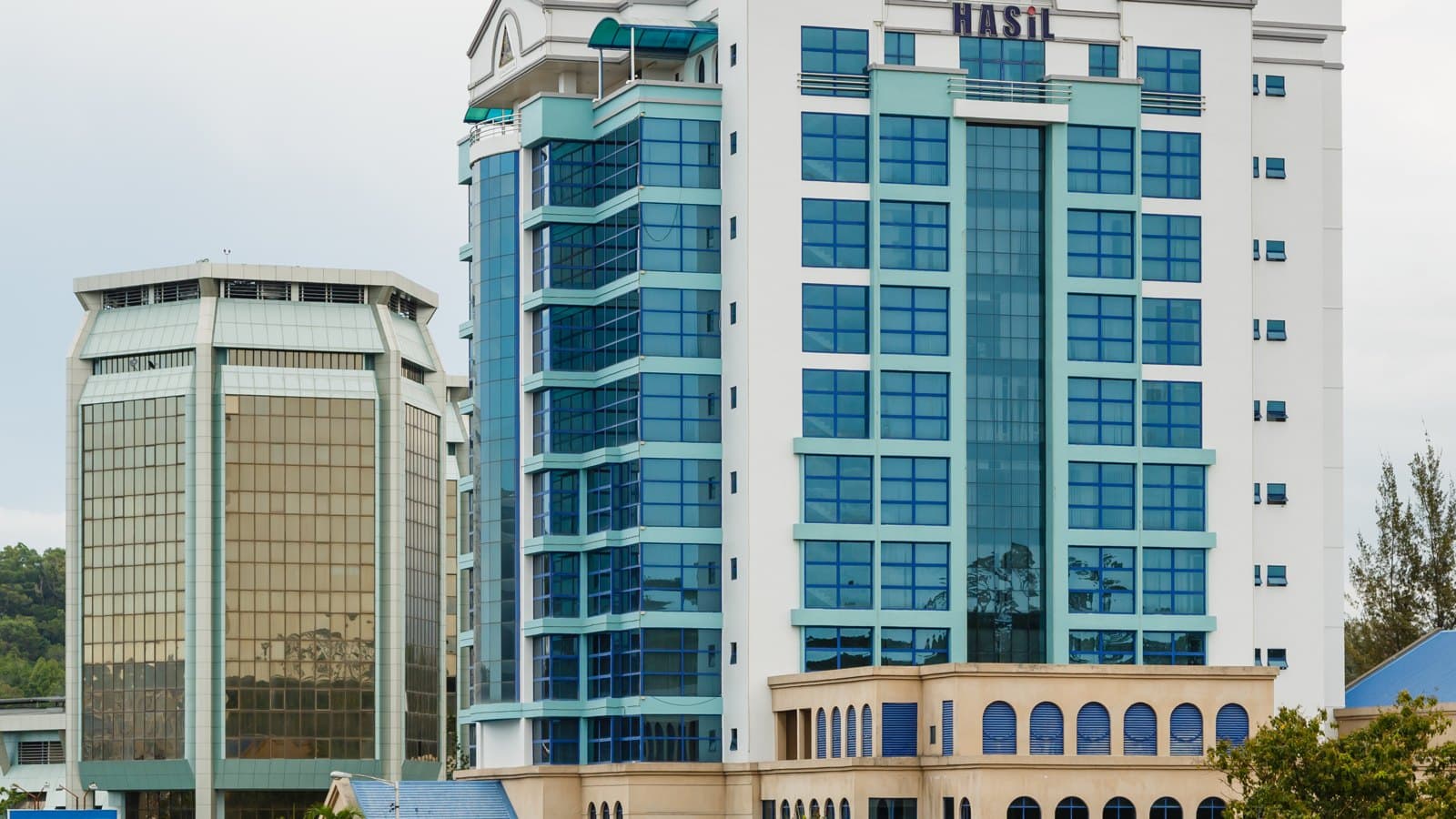
*Cover image: CEphoto, Uwe Aranas, CC BY-SA 3.0, via Wikimedia Commons. Wisma Hasil, an Inland Revenue Board office, in Kota Kinabalu.*