Most people only think about Real Property Gains Tax when the lawyer mentions it at the signing. By then the price is agreed and the date is fixed, and both decide how much tax you pay. This guide sets out the rules as LHDN publishes them on its RPGT pages and in its Operational Guidelines dated 17 March 2026, so you can do the sums before you list.
Who pays, and on what
RPGT is charged on the gain from disposing of a chargeable asset in Malaysia: houses, condos, shops, farms, vacant land, and shares in a real property company. "Dispose" covers selling, transferring, assigning or gifting. It applies whether or not you live in Malaysia.
The disposal date is the date of the written agreement (your SPA), not the completion date or the date the title changes hands. Your holding period runs from the date of the SPA you bought under to the date of the SPA you sell under. That one rule decides your rate, so check both dates on paper.
The rate table
LHDN sorts sellers into three groups under Schedule 5 of the Act. Part I covers individuals who are Malaysian citizens or permanent residents (and partnerships). Part II covers Malaysian companies and trustees. Part III covers non-citizens without PR and foreign companies.
- Malaysian citizen or PR: 30% within three years, 20% in year four, 15% in year five, 0% from year six.
- Malaysian company: 30% within three years, 20% in year four, 15% in year five, 10% from year six.
- Foreigner without PR: 30% for the first five years, 10% from year six.
The 0% sixth-year rate for individuals has applied since 1 January 2022. It was 5% between 2019 and 2021, which is why older articles still quote it.
How the gain is worked out
The taxable figure is not simply sale price minus purchase price. LHDN lets both sides of the sum carry costs:
- Disposal price = sale price, minus money spent to enhance or preserve the property (LHDN's own example is a kitchen renovation), minus costs of defending your title, minus the incidental costs of selling (agent's commission, legal, valuation and similar professional fees).
- Acquisition price = what you paid, plus the incidental costs of buying (legal, valuer and agent fees).
Then an individual deducts the exemption of RM10,000 or 10% of the gain, whichever is greater. Ordinary repairs and furniture are not "enhancement", so keep receipts for the work that actually added value.
A worked example
Say a Malaysian bought a double-storey house with an SPA dated 15 August 2022 for RM450,000, paying RM8,000 in legal and valuation fees. They spent RM20,000 rebuilding the kitchen. They sell under an SPA dated 20 October 2026 for RM600,000, paying RM14,000 in agent's commission and legal fees. The figures are illustrative.
- Holding period: four years and two months, so this is a fifth-year disposal at 15%.
- Disposal price: RM600,000 minus RM14,000 minus RM20,000 = RM566,000.
- Acquisition price: RM450,000 plus RM8,000 = RM458,000.
- Gain: RM108,000. Exemption: 10% is RM10,800, which beats RM10,000.
- Chargeable gain: RM97,200. Tax at 15%: RM14,580.
The buyer holds back 3% of RM600,000 = RM18,000 and pays it to LHDN. That covers the tax, so the seller can claim the RM3,420 difference back. Had the seller signed after 15 August 2027, the rate would have been 0%.
The buyer's 3%, and how to avoid overpaying it
Whenever the price is paid in money, the buyer must retain the lower of the whole cash price or a fixed share of it, and remit it to LHDN within 60 days of the disposal date:
- 3% when the seller is a Malaysian or PR, regardless of how long they held the property.
- 5% when the seller is a Malaysian company selling within three years (3% after that).
- 7% when the seller is a foreigner.
Two changes help sellers. If the disposal is exempt or not chargeable (the private residence election, or a no-gain transfer such as a gift to your child), the seller can submit Form CKHT 3 through e-CKHT, and the guideline says the buyer may then skip the retention. And from YA 2026, a seller can declare the deemed tax amount to the buyer before payment, letting the buyer remit that figure instead of 3% if it is lower. A buyer who fails to remit faces a 10% increase on the unpaid sum, and it becomes a debt to the government.
Forms, deadlines and penalties
Since 1 January 2025, RPGT runs on self-assessment, and every return must go through e-CKHT on MyTax (mytax.hasil.gov.my). LHDN treats a paper form as not submitted.
- Seller: Form CKHT 1A (property) within 60 days of the disposal date. The return itself is the assessment. Pay any balance within 90 days of the disposal date. From 1 January 2026, instalments are allowed.
- Buyer: Form CKHT 2A within 60 days, one per buyer, plus the retention payment.
- Records: keep documents for seven years. Refund claims must be made within five years after the end of the year of assessment.
- Penalties: failing to file can cost up to three times the tax. An incorrect return can cost up to 100% of the tax under-declared. LHDN's guideline also lists civil action and travel restrictions for unpaid tax.
No TIN yet? Register through e-Daftar on MyTax first.
When no tax arises
LHDN deems some transfers to be at no gain and no loss: property passing to an executor or heir on death, a sale between spouses, a transfer between ex-spouses under a divorce court order, and gifts between husband and wife, parents and children, or grandparents and grandchildren. Since 2017 the donor must be a Malaysian citizen for the gift rule to apply.
The private residence exemption under section 8 is the other big one. A Malaysian or PR may use it once in a lifetime, by election on Form CKHT 3, and the choice cannot be undone. Since a fifth-year sale already drops to 15% and a sixth-year sale costs nothing, it usually makes sense to save it for a home you must sell early at a large gain.
What Budget 2027 changed
Nothing, for sellers. The Ministry of Finance's Langkah Cukai Belanjawan 2027 document (36 appendices) has no RPGT measure. For buyers, Appendix 16 proposes widening the first-home stamp duty exemption: 100% up to RM500,000, and 50% on the portion between RM500,000 and RM750,000, for SPAs from 1 January 2027 to 31 December 2030.
Related reads
- First-home stamp duty and legal fees in Malaysia
- Tenancy agreement stamp duty
- Cukai pintu (assessment tax) explained
- What happens to property if you die without a will
Sources: LHDN's RPGT pages on rates, exemptions, retention, penalties and filing (read 23 October 2026), LHDN's Garis Panduan Operasi CKHT dated 17 March 2026, and MOF's Langkah Cukai Belanjawan 2027. This is a factual summary, not tax advice; a tax agent can check your own dates and costs.
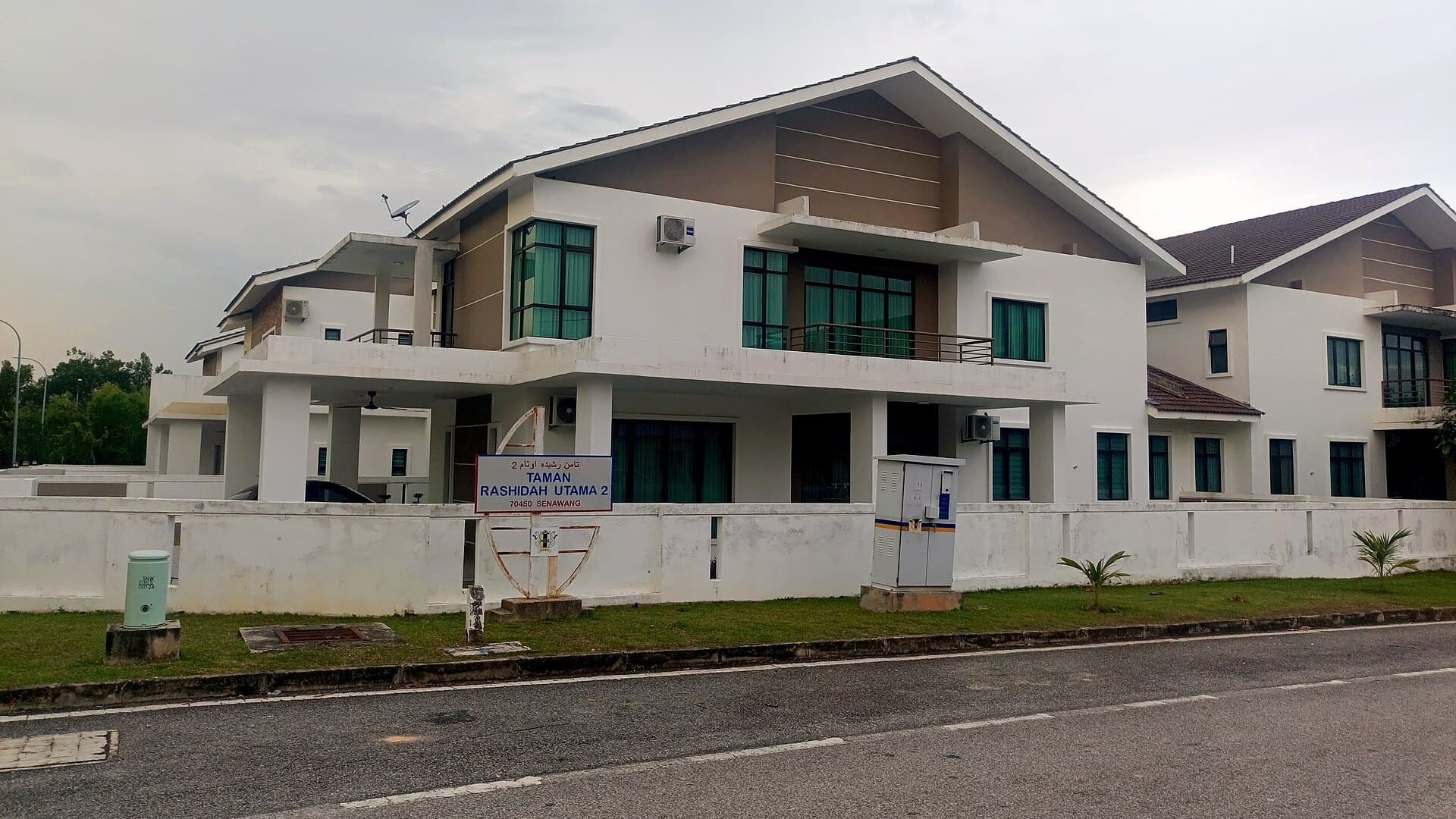
*Cover image: double-storey homes at Taman Rashidah Utama 2, Senawang. Photo: AyyanD, CC BY-SA 3.0, via Wikimedia Commons.*