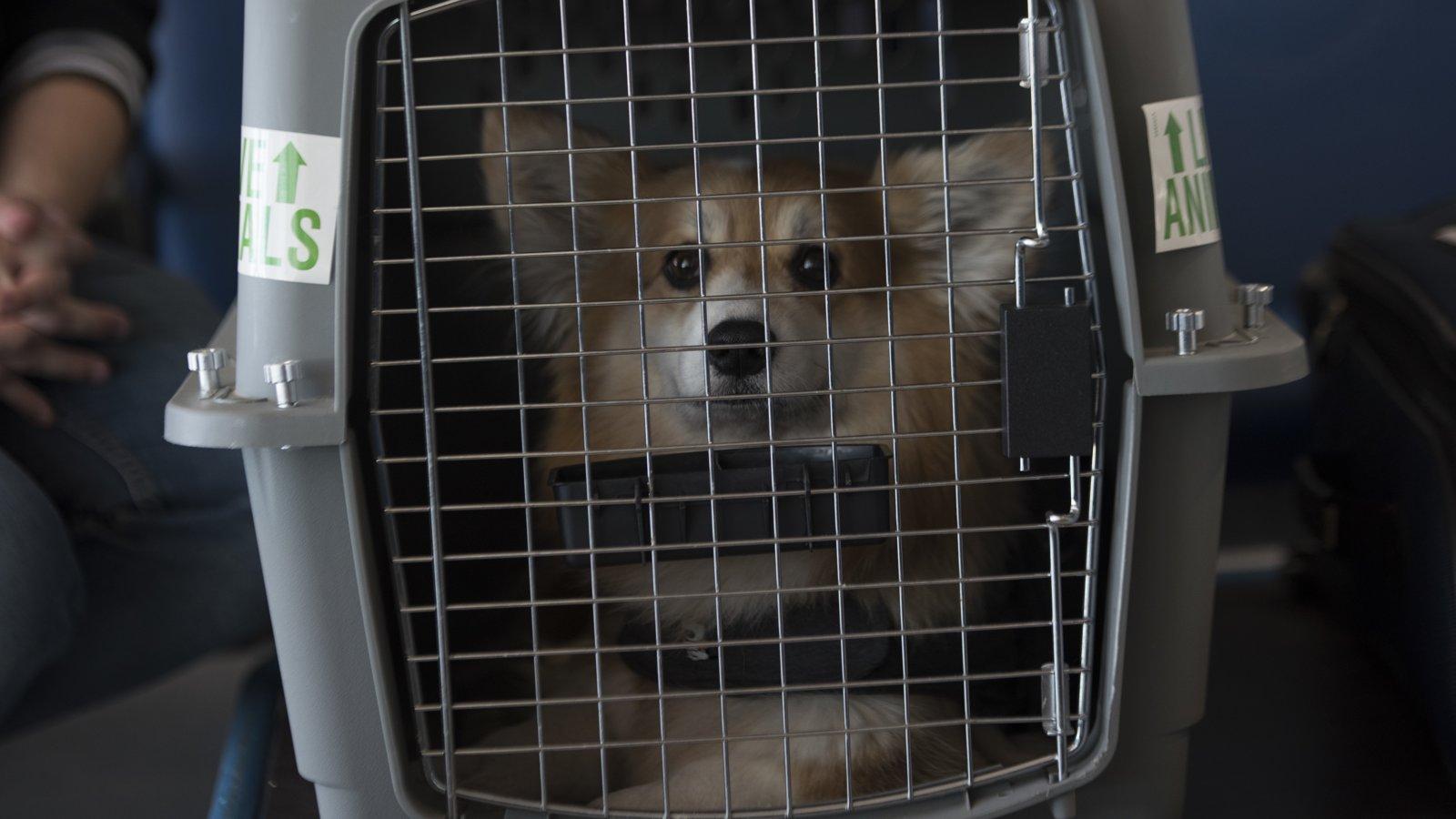
*Cover image: a dog in an airline travel crate marked "Live Animals" at a passenger terminal, by Airman 1st Class Taylor Slater, U.S. Air Force, via Wikimedia Commons (public domain).*
Moving to Kota Kinabalu for work, or relocating to Singapore, with a cat or dog is not like booking a seat. The paperwork depends on where the pet is going, some of it takes months, and two of Malaysia's main airlines will not take the animal at all. This guide sets out what the official rules say as of 17 November 2026.
Step 1: pick an airline that carries pets
- AirAsia says on its support page that it does not accept any pets or animals on its flights.
- Firefly says the same in its Conditions of Carriage (clause 7.6.1).
- Malaysia Airlines accepts dogs, cats and household birds with advance permission, in a proper container and with health certificates and permits. They travel in the hold, not the cabin, and are charged as excess baggage (Conditions of Carriage, December 2024). Guide dogs fly free. The airline publishes no RM pet fee, so ask when you book.
- MASkargo's MK Live service ships pets as live-animal cargo under IATA rules, in an IATA-standard crate, with breed and temperature embargoes on some routes. It publishes no rates.
We could not confirm Batik Air Malaysia's policy from its own pages, so check with the airline directly.
Step 2: Peninsular Malaysia to Sabah
Sabah has its own entry rules for dogs and cats arriving from the Peninsula, set by the Sabah Department of Veterinary Services (latest version posted in 2026). Your pet needs:
- An ISO-compatible microchip, with the number on every document.
- A veterinary health certificate from the veterinary authority where you are flying from, stating the pet showed no signs of rabies within 48 hours of the flight.
- A rabies vaccination given 3 to 12 months before the flight if it is the first jab (given when the pet was at least 3 months old), or a booster within the past year.
- A FAVN rabies antibody test at a WOAH-approved laboratory showing at least 0.5 IU/ml, on a blood sample taken 30 days to 24 months before the flight. The lab report must be in English and show the microchip number.
- Treatment against internal and external parasites within 15 days of the flight.
On arrival, the pet is inspected at the MAS cargo office at KKIA. Hand-carrying is not allowed, and importers who break this rule can be warned or blacklisted for up to a year. The pet then serves at least 14 days of quarantine at the Veterinary Quarantine Station in Kinarut, Papar. Without the antibody test it is 60 days, and without the health certificate the pet is refused entry. Tell the KKIA Terminal 1 animal quarantine office (088-413401) your arrival time at least two days ahead.
Sabah also bans certain breeds outright, including the Akita, American Pit Bull Terrier, Dogo Argentino, Fila Brasileiro, Tosa Inu and Tibetan Mastiff. Restricted breeds such as German Shepherds, Rottweilers, Malinois and Alaskan Malamutes must be neutered before entry.
Sarawak: check with the state first
Sarawak has been fighting a rabies outbreak since 2017 and recorded 26 animal cases in 2026 up to August (Malay Mail). A Selangor DVS officer told Kosmo in 2024 that taking a dog or cat to Sarawak needs rabies vaccination records, a Sarawak import permit and an export permit from the Peninsular state. We could not reach the DVS Sarawak website while preparing this guide, so we have not listed fees or quarantine periods. Contact DVS Sarawak before you book anything.
Step 3: Malaysia to Singapore
Singapore's Animal & Veterinary Service treats Malaysia as a Schedule III country. You need:
- A Singapore dog or cat licence, then an import licence: S$50 (two working days) or S$100 express (one working day), valid 90 days.
- An ISO microchip and a valid rabies vaccination.
- A rabies blood test at least 28 days after the jab, taken at least 90 days and within 12 months before export.
- A health certificate endorsed by a government vet before departure.
- At least 30 days of quarantine at the Animal Quarantine Centre, plus a rabies jab on arrival. From 1 December 2026 the daily fee rises to S$36 (fan room) or S$44 (air-conditioned).
AVS says a Singapore pet that visits Malaysia, even for a day, faces the same 30-day quarantine on return. By land, pets are cleared at Tuas Checkpoint.
Leaving Malaysia for anywhere else
The destination country's rules come first. On the Malaysian side, the Department of Veterinary Services issues the veterinary health certificate through the ePermit system, apply at least a week before you fly, and MAQIS issues the export permit. Fees gazetted in 2013 (P.U.(A) 115/2013) are RM40 for a dog or cat permit and RM20 (dog) or RM10 (cat) for the export inspection. Confirm current amounts with MAQIS.
A realistic timeline for Sabah
- Four months out: microchip, then the first rabies jab.
- Three months after the jab: the earliest the pet meets Sabah's 3-month rule. The FAVN blood sample must be taken at least 30 days before departure, so book it early.
- Two weeks out: parasite treatment, health certificate, MAS cargo booking.
- Two days out: tell the KKIA quarantine office your arrival time.
*Sources: DVS Sabah, "Additional conditions to import dog or cat from Peninsular Malaysia" (PDF); Singapore AVS dog and cat import page and Animal Quarantine Centre fees page; AirAsia support FAQ; Firefly Conditions of Carriage v2.4; Malaysia Airlines Conditions of Carriage (28 December 2024); MASkargo MK Live; DVS import rules for dogs and cats and export health certificate pamphlet; MAQIS pet import guide and P.U.(A) 115/2013; Malay Mail (22 August 2026) and Kosmo (23 May 2024). Checked 17 November 2026.*