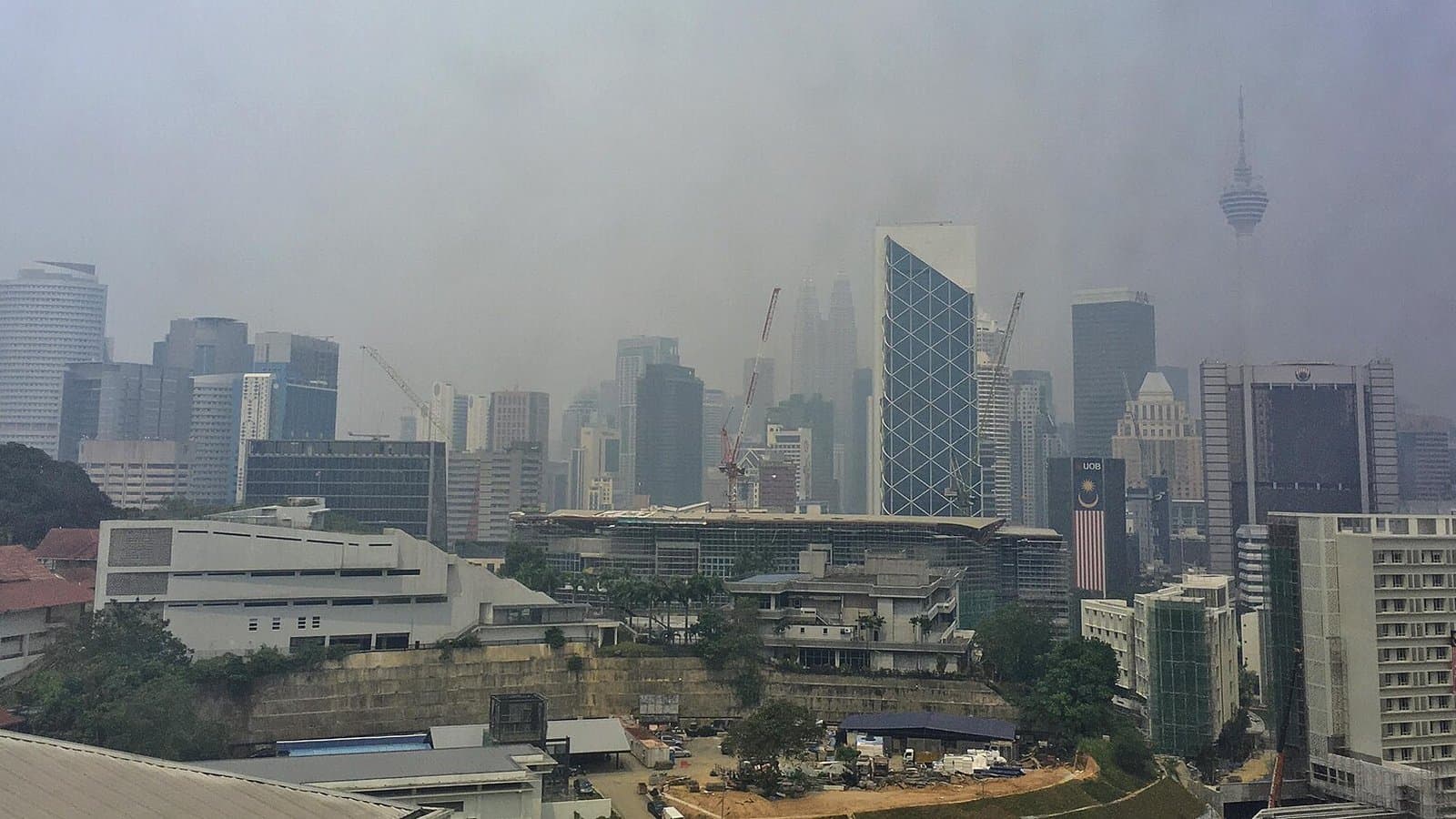
> Live status, read straight from the Department of Environment's APIMS feed at 3pm on 29 August 2026: 31 of the 67 reporting stations are in the "unhealthy" band or worse, two of them "very unhealthy" — Sri Aman 228 and IPD Serian 223, both in Sarawak. Not one station nationwide is rated "good". This page explains what those numbers mean, when schools actually close, and where to check the live reading for your own area.
Where the haze is right now
The August 2026 episode began as a Sarawak story and has become a national one. At 3pm on 29 August 2026 these stations were in the unhealthy band or worse:
- Sarawak (worst affected): Sri Aman 228 and IPD Serian 223 are both "very unhealthy". Then Sarikei 194, Samarahan 182, Kuching 179, Mukah 170, Sibu 166, Bintulu 156, Kapit 156 and Samalaju 129.
- Klang Valley: Cheras 161, Shah Alam 157, Batu Muda 156, Johan Setia 156, Petaling Jaya 152, Klang 121, Kuala Selangor 119.
- Northern peninsula: Sungai Petani 162, Minden 158, Seberang Perai 157, Taiping 157, Seberang Jaya 156, Tanjung Malim 156, Kangar 154, Langkawi 153, Alor Setar 152, Tasek Ipoh 151, Kulim Hi-Tech 110.
- Elsewhere: Nilai 153, Seremban 151, Segamat 140.
Readings update hourly and move through the day, so treat that list as a snapshot rather than a forecast.
How this episode unfolded
- 8 August — five Sarawak areas unhealthy, Serian highest at 171.
- 11 August — 11 Sarawak areas unhealthy, Serian 189.
- 12-13 August — Serian passes API 200. Six schools move to online learning, then 108 schools in Serian close.
- 17 August — Serian schools reopen as readings ease.
- 20-21 August — the worst of it. 591 schools shut across 10 district education offices, affecting 197,323 students (509 primary schools with 107,590 pupils and 82 secondary schools with 89,733 students). Serian hit 239 at 8am.
- 24 August — all 10 districts reopen. In the same week the smoke crosses to the peninsula, with Kuala Lumpur and Penang recording unhealthy air.
- 26-28 August — conditions worsen nationwide. By the evening of 28 August, Sri Aman is "very unhealthy" at 218 and 21 other areas are unhealthy.
- 29 August — 31 stations unhealthy, two of them very unhealthy.
What the API numbers mean
Malaysia's Air Pollutant Index is calculated on a 24-hour running average of whichever pollutant is dominant, which is usually fine particulate matter (PM2.5) during a haze episode. That averaging is why the number lags what your eyes and throat are telling you: a sharp deterioration at lunchtime shows up in the index hours later.
In the 101-200 "unhealthy" band everyone can be affected, and high-risk groups worst of all — young children, older people, pregnant women, and anyone with asthma, another respiratory condition or heart disease.
When schools actually close
The National Haze Action Plan sets the triggers, and they turn on the reading rather than the season:
- Above API 100 — outdoor activities involving students are suspended.
- Above API 200 — schools, kindergartens and childcare centres close.
- Above API 150 sustained for more than 24 hours — authorities may additionally suspend outdoor activity, close schools and carry out cloud seeding where there is enough cloud cover to work with.
Closures are announced district by district by the state education department, not nationally. A school 40km up the road can stay open while yours shuts, so follow your own district education office rather than the state headline.
Where the smoke is coming from
This episode is overwhelmingly transboundary. The Asean Specialised Meteorological Centre counted 514 hotspots in Kalimantan and 176 in Sumatra on 28 August 2026, against just three inside Malaysia — one each in Johor, Sarawak and Terengganu. Those figures were cited by Department of Environment deputy director-general Azuri Azizah Saedon. A prolonged dry spell and below-average rainfall have sharpened both the imported smoke and local open burning.
The Department of Environment says it has stepped up enforcement and patrols in areas at heightened risk of open burning, and both the National Open Burning Action Plan and the National Haze Action Plan have been activated.
Open burning is a serious offence
Under section 29A of the Environmental Quality Act 1974, open burning carries a fine of up to RM500,000, or imprisonment of up to five years, or both. That is the penalty the Department of Environment publishes on its own open-burning page. A long-proposed amendment would introduce a RM25,000 minimum and raise the ceiling to RM1 million, but the figure above is what DOE currently states as the law.
To report open burning, call the Fire and Rescue Department on 999, or the Department of Environment on its hotline 1-800-88-2727 or complaint line 03-8889 1972.
How to check the live reading (the address has changed)
The address most guides still print, apims.doe.gov.my, no longer serves the data directly — it redirects to the Department of Environment's MyEQMS portal. The live hourly table now sits at eqms.doe.gov.my, in the APIMS section. It publishes an hourly reading for each station over the past 24 hours, a national ranking and a trend chart; 67 stations were reporting when this page was updated.
Check the station nearest you rather than your state as a whole. On 29 August, Miri sat at 74 while Sri Aman, in the same state, was at 228.
How to protect your family
- Check the reading before you go out, and check your nearest station, not the state average.
- Cut outdoor exertion, especially for children, older people and anyone with a respiratory or heart condition.
- Wear an N95 or KN95 outdoors — ordinary surgical and cloth masks do little against fine PM2.5 particles.
- Keep windows and doors shut, run an air purifier if you have one, and set air-conditioning to recirculate.
- Stay hydrated and watch for symptoms — a persistent cough, breathlessness, or eye and throat irritation. Seek medical attention if they worsen.
Related reads
- Family-Friendly Things To Do in Kuching, Sarawak — indoor options for when outdoor plans are cancelled
- Kuching Food Institutions: The Sarawak Must-Eat List — eating your way around one of the worst-hit areas
- Kolo Mee and Sarawak Laksa in Kuching — the two bowls Kuching is known for
*Air quality readings are taken from Malaysia's official APIMS feed and update hourly, so the numbers above may have moved since publication — always check the live reading for your own area.*
*Cover image: Benjy8769, CC BY-SA 4.0, via Wikimedia Commons*