> Quick view: if you are hurt at work, or on your normal route to or from work, PERKESO's Employment Injury Scheme covers you. It pays for treatment, then pays 80% of your average assumed daily wage for every day of medical leave once that leave is 4 days or longer, counting the day of the accident. Your employer must report the accident within 48 hours of being told, using Borang 34.
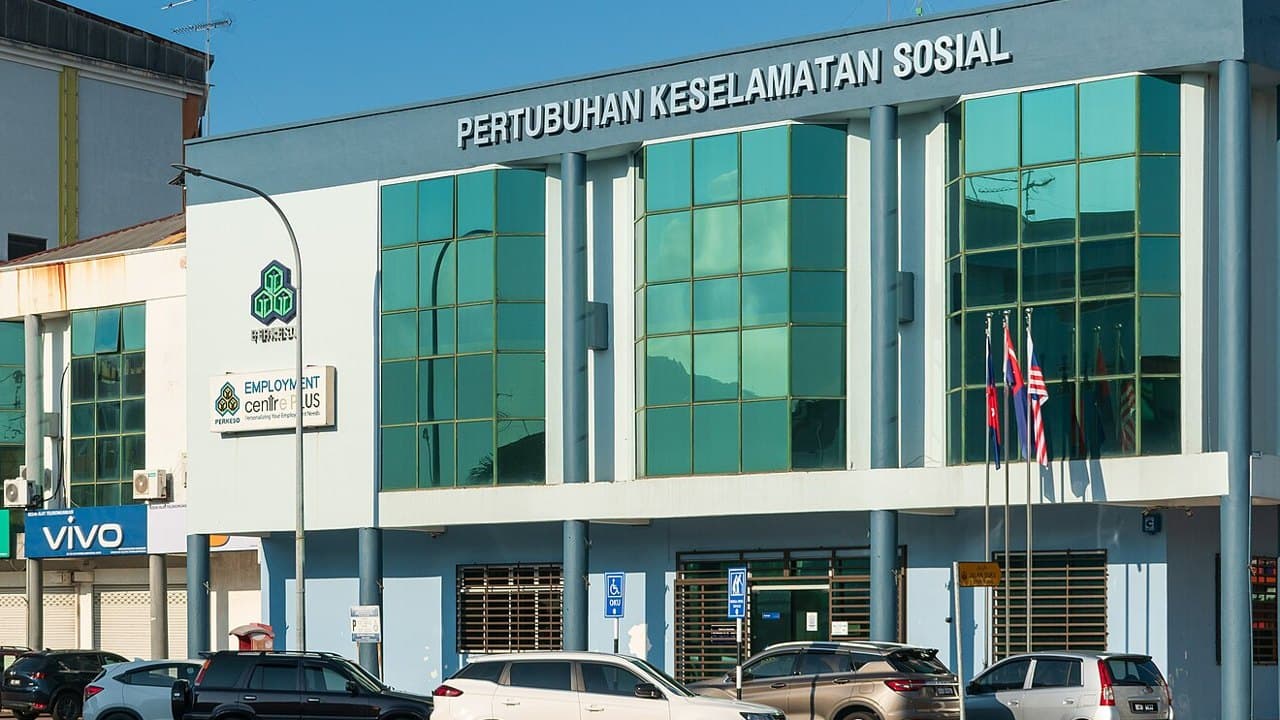
*Cover image: Dominic Nelson / Wikimedia Commons, CC BY-SA 4.0 (PERKESO office, Kluang)*
A slip in the warehouse, a motorcycle crash on the Federal Highway at 7.40am, a burn in a restaurant kitchen. Most Malaysian employees have been paying into PERKESO (also called SOCSO) since their first payslip, yet many only find out what it covers when they are lying in a hospital ward. This guide explains the scheme in plain terms.
We used PERKESO's own pages: the Employment Injury Scheme page (benefit rates), the Benefit Application page, the Borang 34 form (Amendment 2/2026), its filling guide and document checklist, and the employer and contributions pages. All were read on 20 October 2026.
Who is covered
The Employees' Social Security Act 1969 (Act 4) applies to every private-sector employer with one or more employees. If you work under a contract of service and your employer contributes to PERKESO for you, you are an insured person.
Contributions come in two categories:
- First Category, under 60: the employer pays 1.75% and you pay 0.5% of monthly wages, following PERKESO's contribution schedule. This covers both the Employment Injury Scheme and the Invalidity Scheme.
- Second Category, 60 and above: the employer alone pays 1.25%, and you are covered for employment injury only. New employees who join at 55 or older with no earlier contributions also fall here.
Government employees are not covered by this scheme, and the self-employed have a separate scheme (see our related reads).
Which accidents count
PERKESO's page lists four kinds of protected events:
- Work accidents: while you are working or on a working day's duties.
- Commuting accidents: on the route between where you live or stay and your workplace, on any journey directly connected to your work, and between your workplace and where you eat during an authorised break.
- Emergency accidents: while helping, rescuing or protecting people at your employer's premises during an emergency.
- Occupational diseases: illnesses caused by your job and listed in the Fifth Schedule of the Act, such as hearing loss from constant loud noise, or occupational asthma from dust or chemicals.
The rule that decides most commuting disputes is one line on PERKESO's page: an accident during any interruption or deviation is not treated as arising out of your employment. Stopping to fetch your child from school, or turning off for a personal errand, can take you outside the cover. Accidents outside work hours that are not linked to your job fall under LINDUNG 24 Jam instead. That is a separate scheme, and you cannot claim both for one accident.
What the scheme pays
These are PERKESO's published rates.
- Medical benefit: free treatment at a PERKESO panel clinic or a government clinic or hospital until you recover, with second-class ward care for serious injuries. If you were treated at a non-panel clinic, you or your employer can apply for reimbursement, subject to PERKESO's conditions.
- Temporary Disablement Benefit: 80% of your average assumed daily wage, minimum RM30, maximum RM158.67 a day. It is paid only when a doctor certifies medical leave of at least 4 days including the day of the accident, and not for days you work and earn wages.
- Permanent Disablement Benefit: 90% of your average assumed daily wage, RM30 to RM178.50 a day. You must claim within 12 months of the last day of temporary disablement. A Medical Board assesses you. An assessment of 20% or less is paid as a lump sum. Above 20%, the benefit is paid monthly for life, and you can convert one fifth of the daily rate into a lump sum.
- Constant-attendance allowance: RM500 a month if you are totally and permanently disabled and need someone with you at all times.
- Rehabilitation: physiotherapy, prostheses, wheelchairs, hearing aids, spectacles and vocational training, paid at PERKESO's set rates.
- If the worker dies: dependants share 90% of the average assumed daily wage (a widow or widower receives 3/5 for life, children 2/5). There is also a funeral benefit of up to RM3,000, the actual cost or RM3,000, whichever is lower, plus education loans for the children.
A worked example
PERKESO works out your "assumed" wage from your contribution band, not your exact payslip. The maximum rate shows how this works: RM158.67 is 80% of RM5,950 divided by 30, and RM5,950 is the assumed wage for the top band. For someone earning RM3,000 a month, the same method gives about RM79 a day (80% of RM2,950 ÷ 30). A fortnight of MC after a work accident would be worth roughly RM1,100, with treatment covered separately. PERKESO's own calculation is the one that counts.
How to claim, step by step
- Get treated and keep every MC. The checklist asks for the original MC and a medical certificate.
- Tell your employer straight away. For an accident notice, PERKESO's filling guide says the form must be submitted by the employer. The employer completes sections B, C, D, H and I, with its company stamp, and you confirm and sign Section J.
- Your employer reports within 48 hours of being told. This is a stated employer duty on PERKESO's employer page.
- For a road accident, make a police report. You need the original police report, or a copy certified by the station that issued it. Borang 34 cites Regulation 71(1).
- Gather the extras. PERKESO lists a copy of your IC (front and back), a bank account page in your own name (not a joint account), payslips for the 6 months before the accident, the attendance record for that month, and a sketch map of the route for commuting accidents. The guide lists six banks for payment: CIMB, Maybank, BSN (Giro), Bank Muamalat, RHB and Public Bank.
- Submit at a PERKESO office. PERKESO says applications are currently submitted at the nearest office counter or by post. Employers can also start an accident notice online on the LINDUNG Faedah portal (lindungfaedah.perkeso.gov.my).
If your employer will not file, the guide does not set out what you do next, so call PERKESO on 1-300-22-8000 or go to the nearest office with your documents. PERKESO can ask any party for extra documents.
Mistakes that delay or sink claims
- Fewer than 4 days of MC. A 2-day MC after a minor cut gets treatment covered but no Temporary Disablement Benefit.
- The detour. If you stopped at the pasar malam on the way home, say so honestly. A false statement is an offence under section 93 of the Act, punishable by up to two years in jail, a fine of up to RM10,000, or both.
- No police report for a road crash. Make one, even if no other vehicle was involved.
- Paying a middleman. PERKESO's checklist says plainly that its claims service is free and warns against agents who charge a fee or commission.
- Missing the 12-month window for permanent disablement after your last day of temporary disablement.
For a car crash, your PERKESO claim runs separately from any motor insurance claim. Our related guide covers the insurance side.