> Quick view: what happened at the Gig Workers Tribunal's first sitting on 1 September 2026, and what the gazetted Act 872 says about getting there. Sources: the Human Resources Ministry statement of 2 September 2026 as carried by FMT, and Laws of Malaysia Act 872, Gig Workers Act 2025, royal assent 16 December 2025, gazetted 31 December 2025. For the money side of the Act, see our earlier piece on the 1.25 per cent PERKESO deduction.
For five months the Gig Workers Act 2025 was a law with no case law. That ended on 1 September 2026 at the Kuching labour office in Sarawak, where the Gig Workers Tribunal sat for the first time.
The Human Resources Ministry, announcing it the next day, said the dispute was between an e-hailing worker and platform provider GrabCar Sdn Bhd, and that the issues raised concerned the use and operation of the GrabCar platform, including its Saver Trips and Advance Booking features and its cashback incentives. The Tribunal's deputy president, Suzarika Sahak, heard it. The gig worker represented himself. GrabCar was represented by an employee. Another date was set for further testimony and the examination of witnesses.
Two details in that paragraph are not incidental. They are written into the Act.
Nobody gets a lawyer, and that is deliberate
Section 36(3) of Act 872 says it plainly: save as provided in subsection (2), no party shall be represented by an advocate and solicitor.
Subsection (2) is the whole list of who may stand in for you. A contracting entity may be represented by its own duly authorised employee. A gig worker may be represented by an official or authorised member of a gig workers' association, which the Act defines as an association registered under the Societies Act 1966 consisting of gig workers, or by any of his family members. That is it. Everyone else appears in person.
Read that against the first case and the design becomes visible. A rider stood up alone against a company represented by its own staff member, and neither side could buy its way into a better advocate. It is the same principle the Consumer Claims Tribunal runs on, and it is the reason the Tribunal can work at all for a claim worth a few hundred ringgit.
Section 37 adds that all hearings before the Tribunal shall be public. If you want to know what these cases actually look like before filing one, you are entitled to sit at the back.
You cannot walk into the Tribunal
This is the part most riders will get wrong, and the Act is specific about the route.
Step one is the platform's own complaint desk. Section 17 lets a gig worker lodge a written complaint of a dispute with a contracting entity that is not an individual or sole proprietor, and requires that entity to initiate and resolve the dispute through the internal grievance mechanism in the service agreement within thirty days of the complaint being lodged. Put the complaint in writing and date it, because that thirty day clock is the thing that unlocks everything after it.
Step two is conciliation, not the Tribunal. Under section 18, the Conciliator is the Director General for Industrial Relations, the Deputy Director General, or an officer appointed under the Industrial Relations Act 1967. Section 18(3) sets out exactly five situations in which you may lodge a complaint for conciliation: the complaint is against a contracting entity that is an individual or sole proprietor; you are dissatisfied with a platform's written deactivation decision under section 14(9); no internal grievance mechanism was provided at all; you are dissatisfied with the outcome of the internal mechanism; or the thirty days lapsed without resolution.
Step three happens without you. Section 19(5) says that where the Conciliator is satisfied there is no likelihood of the dispute being settled, the Conciliator shall refer the matter to the Tribunal. Section 20 lets the Minister conciliate any dispute and refer it in the same way. You do not file at the Tribunal. The Tribunal receives you.
One shortcut exists. Section 17(3) says the internal grievance route does not apply to a dispute about deactivation under section 14. If your account has been switched off, you are not required to spend thirty days waiting on the platform's own process before going to a Conciliator. Given that the ministry named account deactivation and suspension, loss of income and account reactivation among the other disputes queued for the Tribunal, that shortcut is likely to be the most used provision in the Act.
What the Tribunal can and cannot do
Under section 33, the Tribunal hears disputes referred by the Conciliator or the Minister and may grant any award it deems just and appropriate, including consequential loss or damages. It has no jurisdiction over offences under the Act and none at all over Part VIII, the social security part, so a complaint that your 1.25 per cent is not reaching PERKESO is a matter for the enforcement officers and PERKESO, not for the Tribunal.
Section 42 requires an award without delay and, where practicable, within thirty days of the last day of hearing. An award can order compensation, order a party to comply with the service agreement or with the Act, order that a gig worker is entitled to perform his service or access the platform again, or give the platform permission to deactivate.
Section 44 gives fourteen days from the date the award is pronounced to appeal to the High Court. Section 45 makes failure to comply with an award an offence carrying a fine of up to RM50,000, imprisonment of up to two years, or both, with a further RM500 for each day the offence continues after conviction.
The Schedule is the sentence that decides who is covered
Here is the provision that gets left out of almost every summary, and it changes the answer for a large group of Malaysians who think they are covered.
Section 2 defines a gig worker as an individual who is a Malaysian citizen or permanent resident, receives earnings for a service, and enters into a service agreement for the performance of either any service with a contracting entity who is a platform provider, or any service as specified in the Schedule with a contracting entity who is not a platform provider.
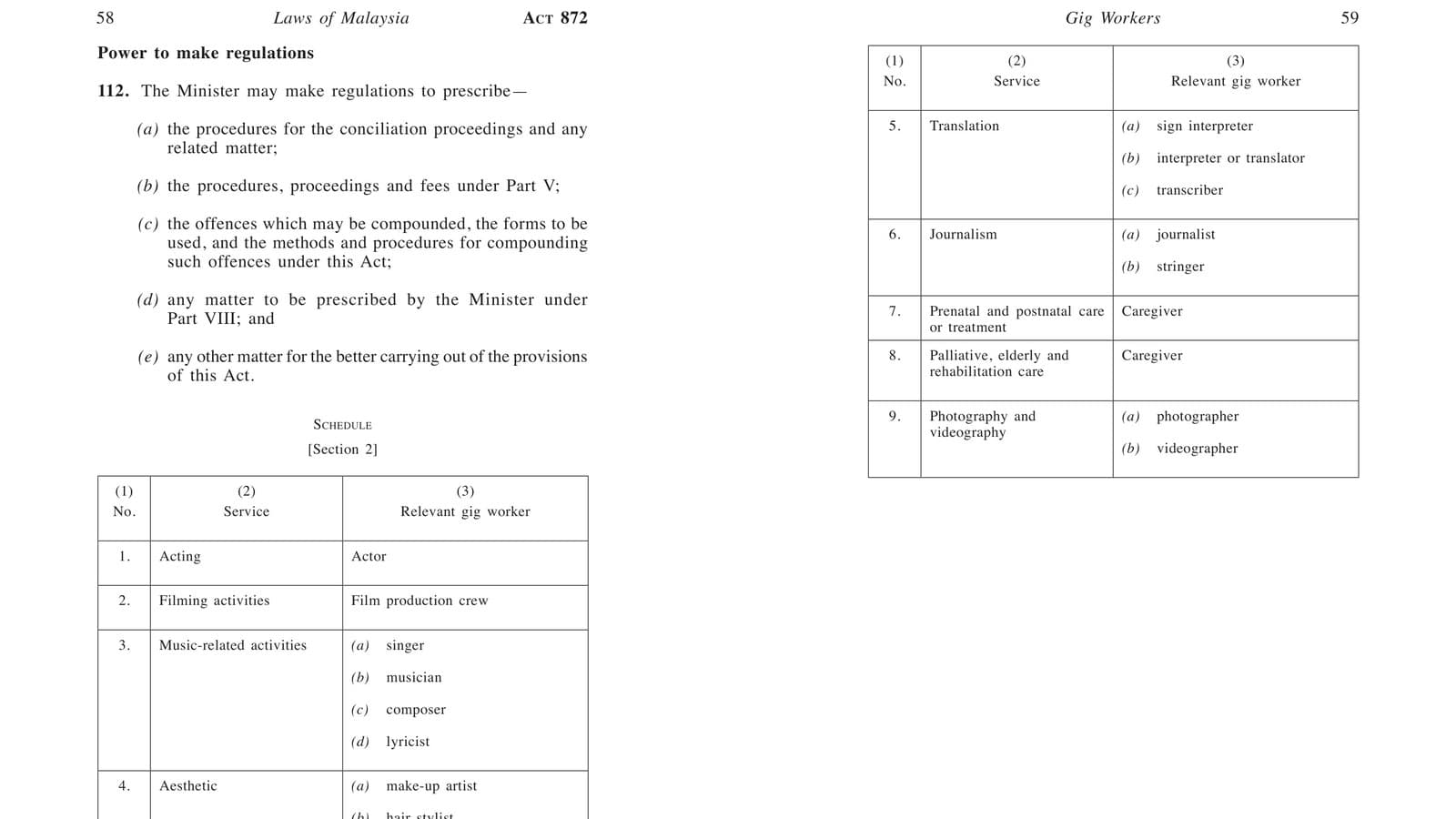
If your work runs through a platform, the first limb catches you and the type of work does not matter. If it does not, the second limb applies, and the Schedule to Act 872 is a closed list of nine entries:
- Acting (actor)
- Filming activities (film production crew)
- Music-related activities (singer, musician, composer, lyricist)
- Aesthetic (make-up artist, hair stylist, stylist)
- Translation (sign interpreter, interpreter or translator, transcriber)
- Journalism (journalist, stringer)
- Prenatal and postnatal care or treatment (caregiver)
- Palliative, elderly and rehabilitation care (caregiver)
- Photography and videography (photographer, videographer)
That is the whole list. A freelance graphic designer, copywriter, web developer, private tutor, accountant, event MC or trainer invoicing clients directly is not a gig worker under Act 872, because none of those services is specified in the Schedule and there is no platform provider in the arrangement. The ministry told FMT that the Tribunal has already received filings from non-platform gig workers, including claims for payment for services already performed. The nine entries above are the ones that will get through.
Section 110 lets the Minister amend the Schedule by order published in the Gazette, so the list can grow without a new Act. As of 9 September 2026 it has not.
One entry worth noticing if you work in care: item 8, palliative, elderly and rehabilitation care, brings a freelance caregiver inside the Act even with no app in the middle. That is a real protection in a sector where a great deal of work is arranged informally.
Citizens and permanent residents only
The first line of the definition is a filter that is rarely mentioned. A gig worker under Act 872 must be a citizen or a permanent resident of Malaysia. A foreign national riding for a platform in Malaysia is outside the Act entirely, which means outside the earnings, deduction, earnings slip, deactivation and dispute provisions as well as outside the PERKESO contribution.
Two offices, two kinds of complaint
The Tribunal is not the only door. A Labour Department (JTKSM) briefing deck on Act 872, posted by the Sabah Labour Department in April 2026, splits the Act between agencies. Parts II and III, which cover service agreements and gig workers' rights, sit with the Labour Department (JTK). Part IV, dispute resolution, sits with the Industrial Relations Department (JPPM), whose Director General is the Conciliator named in section 18. Part VIII, social security, sits with PERKESO.
The split matters because some things a platform does wrong are offences rather than disputes, and section 33 keeps offences away from the Tribunal. The deck lists the Part III offences JTK officers investigate on a complaint, with the choice to compound or prosecute:
- Late payment of earnings, under section 11(2). Where the service agreement sets no payment period, section 11 requires earnings to be paid within seven days of performing the service.
- An unlawful deduction from earnings, tips or rewards, under section 12(2). Section 12 allows only three kinds: recovering an overpayment the entity itself made by mistake within the three months before, a deduction permitted by the Act or another written law, or one authorised by the Director General.
- Refusing an earnings slip, under section 13(3). Any contracting entity other than an individual must give one when the worker asks.
- Breaking the deactivation procedure in section 14: no written notice of a suspension, no right to be heard, no written explanation of the decision, or failing to reactivate the account and pay the worker when the Act requires it.
So a rider with an unexplained deduction has two routes that do different jobs. A complaint to JTK can get the platform investigated and fined for the offence. The grievance and conciliation route is the one that can end with the Tribunal ordering the money back.
What a wrongful suspension is worth
Section 14 is the one place where the Act puts a number on lost income. A platform may suspend or restrict a worker's access for up to 14 days to investigate, must give written notice, and must give the worker a right to be heard. If it finds no breach, it must reactivate the account and pay half of the worker's average daily earnings for the suspension period, calculated on earnings for actual days of service in the thirty days before the suspension. If it does find a breach, it may terminate access and the service agreement, or extend the suspension by no more than seven further days, and it must explain the decision in writing.
The JTK deck works an example. A worker is suspended for five days. The five most recent days of actual service before the suspension earned RM100, RM120, RM80, RM90 and RM110, which is RM500. The average daily earnings are RM100, half of that is RM50, and five days at RM50 comes to RM250, owed with the reactivation.
That RM250 is a statutory minimum the platform owes without any hearing. A worker who says the suspension cost more, for example a lost incentive tier, is making a claim for consequential loss, and that is the kind of award section 33 lets the Tribunal make once the dispute has been through conciliation.
The enforcement clock runs out this month
Act 872 came into force on 31 March 2026. At a press conference at Menara Perkeso that day, Human Resources Minister Datuk Seri R. Ramanan said platform providers had been given three to six months to integrate their systems with PERKESO, describing it as a moratorium rather than an amnesty. His words were that the ministry was not going on a witch-hunt to penalise anyone who was not compliant by the next day, but that once an Act comes into play it must be enforced and taken seriously. He said all platforms had been served notice as early as March the previous year, and that 37 engagement sessions involving roughly 3,873 participants preceded the Bill.
Three months from 31 March was 30 June 2026. Six months is 30 September 2026, the end of this month.
The mid-point reading was not encouraging. On 25 April 2026 PERKESO issued a statement urging platform providers to align their systems and submit worker details promptly, saying that onboarding had covered only about two per cent of an estimated 1.2 million gig workers in Malaysia despite its own digital infrastructure being fully ready. It acknowledged concerns raised by the Malaysian E-hailing Coalition and said it was prepared to adopt stricter enforcement measures if platform providers failed to meet the requirements. The Human Resources Ministry has put the number of workers the Act benefits at 1.64 million; the Cabinet figure quoted a few weeks before commencement was more than 1.2 million, so treat any single count as an estimate.
Five months later the picture had changed. On 22 September 2026, during a PERKESO Ops Kesan 2.0 enforcement operation in the Klang Valley, PERKESO deputy chief executive (operations) Azirruan Arifin said 1.17 million gig workers had been registered, that platform providers must ensure registration and contributions for gig workers are made as the Act requires, and that enforcement will begin on 1 October 2026, as reported by The Star. The same operation, run by some 300 officers from 54 PERKESO offices, targeted employers, platform providers and self-employed workers, and PERKESO said it has issued more than 2,000 compound notices to non-compliant employers since July. The grace period, in other words, ends on the day after the six-month mark, and it now has a named start date.
What to do about it this week
- Check the deduction is actually happening. If no PERKESO line appears on your earnings screen, your platform may still be inside its integration window. Verify your contribution status yourself through the PRIHATIN app or portal rather than assuming the platform has filed it.
- Put every complaint in writing and date it. The thirty day internal clock under section 17 starts from the date the complaint is lodged, and you will need that date if you go to a Conciliator.
- If you have been deactivated, do not wait thirty days. Section 17(3) takes deactivation disputes out of the internal route. Section 14 separately caps an investigative suspension at fourteen days, requires written notice, and if no cause is found requires reinstatement plus half the average daily earnings for the days lost.
- Screenshot the incentive terms before they change. The first case turned on Saver Trips, Advance Booking and cashback incentives, all of which are configured in an app that can be updated overnight.
- If you are a non-platform freelancer, read the Schedule. If your service is not one of the nine, Act 872 does not reach you, and PERKESO's LINDUNG Kendiri route under the Self-Employment Social Security Act 2017 remains voluntary and self-funded.
- Take late pay, unlawful deductions and a refused earnings slip to the Labour Department too. Those are offences under sections 11, 12 and 13 that JTK investigates, separate from any dispute you take to conciliation.