The Indah Water bill is the cheapest utility most Malaysian households pay, and the one fewest people read. That changed a little over the past three years, because the charge has roughly doubled. Indah Water Konsortium (IWK) now says the revised tariff, phased in from 2022, reached full implementation in 2026. Here is what that means for your bill.
Everything below comes from IWK's own charges, desludging and payment pages, read on 9 October 2026, with background from a Bernama report on the 2022 decision and an IWK statement carried by *The Sun* in January 2026. IWK runs the public sewerage system for Peninsular Malaysia and Labuan. Sabah and Sarawak are outside its concession and handle sewerage separately, and a few local areas are run differently, so the name on your bill is what counts.
*Image: Indah Water Konsortium.*
*Updated 17 October 2026: rates rechecked and unchanged; added the TNG eWallet RM2 cashback (to 30 November 2026), WhatsApp e-bills and IWK's new receipt notice.*
What a connected home pays in 2026
If your toilet drains into an underground sewer pipe that runs to a treatment plant, you are a connected customer and pay a flat monthly charge by category:
- Low-cost houses and government quarters in categories F, G, H and I: RM4.09 a month
- Houses in kampung, new villages and estates: RM5.12 a month
- All other homes, and government quarters in categories A to E: RM15.32 a month
The third line covers most terraces, condominiums and apartments. Water use does not change it. A one-person studio and a five-bedroom bungalow in the same category pay the same.
IWK's page adds that it absorbs a rebate of RM0.09 to RM0.32 a month for financial year 2026. It does not say which category gets which rebate, but the figures are exactly the gap between each rate and a round RM4, RM5 and RM15. Over a year, the top rate is RM183.84 before the rebate, or RM180 if the full RM0.32 rebate applies to it.
Why it went up
Before the revision, connected homes paid RM2 to RM8 a month. The Cabinet agreed a new structure on 20 April 2022, and the then Ministry of Environment and Water announced it on 27 September 2022 (Bernama): desludging charges rose from 1 October 2022 and connected charges from 1 January 2023, the first revision in nearly 28 years. The legal basis is the Water Services Industry Act 2006 and the Water Services Industry (Sewerage Services Charges) Regulations 2022, later amended.
IWK's argument, repeated in its January 2026 statement, is that the charge still sits below cost. It puts the average cost of serving a connected home at about RM17 a month, against the RM15.32 top rate.
Septic-tank homes: you pay per visit
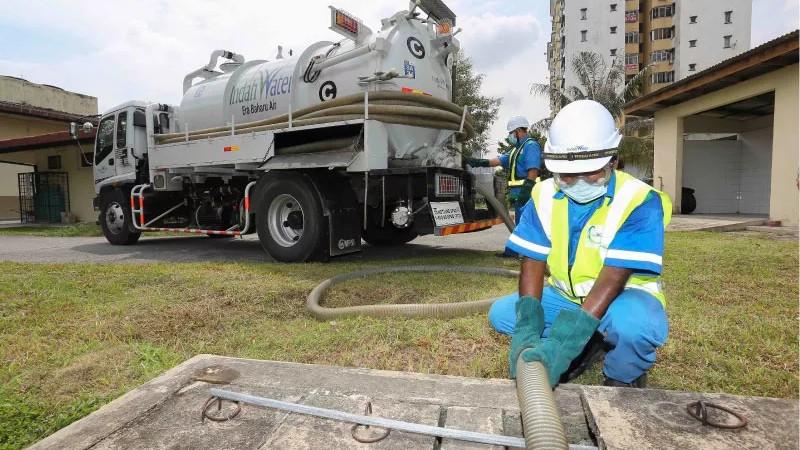
Older houses, many kampung homes and some estates still have an individual septic tank instead of a sewer connection. Under the desludging regulations that took effect on 30 March 2021, these tanks must be emptied on a schedule:
- Inside a local authority (PBT) area: every 24 months, at RM192, which IWK expresses as RM8 a month
- Outside a local authority area: every 36 months, at the same RM192, or RM5.33 a month
That price covers standard tanks across all three domestic categories. Non-standard tanks or pour-flush systems cost RM260 below 2.5 cubic metres, RM390 from 2.5 to 4.5 cubic metres, and RM130 for each extra cubic metre above 4.5. IWK says the real cost of a desludging is around RM430 a tank.
The trap is the RM80 abortive charge, billed per trip after a written notice if the crew cannot get to the tank (a car parked over the manhole, a locked gate), if you refuse the scheduled visit, or if the tank turns out to be empty. IWK says it will not charge when you cancel for a valid reason such as a death, a medical emergency, a disaster, lost keys or a car breakdown, when its own crew turns up at a different time from the one agreed, or when a blockage stops the work.
How to pay, and what to do with a new house
- JomPAY: biller code 68502, Ref-1 your sewerage account number, Ref-2 your phone number or email
- IWK customer portal: pay without logging in using only the account number (minimum RM1), or register for e-bills, which IWK now sends by email or WhatsApp
- TNG eWallet: the "Bills" feature, which carries an RM2 cashback until 30 November 2026 (below)
- Online banking: Maybank2u, CIMB Clicks, RHB, Public Bank, Bank Islam, Hong Leong, BSN and Bank Rakyat
- Cash counters: 7-Eleven, 99 Speedmart, Pos Malaysia, BSN, Bank Rakyat and stores with ePay or similar terminals
- IWK counters: Menara Indah Water in Kuala Lumpur, unit offices and UTC branches in Melaka, Kuala Lumpur, Ipoh and Johor Bahru
The RM2 TNG eWallet cashback
IWK's homepage carries a joint campaign with TNG Digital, running 1 June to 30 November 2026. Pay your Indah Water bill through the "Bills" feature in TNG eWallet, in a single transaction of at least RM24, and RM2 comes back to the wallet within three working days. The terms limit it to one cashback per user per calendar month, the first 15,000 eligible transactions a month (90,000 in total), no split or combined payments, and no stacking with other promotions. Queries go to the TNG eWallet careline, +603-5022 3888.
The RM24 floor is the catch, because no monthly rate reaches it. At RM15.32, two months in one payment (RM30.64) qualifies and nets you RM28.64. A kampung home at RM5.12 needs five months (RM25.60), and a low-cost home at RM4.09 needs six (RM24.54). With one cashback a month, you gain nothing by splitting one bill into several payments.
Receipts
IWK says it no longer issues a separate confirmation receipt for bills paid through banks, online banking, e-wallets or appointed agents. The receipt or transaction record from that channel, or your bank statement, is the official proof. Payments made elsewhere show on the account statement in the IWK customer portal after about three working days; paying through "Bayar Bil" inside the portal shows it straight away.
If you have lost your account number, IWK's portal says to call 03-2083 2828 or send your address through its feedback form. Buyers of a property should change the owner's name through the portal's ePermohonan section so arrears and notices go to the right person. In Labuan, sewerage is already billed together with water on a single bill from the Labuan water department (JBA Labuan).
Do not ignore it. IWK's own explanation of joint billing notes that the Water Services Industry Act allows water supply to be suspended over unpaid water or sewerage bills. Households registered under eKasih can ask IWK for a rebate; the page does not state the amount.