Every few months the same argument runs through a Malaysian condo WhatsApp group. The management office announces a new rate. Somebody says the developer has no right to raise it. Somebody else says they will stop paying until the lift is fixed. Almost nobody quotes the law, which is unfortunate, because the law is unusually specific about all three points.
The governing statute is the Strata Management Act 2013 (Act 757). It came into operation on 1 June 2015 for Kuala Lumpur, Labuan and Putrajaya, and on separate dates in each state. Section 1(2) limits it to Peninsular Malaysia and the Federal Territory of Labuan, so owners in Sabah and Sarawak are under different state legislation and the sections below do not apply to them.
Who actually sets the charge
Before a joint management body exists, the developer determines the Charges and the sinking fund contribution. An owner who thinks the figure is wrong does not have to sue. Section 12(7) lets them apply to the Commissioner of Buildings for a review, and the Commissioner can either fix the sum himself or order the developer to appoint a registered property manager, at the developer's own cost, to recommend one.
Once a JMB is established, section 25(3) takes over. The amount is determined by the joint management body from time to time, and it must be in proportion to the allocated share units of each parcel. That single phrase settles a lot of arguments. It means a bigger parcel pays more than a smaller one in the same block, it means the split is not per door, and it means a management office cannot quietly charge two owners different rates for identical parcels. Share units are assigned under the Strata Titles Act and printed in the schedule of parcels, so the arithmetic is checkable.
Section 25(2) is the one owners forget to enforce. The developer has to pay the Charges and sinking fund contribution on every parcel it has not sold, at the same rate a buyer would pay. Unsold stock is not free.
The sinking fund is not a slush fund
The sinking fund contribution is a separate line. Under section 25(4) it is a sum equivalent to 10% of the Charges unless the general meeting determines otherwise, and it may not be set below that.
Section 24(2) then restricts what the money can be spent on: painting or repainting any part of the common property, acquiring movable property for use in relation to the common property, and renewing or replacing any fixture or fitting in the common property. Day to day cleaning, security wages and the electricity bill for the lobby come out of the maintenance account, not this one. If a committee proposes to pay a routine operating cost out of the sinking fund, that is the provision to point at.
What happens when somebody stops paying
The chain is short and it moves faster than most owners expect.
First, the JMB serves a written notice demanding payment. Section 34(1) says the notice must give the owner not less than fourteen days from the date of service.
Second, if the money is still unpaid, section 34(2) gives the body a choice: file in court, file at the Tribunal, or go straight to section 35.
Third, and this is the part that surprises people, section 34(3) makes it an offence for an owner to fail to comply with that notice without reasonable excuse. The penalty is a fine up to RM5,000, imprisonment up to three years, or both, with a further fine of up to RM50 for every day the offence continues. Arrears on a strata parcel are not an ordinary civil debt.
Interest is capped. Section 25(6)(b) says the rate is whatever the JMB determined at its first annual general meeting under paragraph 19(1)(d), but it shall not exceed ten per cent per annum. During the developer's management period section 12(6) sets a flat 10% a year calculated on a daily basis. A management office charging 1.5% a month, which is 18% a year, is outside the Act.
The warrant of attachment
Section 35 is the enforcement route people have heard about without knowing the detail. On a sworn written application by a member of the joint management committee, the Commissioner of Buildings may issue a warrant of attachment in Form A of the Third Schedule, authorising seizure of movable property belonging to the defaulting owner, found in the building or anywhere else in the state. The warrant is executed in the presence of the Commissioner or an officer from the Commissioner's office, and an inventory is served in Form B.
Three details in that section matter to ordinary owners and tenants:
- A tenant or occupier who pays the arrears to stop the seizure may deduct the amount from the rent, unless a written agreement says otherwise, and may keep the goods until reimbursed (section 35(5)).
- Anyone whose property is attached and who disputes the legality has fourteen days to apply to the Magistrate's Court for an order releasing it (section 35(7)).
- If the sum is still unpaid fourteen days after attachment, the property can be sold (section 35(8)).
The quiet penalty: losing your vote
Paragraph 21 of the Second Schedule provides that a proprietor is not entitled to vote if, on the seventh day before the date of the meeting, any part of the Charges, the sinking fund contribution or any other money due to the management corporation in respect of the parcel is in arrears. Paragraph 14 requires the committee to post the list of who may vote on the notice board at least 48 hours before the meeting.
So the practical deadline before an AGM is not the meeting date. It is a week earlier, and the list goes up in public.
The Strata Management Tribunal
Part IX of the Act creates the Tribunal, which sits under the Ministry of Housing and Local Government and is designed for owners to use without a lawyer.
Who can file (section 107): a developer, a purchaser, a proprietor including an original proprietor, a joint management body, a management corporation, a subsidiary management corporation, a managing agent, and any other interested person with the Tribunal's leave.
How (section 108): a claim is made in the prescribed form, Form 1, with the prescribed fee. The Tribunal's published fee is RM100 for a residential claim and RM200 for a commercial or industrial one, with a lower fee for a defence to counterclaim. Fees are set by regulations and can change, so confirm the current figure with the Tribunal registry before you pay.
The ceiling (section 105(1)): the Tribunal hears the claims listed in Part 1 of the Fourth Schedule where the total amount sought does not exceed RM250,000.
No time bar (section 105(2)): the Limitation Act 1953 does not apply to Tribunal proceedings. An eight year old arrears claim is not automatically dead.
What it cannot touch (section 105(3)): any claim in which the title to land, or an estate or interest in land, is in question.
Court is closed off once you file (section 106): where a claim is filed with the Tribunal and it is within jurisdiction, the jurisdiction of the court to hear the same matter is excluded. Choose one forum.
Speed (section 117(1)): the Tribunal makes its award without delay and, where practicable, within sixty days from the first day of the hearing.
Finality (sections 120 and 121): decisions are final and binding, though an award can be challenged on the ground of serious irregularity, and section 118 allows a question of law to be referred to a High Court judge.
Teeth (section 123): anyone who fails to comply with a Tribunal award commits an offence and is liable to a fine up to RM250,000, imprisonment up to three years, or both, and a further fine of up to RM5,000 for every day the non compliance continues.
Filing it yourself: the forms, the fees and the 14 day clocks
The Tribunal is built for owners to run their own case, and the mechanics are published rather than guessed at. A claim can be filed on KPKT's e-TPS portal at etps.kpkt.gov.my, over the counter at the Tribunal's office, or by post.
- Form 1 is the statement of claim, at RM100 for a residential claim and RM200 for a commercial or industrial one.
- Form 2 is the respondent's defence, due within 14 days.
- Form 3 is the reply to a counterclaim, at RM50 residential and RM100 commercial or industrial, also within 14 days.
- A sealed claim must be served within 14 days of sealing.
- Fees are paid in cash, bank draft or money order made out to Akauntan Negara Malaysia-KPKT-T. Personal cheques are not accepted, and a filing sent by post must use a bank draft or money order.
Two things change how you prepare. First, section 110(2) keeps lawyers out of the hearing unless the Tribunal itself considers that the matter involves complex issues of law and one party would suffer severe financial hardship without representation, and if one side is allowed counsel the other is entitled to it too. A company or other body may send a full time paid employee instead. You are expected to argue it yourself, so bring the resolution that fixed the Charges, the schedule of allocated share units, your payment records and the 14 day demand notice.
Second, section 120 deems the award an order of a court, enforceable by any party to the proceedings. That sits next to the section 123 offence, so an unpaid award has a civil enforcement route as well as a criminal one, and you can pick the one that actually gets you paid.
What to do before you escalate
Write to the JMB or MC first and ask for the resolution that fixed the Charges and the schedule of allocated share units. You are entitled to check that the rate and the split match section 25(3).
If the answer is unsatisfactory, the next stop is the Commissioner of Buildings at your local council, not the Tribunal. The Commissioner handles reviews of a developer's figures, issues warrants of attachment, and can act on complaints about how a body is being run.
File at the Tribunal when there is a specific claim within Part 1 of the Fourth Schedule and a number under RM250,000 attached to it.
One last point worth stating plainly. Withholding the service charge because a lift is broken or the pool is closed is not a defence anywhere in Act 757. The Act gives owners a review mechanism, an interest cap, a tribunal and a criminal penalty against bodies that misbehave. It does not give them a right of set off. Pay, then claim.
Related reads
- Buying your first home in Malaysia 2026 for the stamp duty and legal fees before you ever see a service charge bill
- Tenancy agreement stamp duty 2026 if you rent the parcel out, which is where the section 35(5) rent deduction bites
- Dying without a will in Malaysia 2026 for what happens to the parcel, and the arrears attached to it, afterwards
*This is a factual summary of Act 757 as published, not legal advice. Section numbering and fees can change by amendment or regulation, so check the current reprint at the Attorney General's Chambers portal, lom.agc.gov.my, before you rely on any figure here.*
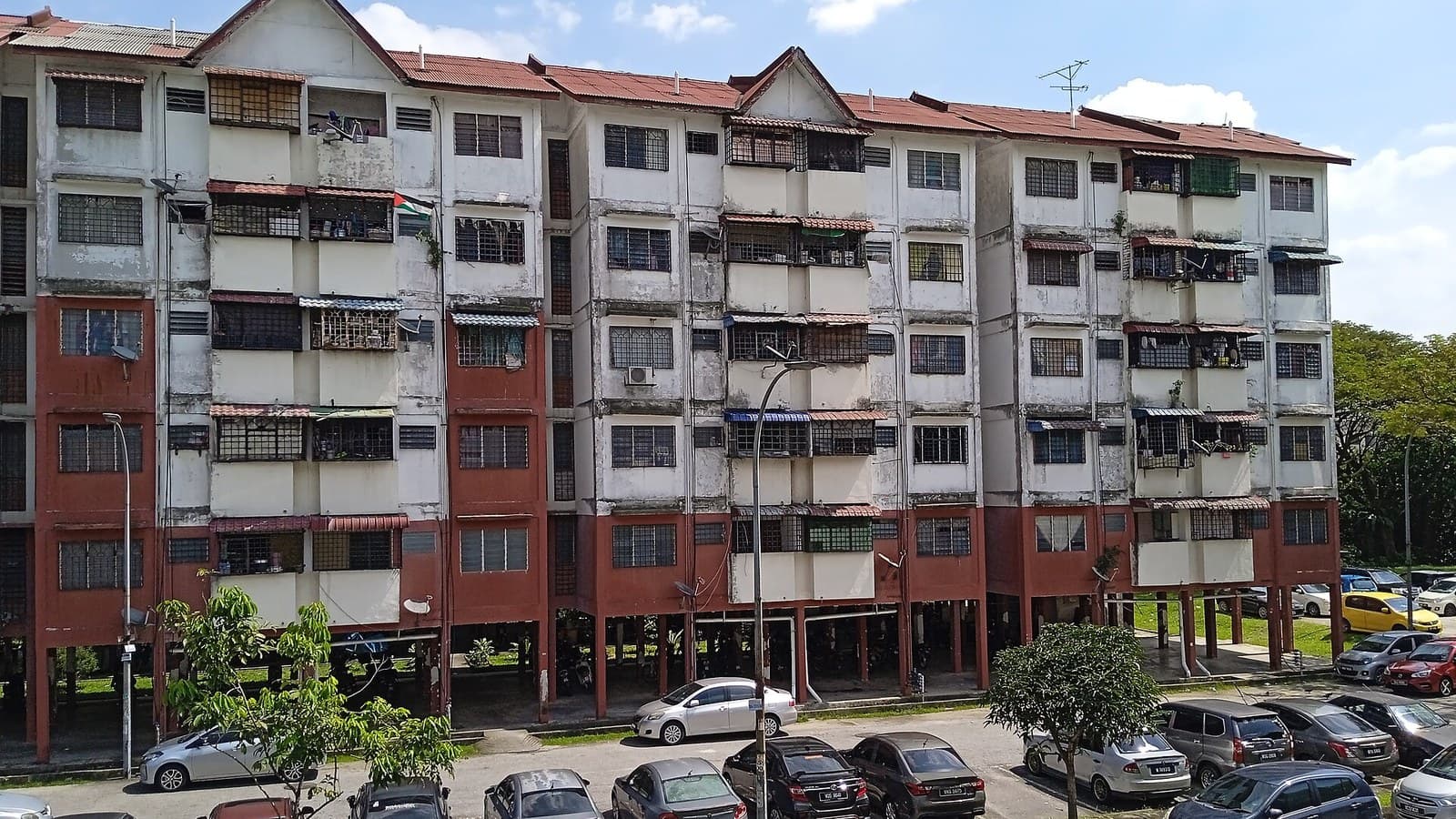
*Cover image: Tanjung 7 Apartment, Kota Damansara, by Wiki Farazi, CC0, via Wikimedia Commons.*