> Quick take: an ordinary number on JPJeBid starts at RM300, but every number you bid on costs a non-refundable RM10, the bid is final the moment it goes through, and you have 12 months to put the plate on a car. The multi-million headlines are about the top five or six numbers in a special series; everyone else is bidding in the hundreds.
The rules below come from the Road Transport Department's own JPJeBid FAQ at jpjebid.jpj.gov.my, read on 23 September 2026. The results of the H series come from Transport Minister Anthony Loke's statement of 21 September, as reported by Media Selangor and Utusan Malaysia.
What just happened with the H series
JPJ opened bidding for the special H series (Nombor Pendaftaran Istimewa Siri "H") to mark Malaysia Day 2026. It ran on JPJeBid from 16 to 20 September. In his statement, Loke said the series collected RM91.21 million: RM89.27 million in winning bids and RM1.94 million in service fees. 34,664 bidders took part and 8,223 numbers were bid for.
The top six numbers were H 1 at RM10.78 million, H 9 at RM4.97 million, H 3 at RM4.21 million, H 5 at RM4.01 million, H 8 at RM4 million and H 6 at RM3.38 million. The most contested were not the expensive ones: H 1001 and H 100 drew 37 bidders each, H 1805 drew 36, and H 1777 and H 4818 drew 32 each.
Utusan reported Loke as saying half the money goes to the Federal Government's Consolidated Revenue Account and half to people-focused Transport Ministry initiatives, with taxi drivers named as beneficiaries because the H prefix was historically used on taxi plates. He said there would be good news for taxi drivers the following week, without giving details.
A quick sum shows where most people's money went. At RM10 per number bid, RM1.94 million in fees means roughly 194,000 number bids were placed. With 8,223 numbers on offer, the great majority of those RM10 fees were paid by people who did not win. That is our arithmetic, not a JPJ figure, but it is the most useful number here for an ordinary bidder.
Who can bid, and the step most people miss
JPJeBid is open to Malaysian citizens and permanent residents aged 18 and above, and to registered businesses and companies. The catch is that you must already have a record in JPJ's MySIKAP system. If you have never owned a vehicle or done a transaction with JPJ, you first register at a JPJ state or branch office (not a UTC) with a copy of your MyKad. After signing up online, you must click the verification link in your email within 30 minutes, and JPJ recommends a Gmail or Yahoo address.
The five price categories
Every number in a series is assigned to a category, and the bidding page shows which. JPJ's FAQ sets these minimums and top-up steps:
- Nombor Bernilai Utama: minimum RM20,000; each top-up at least RM1,000, rising to RM2,000 in the last 30 minutes.
- Nombor Premium: minimum RM5,000; top-ups RM250, then RM500.
- Nombor Menarik: minimum RM2,500; top-ups RM125, then RM250.
- Nombor Popular: minimum RM500; top-ups RM25, then RM50.
- Nombor Biasa: minimum RM300; top-ups RM15, then RM30.
The step is 5% of the minimum for most of the auction and 10% in the final 30 minutes, with no ceiling. The same RM300 to RM20,000 ladder was used for the FH series in February, according to RTM's report of 30 January.
How a bid is placed and paid
There is no deposit. Instead, your first bid must be at least the category minimum, charged to a credit or debit card issued by a Malaysian bank. You can use more than one card for top-ups. Each series runs for 5 days and closes at 10pm on day five, though JPJ says it can change the period.
Two rules catch people out:
- A bid only counts once the card payment completes inside the bidding period. JPJ's FAQ says the time that matters is when the transaction succeeds, not when you pressed the button, and advises against last-minute bidding.
- You cannot withdraw or cancel a bid. Not a top-up, not a first bid.
Results come within 24 hours of closing, by email and in your JPJeBid inbox. If you win, the full amount is taken from your card straight away. If you lose, the bank reverses the hold, which JPJ says takes 7 to 30 working days depending on the card issuer. The RM10 fee stays with the government either way.
There is also a limit on winning, not on bidding. An individual can win at most 3 numbers per series; a company, society or government body can win 5.
After you win: 12 months and no extensions
Bring a printout of the winning result email and a copy of your MyKad to any JPJ office except a UTC, and register the number to a vehicle within 12 months of the offer letter. JPJ allows no extension. If you miss the deadline, or decide you do not want the number, it is withdrawn and nothing is refunded.
A few more rules from the FAQ:
- A number won by an individual can be registered in the name of immediate family only: a parent, spouse, sibling or child. Company-won numbers cannot change name.
- You can name a second nominee in the winning letter, who takes the number only if the winner dies.
- KV numbers must be registered at JPJ Langkawi, and L numbers at JPJ Labuan, because both are duty-free island series.
- Numbers starting with EV can only go on a fully electric vehicle, and a winning EV bid cannot be cancelled or moved to a petrol car.
Is it worth it?
That is a personal call, and this is not financial advice. What the rules make clear is where the risk sits. The minimum for an ordinary number is RM300, but each attempt costs RM10 you will not see again, a winning bid is final, and the plate is worth nothing to you if no car is ready within a year. If you just want a vehicle on the road, you do not need to bid at all: it simply takes the next number in the running series when it is registered.
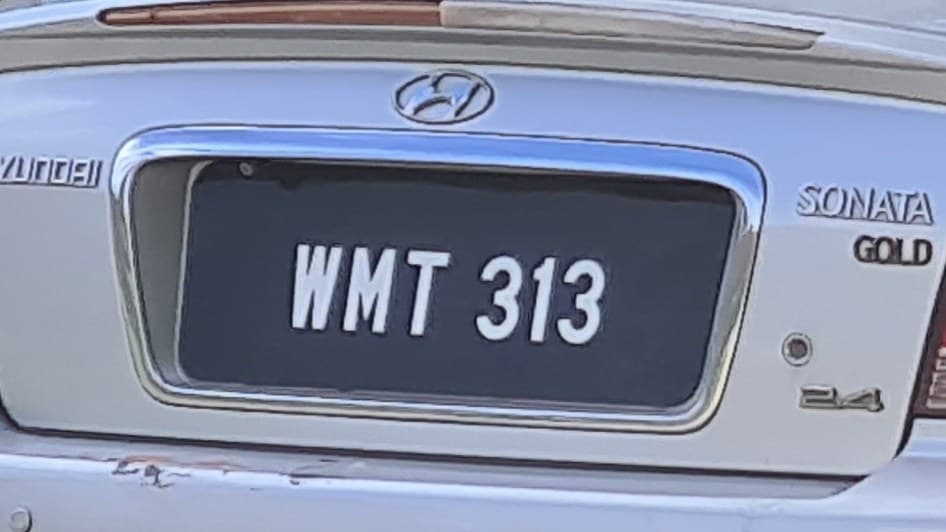
*Cover image: a Kuala Lumpur registration plate on a Hyundai Sonata, Wikimedia Commons, Jolt737, CC BY-SA 4.0*