For four years, electric cars in Malaysia paid no road tax. That ended on 31 December 2025, and every EV renewing since then pays under a new structure based on motor power. The rates are low compared with the old EV table, but they are not all RM20, and a search today returns calculators and articles with figures that do not match JPJ's own document.
This explainer is built on the primary source: the Road Transport Department's circular Surat Pekeliling Bahagian Pelesenan Kenderaan Bil. 01/2026, dated 1 April 2026, whose attachment sets out the road tax (LKM) rates for zero-emission vehicles in the Peninsula, Sabah and Sarawak. We also used Transport Minister Anthony Loke's announcement of the structure as reported by BERNAMA on 4 June 2024, JPJ's MyJPJ renewal FAQ and JPJ's 2026 list of compoundable offences. Motor outputs come from each manufacturer's Malaysian brochure or specification page.
How the new rate works
The rate applies to battery electric and fuel-cell vehicles only, which is what Loke announced in 2024. Hybrids keep an engine and there is nothing in the EV circular that moves them, so they stay on the familiar cc table. One schedule covers saloons and non-saloons, cars owned by individuals and companies, and private e-hailing cars.
Instead of a base rate plus a charge per watt, the table sets a flat fee for each 10,000 W (10 kW) block of motor power:
- Up to 50 kW: RM20.
- 50 to 100 kW: from RM30, rising RM10 per 10 kW block, to RM70.
- 100 to 210 kW: from RM80, rising RM20 per block, to RM280.
- 210 to 310 kW: from RM305, rising RM30 per block, to RM575.
- 310 to 410 kW: from RM615, rising RM50 per block, to RM1,065.
- Above that the step keeps growing, to RM14,415 for 1,000 to 1,010 kW and a flat RM20,000 beyond 1,010 kW.
To find your rate, take the motor output on your registration card or brochure and see which 10 kW block it falls in. A 150 kW car sits in the 140,001 to 150,000 W block and pays RM160. At 150.5 kW it would move into the next block and pay RM180.
What popular EVs pay
Worked from the JPJ table and each maker's published motor output:
- Proton e.MAS 5 Prime (58 kW) RM30, Premium (85 kW) RM60.
- BYD Dolphin Dynamic (70 kW) RM40, Premium (150 kW) RM160.
- BYD Atto 2 (130 kW) and MG4 Standard (125 kW) RM120.
- Perodua QV-E (150 kW), Chery Omoda E5 (150 kW) and BYD Atto 3 Ultra (150 kW) RM160.
- Proton e.MAS 7, all variants (160 kW), RM180.
- BYD Sealion 7 Dynamic (170 kW) RM200.
- Tesla Model 3 RWD (208 kW) RM280, Model Y RWD (220 kW) RM305. These two outputs are from the ministry's 2024 briefing slide, because Tesla Malaysia does not list kW.
- BYD Seal Premium and Sealion 7 Premium (230 kW) RM335.
- BYD Seal Performance and Sealion 7 Performance (390 kW) RM965.
For comparison, JPJ's petrol table charges an individually owned 1.5-litre saloon RM90 in the Peninsula and a 2.0-litre saloon (1,998cc) RM379. So a small EV is now in the same range as a small petrol car, while a dual-motor performance EV pays more than a 2.0-litre.
Sabah, Sarawak, Langkawi and Labuan
The circular's heading covers the Peninsula, Sabah and Sarawak together, so an EV in Kuching or Kota Kinabalu pays exactly the same as one in KL. That is a change from petrol cars, where the Sabah and Sarawak table is cheaper. Paragraph 12 of the circular halves the rate for vehicles registered and used in Langkawi and Labuan. Pangkor and Tioman are not mentioned in the EV circular.
No discount year
Nothing in the circular phases the rate in for private cars. Some calculators and blogs mention a MyJPJ digital rebate or percentage discounts in 2026; we found no JPJ document supporting either.
Renewing, and the page to ignore
Renewal works as for any car. JPJ's MyJPJ FAQ says you can renew when the current road tax has less than two months left, you hold valid insurance, and the vehicle is not blocked. Channels include the MyJPJ app (individual citizen owners, local debit or credit card), JPJ counters and kiosks, Pos Malaysia and MyEG, and JPJ says the fee is the same everywhere. The digital road tax in MyJPJ has been accepted since February 2023, so there is no disc to display.
One warning. When we checked on 15 September 2026, JPJ's English rate calculation guide page still linked the 2022 electric vehicle guideline, a base-plus-progressive table from the exemption years. Use the 2026 circular or the fee MyJPJ shows at checkout, not that PDF.
What an expired road tax costs
Driving with expired road tax is an offence under section 23(1) of the Road Transport Act 1987, with a fine of up to RM2,000. JPJ's 2026 offence list sets the compound for a private vehicle with valid insurance at RM150 if paid within 15 days, RM200 within 30 days and RM300 within 60 days. Having no road tax at all under section 15(1) is not compoundable and goes to court.
Related reads
- Renewing road tax and your driving licence online: the step-by-step for MyJPJ.
- Car loans after the Hire-Purchase (Amendment) Act 2026: what financing an EV now costs.
- Car rental in Kota Kinabalu: for Sabah drivers comparing costs.
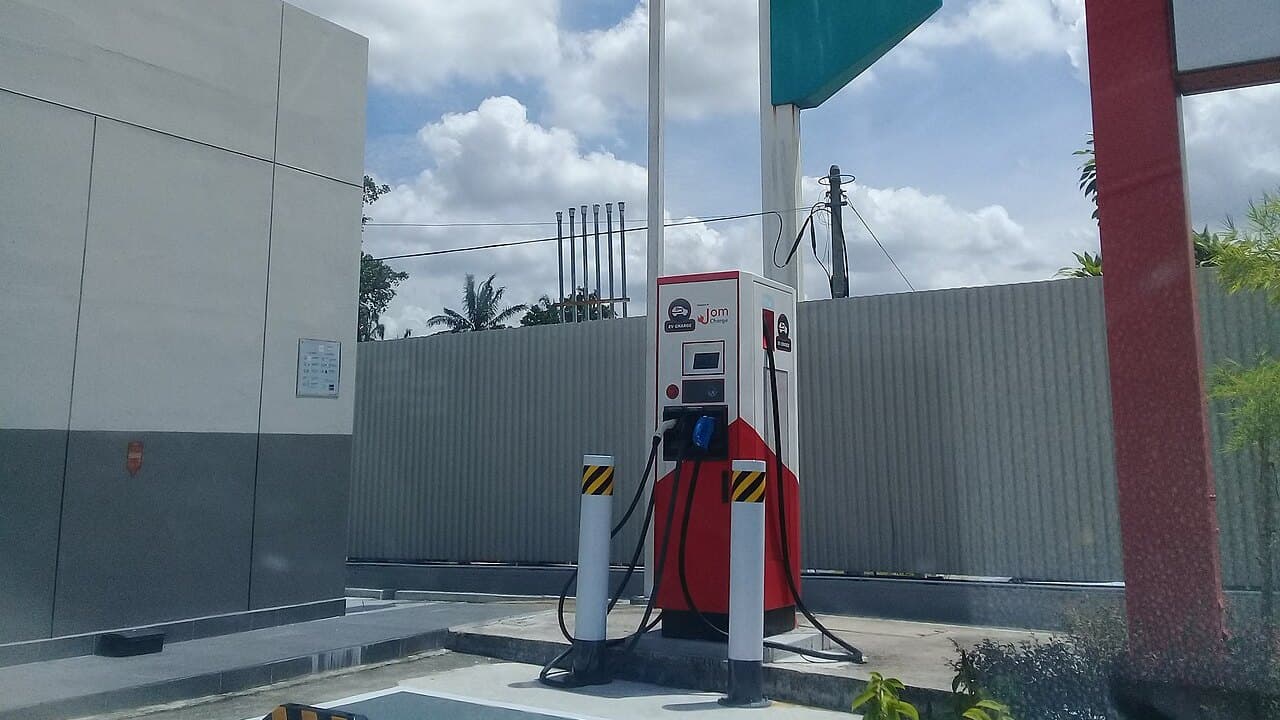
*Cover image: JomCharge EV charger at Ayer Keroh R&R, Melaka, by Wiki Farazi, CC0, via Wikimedia Commons*
*Sources: JPJ Surat Pekeliling Bahagian Pelesenan Kenderaan Bil. 01/2026 (1 April 2026) and its ZEV rate attachment; JPJ LKM calculation guideline (petrol and diesel); JPJ MyJPJ e-LKM FAQ; JPJ Senarai Kesalahan 2026; Road Transport Act 1987; BERNAMA, 4 June 2024; manufacturer specification pages. All read on 15 September 2026.*