Adopting a child in Malaysia is not one process but two, and which one you use decides your child's birth certificate, inheritance rights and even whether you need a lawyer. The rules are spread across two 1952 Acts, the Child Act 2001 and the forms of two government departments. This guide puts them in one place. It is a factual summary, not legal advice.
There is also a reason to read up now. On 15 October 2026 the Deputy Home Minister tabled the Adoption (Amendment) Bill 2026 for its first reading in the Dewan Rakyat. NST reported on 9 November that it is among the bills lined up for debate from 30 November.
Route 1: a court order under Act 257 (non-Muslims)
The Adoption Act 1952 does not apply to anyone who professes Islam, or to a Muslim child. Under it, a High Court or Sessions Court makes an adoption order after a private hearing. The main conditions:
- The child must be under 21 and never married. This is the age the 2026 bill would cut to 18.
- The adopter must be at least 25 and at least 21 years older than the child, unless the court finds special circumstances. A relative of the child needs only to be 21. A single man cannot adopt a girl except in special circumstances.
- Care and notice: the child must have been in your continuous care for at least three months immediately before the order. You must also give the state JKM office written notice at least three months before the order is made.
- Consent: every parent or guardian must consent, and so must your spouse if you apply alone. The court can dispense with consent if a parent abandoned or ill-treated the child, cannot be found, or unreasonably refuses.
- Welfare check: the court appoints a guardian ad litem, usually a JKM officer, to investigate your circumstances and confirm no money changed hands.
JPN's page says you apply through a law firm or the Legal Aid Department. After the order, the lawyer files form JPN.AA04 at JPN headquarters in Putrajaya with the original order and birth certificate. The fee is RM5. JPN then issues a new birth certificate. Section 25A of the Act bars the words "adopted" or "adoptive" from appearing on it, and the Act says the new certificate replaces the old one for all purposes.
Route 2: JPN registration under Act 253 (anyone)
The Registration of Adoptions Act 1952 covers Muslims and non-Muslims. It does not create an adoption in court. It records one that has already existed in fact. JPN's de facto adoption page sets out the requirements:
- The child must be under 18, never married, and must have lived with you continuously for at least two years. JPN's FAQ says the Registrar cannot shorten this.
- The adopter must be at least 25 and 18 years older than the child. Siblings, uncles and aunts need only be 21. At least one adoptive parent must be a citizen or permanent resident.
- Forms: JPN.AA01, a statutory declaration of the birth parents' consent (JPN.AA07), and Borang 13 from JKM. The child must attend the interview with the Registrar of Adoptions at the district JPN office.
- Fee: RM30, paid only after the application is approved.
The child then receives an Adoption Certificate, not a new birth certificate. JPN's FAQ says it has the same standing for school, MyKad and passport applications. JPN's FAQ also says a Muslim child cannot be adopted by non-Muslim parents. A child registered under Act 253 can later be adopted under Act 257, but not the other way round.
Where most people start: JKM's foster list
If you have no particular child in mind, the route runs through the Social Welfare Department. JKM's foster-parent page lists these requirements: one applicant at least 25 and 18 years older than the child, married at least five years if married (shorter marriages can be considered in some cases), single applicants considered, enough income, good health and a safe home. You apply online through JKM's Sistem ANAK or at a district welfare office, then go through an interview and a home visit. Approved families stay on the list for two years, with a one-year extension.
A placed child is fostered under the Child Act for two years. After that you can apply under either Act. Expect to wait. Kosmo reported in March 2024, quoting JKM's child development division, that 684 families were considered from 2021 to 2023, while 53 children were offered for fostering and 20 were placed.
Inheritance and other effects
Under section 9 of Act 257, an adopted child inherits on intestacy as if born to the adopter in marriage. Act 253 has no equivalent provision, so parents using it should make a will. For Muslims, the Federal Territories Mufti's office has ruled that an adopted child does not inherit under faraid, but can receive property by hibah (gift) or wasiat (bequest), which is generally limited to one-third of the estate.
JPN's FAQ is also clear that adoption does not decide a child's citizenship, which is handled separately.
What is illegal
Adopting without registering breaks no law, JPN's FAQ says, but the adoption then has no legal recognition. Paying or receiving money for a child is a crime under section 48 of the Child Act 2001, punishable by a fine of up to RM50,000, up to 20 years' jail, or both. Section 26 of Act 257 also bans advertising that you want to give up or adopt a child, and bans anyone other than JKM's Director-General from arranging adoptions.
The 2026 bill
According to Bernama, the bill would lower the Act 257 age limit from 21 to 18. That would match the Child Act, the Age of Majority Act, the voting age and the citizenship amendment in Act A1752. Bernama said it proposes other changes too, but these had not been reported as of 19 November. In November 2025 the Home Ministry said both Acts were under review after a paedophile ring was found to have used the adoption system. No amendment to Act 253 has been tabled yet.
*Sources: Adoption Act 1952 (Act 257) and Registration of Adoptions Act 1952 (Act 253), reprints hosted by the Home Ministry; Child Act 2001 (Act 611), 2023 reprint; JPN's adoption service pages and adoption FAQ; JKM's foster-parent application page (jkm.gov.my did not load for us on 19 November; read from its archived copy) and Sistem ANAK; Federal Territories Mufti, Al-Kafi #1671; Bernama, 15 October 2026; NST, 9 November 2026; FMT, 12 November 2025; Kosmo, 26 March 2024.*
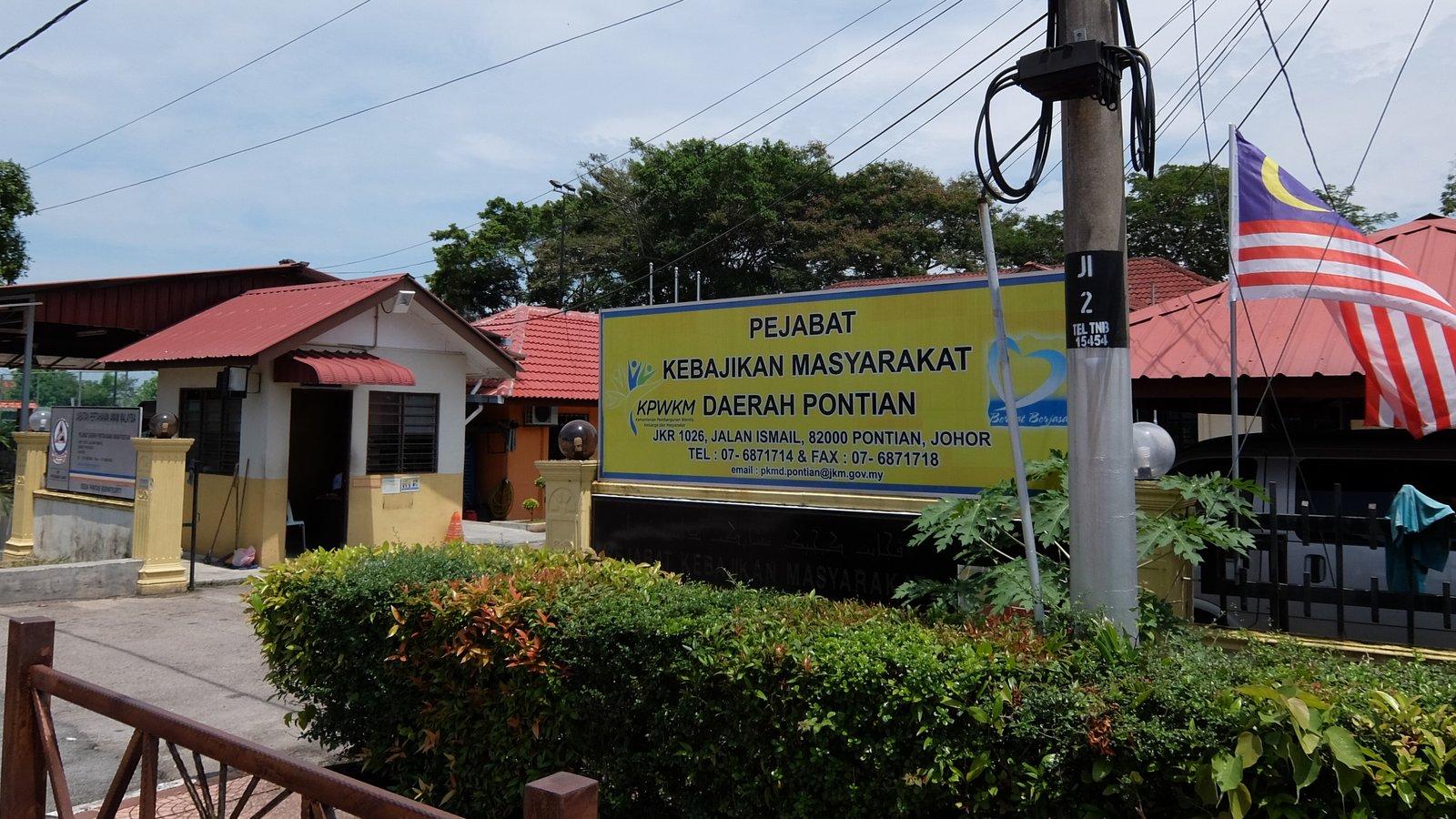
*Cover image: Pontian district social welfare office, Johor, by Chongkian (Wikimedia Commons, CC BY-SA 4.0).*