Malaysia has had a legal minimum wage since 2013, and on 9 October 2026 the Budget 2027 speech announced the next step: RM2,000 a month from June 2027. Headlines stopped there. For a worker or a small employer the more useful questions are what the law requires today, what exactly changes next June, and which businesses the new exemption lets off.
This explainer is built from three primary documents: the Minimum Wages Order 2024 as gazetted on 4 December 2024, the National Wages Consultative Council Act 2011 (Act 732) that it is made under, and the Ministry of Finance's text of the Budget 2027 speech.
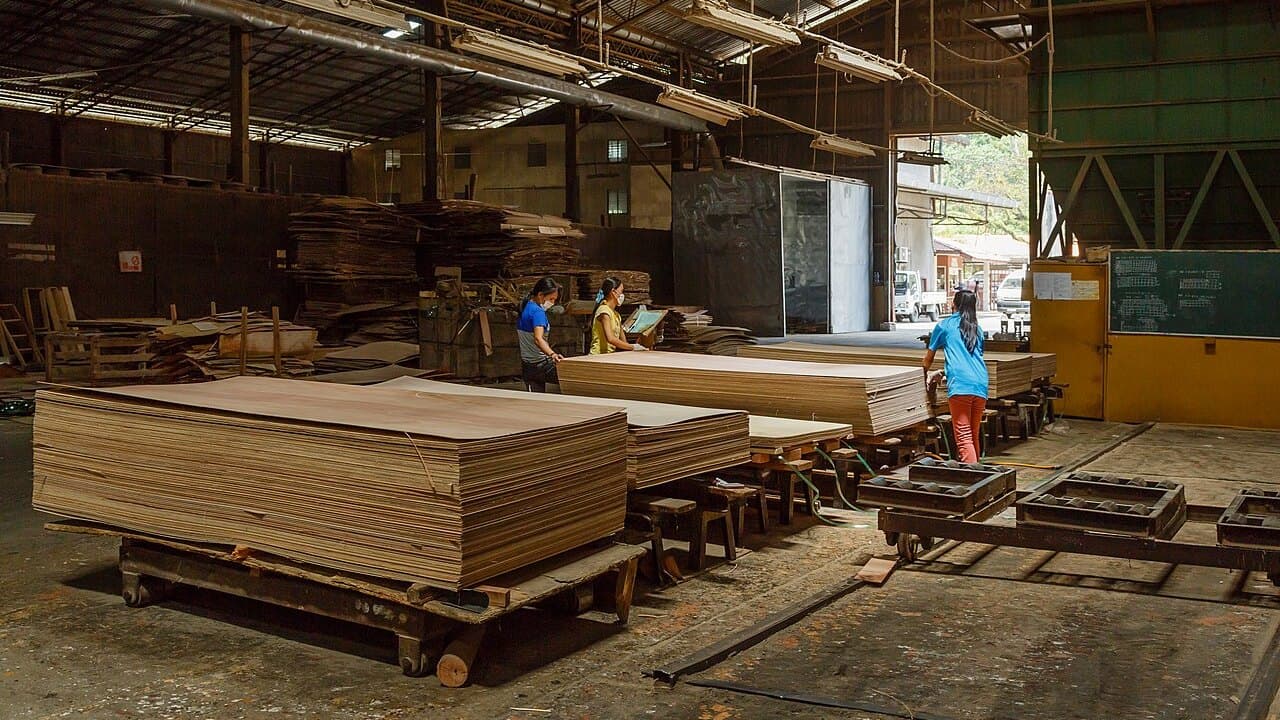
*Cover image: CEphoto, Uwe Aranas / Wikimedia Commons (CC BY-SA 3.0), workers at a plywood factory in Sandakan, Sabah.*
The rate today: RM1,700 for everyone
The 2024 Order took effect in two stages. From 1 February 2025, employers with five or more workers, and any employer in a professional activity classified under MASCO regardless of headcount, had to pay RM1,700. Employers with fewer than five workers were allowed to stay at RM1,500 until 31 July 2025. Since 1 August 2025 the same RM1,700 has applied to all of them.
The Order also fixes daily and hourly equivalents, so a worker who is not paid monthly is still covered:
- Monthly: RM1,700
- Daily, 6-day week: RM65.38
- Daily, 5-day week: RM78.46
- Daily, 4-day week: RM98.08
- Hourly: RM8.72
Workers paid only by piece rate, tonnage, task, trip or commission, with no basic wage, must still end the month with at least RM1,700 (paragraph 5(2)).
One group is outside the Order entirely. Paragraph 2 says it does not apply to domestic servants as defined in the Employment Act 1955 and the Sabah and Sarawak Labour Ordinances, so live-in helpers are not covered by the national rate.
What counts toward the minimum
The test is your basic wage. Section 43 of Act 732 makes it an offence to fail to pay "the basic wages as specified in the minimum wages order", and section 24 says any contract with a lower basic wage is automatically read up to the minimum. In practice, a payslip showing RM1,500 basic plus a RM200 attendance allowance does not meet a RM1,700 minimum. Overtime, allowances and bonuses sit on top of the floor, not inside it.
Because overtime is calculated from your pay, the floor also sets minimum overtime. For a monthly worker on an 8-hour day, RM1,700 ÷ 26 ÷ 8 is about RM8.17 an hour, so weekday overtime at 1.5 times is at least about RM12.26 an hour. At RM2,000 the same formula gives about RM9.62 and RM14.42. Those are our calculations using the Employment Act formula covered in our overtime guide.
What Budget 2027 announced
Paragraph 32 of the speech, under the heading "Upah Bermaruah Untuk Rakyat", says the government agreed to raise the minimum wage from RM1,700 to RM2,000, effective from June 2027. It then says MSMEs with sales below RM50 million are exempted to give them room to adjust their business models, and that more than 4 million workers will be subject to the new rate.
The same paragraph announces a separate RM2,500 a month minimum for semi-skilled and graduate jobs "as a start", and welcomes government-linked companies raising their own living-wage benchmark from RM3,100 to RM3,400 (about 230,000 workers). Paragraph 33 adds that non-SME companies will only get a tax deduction for salaries paid through bank accounts.
The exemption did not appear out of nowhere. On 30 September 2026, Entrepreneur Development and Cooperatives Minister Steven Sim said the Cabinet had agreed to exempt MSMEs from the new increase "for the time being", and that wages there would be lifted through other routes such as subsidies under the Progressive Wage Policy (as reported by Bernama).
If the June 2027 rate follows the same formula as the 2024 Order (which is how RM1,700 becomes RM8.72), the figures would be:
- Monthly: RM2,000
- Daily, 6-day week: about RM76.92
- Daily, 5-day week: about RM92.31
- Daily, 4-day week: about RM115.38
- Hourly: about RM10.26
These are our projections, not gazetted numbers. EPF moves with it: at RM2,000 the 11% employee share is RM220 (RM33 more than at RM1,700) and the 13% employer share is RM260 (RM39 more).
What is still unknown
Nothing announced in a Budget speech changes your pay by itself. Under section 23 of Act 732, a new rate needs a minimum wages order published in the Gazette. The 2024 Order was gazetted on 4 December 2024, about two months before its first stage began. As of 14 October 2026, no 2027 Order has been published, which leaves four open questions:
- Which sales figure counts. The speech says "hasil jualan di bawah 50 juta ringgit" without saying annual or over what period. It also differs from SME Corp Malaysia's usual definition, which sets RM50 million for manufacturing but RM20 million for services, with headcount limits too.
- What exempt firms must pay. The most likely reading is that they stay at RM1,700, but the speech does not say it.
- How long the exemption lasts. Neither the speech nor the 30 September statement gives an end date.
- The exact start day in June 2027.
Until the Order is out, a worker at a small firm should not assume RM2,000 next June, and an employer near the threshold should not assume the exemption fits it.
If your employer pays less than the minimum
Under section 43, failing to pay the minimum basic wage carries a fine of up to RM10,000 for each employee. A repeat offence can mean up to RM20,000 or five years' jail (section 47), and after conviction the court can order the employer to pay the shortfall plus any payments calculated from it (section 44).
Keep your payslips, bank statements and any written offer letter, then lodge a complaint with the Department of Labour (JTKSM) in Peninsular Malaysia and Labuan, or JTK Sabah or JTK Sarawak in East Malaysia. For a wider wage dispute, the Labour Department can also hear a claim without a court case (section 69 of the Employment Act in Peninsular Malaysia and Labuan).
Related reads
- Overtime pay in Malaysia: the formula and the RM4,000 cut-off
- Budget 2027 income tax changes
- Resigning or retrenched: notice periods and final pay
- EPF Akaun Fleksibel withdrawals
*Sources: Minimum Wages Order 2024 [P.U. (A) 376/2024], gazetted 4 December 2024, paragraphs 1-5; National Wages Consultative Council Act 2011 (Act 732), sections 23, 24, 25, 43, 44 and 47 (JTKSM copy); Ministry of Finance, Ucapan Belanjawan 2027 (9 October 2026), paragraphs 32-33, and the Budget 2027 touchpoint summary, read on belanjawan.mof.gov.my on 14 October 2026; Bernama and The Star, 30 September 2026. Projected June 2027 daily, hourly and overtime figures are our own calculations. This is a factual explainer, not legal advice.*