Prime Minister and Finance Minister Anwar Ibrahim tabled Budget 2027 in the Dewan Rakyat on Friday, 9 October 2026. For salaried households, the part that changes your own numbers sits in the Finance Ministry's tax-measures annex, *Langkah Cukai Belanjawan 2027*, published the same afternoon. We read it line by line. Appendices 1 to 9 cover individuals, and every one of them takes effect from the year of assessment 2027.
That date matters more than any rate. The year of assessment 2027 covers income you earn from 1 January to 31 December 2027, and you claim it in the return due in 2028. The return you file next year, for 2026 income, still uses the old rates and the relief list we covered in our guide to the reliefs new for 2026.
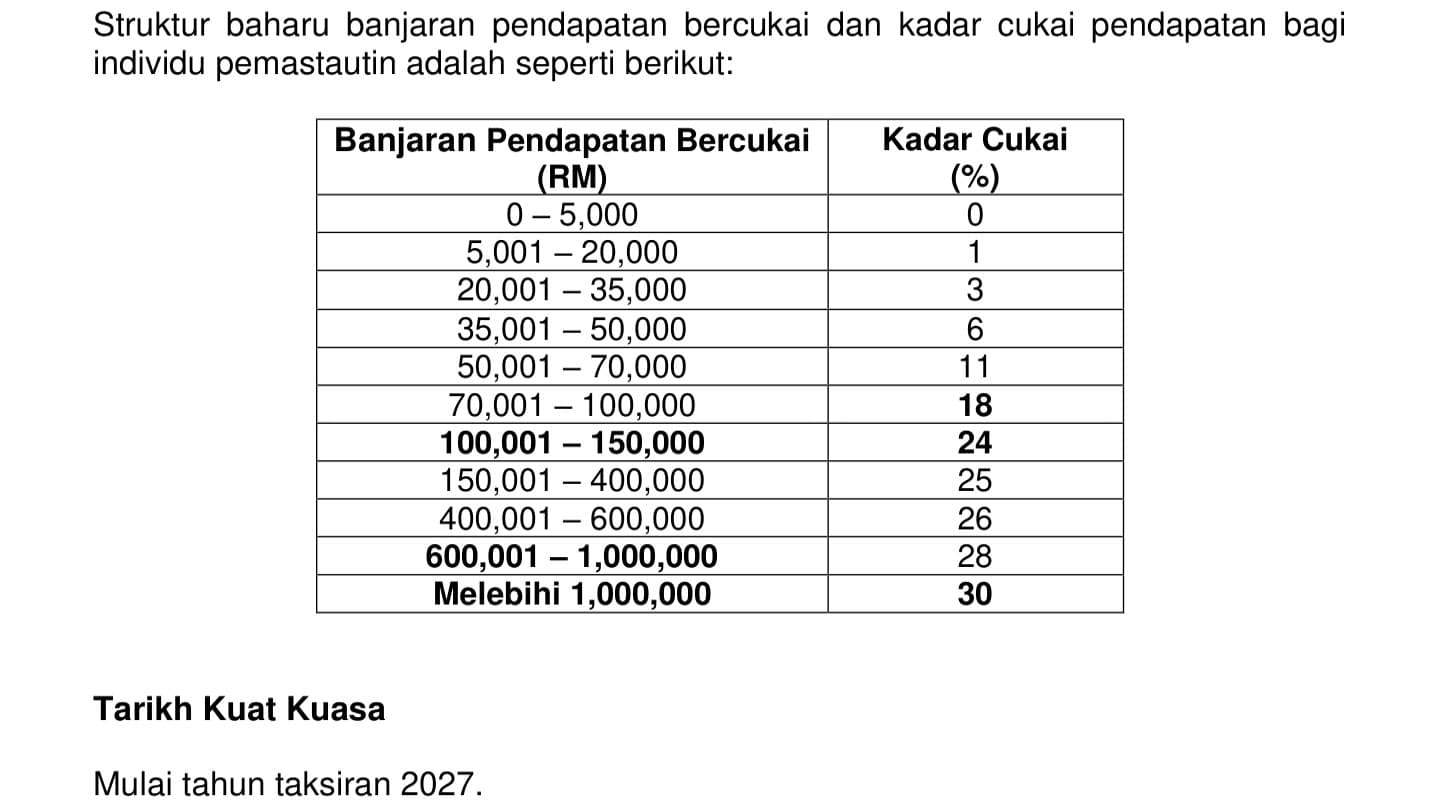
*Image: Finance Ministry, Langkah Cukai Belanjawan 2027, Appendix 1, the new resident tax table.*
The new rate table
Appendix 1 restructures the resident individual scale. The first five bands are untouched. The changes:
- RM70,001-RM100,000: 19% becomes 18%.
- RM100,001-RM150,000: a new band at 24%. Until now everything from RM100,001 to RM400,000 paid 25%.
- RM150,001-RM400,000: stays at 25%. RM400,001-RM600,000 stays at 26%.
- RM600,001-RM1,000,000: stays at 28%, but the band now stops at RM1 million instead of RM2 million.
- Above RM1,000,000: 30%. Previously 30% applied only above RM2 million.
The full scale from 2027 reads: 0% to RM5,000, 1% to RM20,000, 3% to RM35,000, 6% to RM50,000, 11% to RM70,000, 18% to RM100,000, 24% to RM150,000, 25% to RM400,000, 26% to RM600,000, 28% to RM1 million, and 30% above.
Two consequences follow. If your chargeable income is RM70,000 or less, the rate cut gives you nothing; only the bigger personal relief helps. And the rate cut is worth at most RM800 a year (RM300 on the 18% band plus RM500 on the 24% band), reached once chargeable income passes RM150,000.
RM12,000 personal relief, the first rise since 2010
Appendix 2 raises the relief for the individual and dependent relatives from RM9,000 to RM12,000. It has been RM9,000 since the year of assessment 2010. Everyone who files gets it automatically, so an extra RM3,000 comes off every taxpayer's chargeable income. At an 11% marginal rate that is RM330; at 24% it is RM720.
What five salaries save
Our assumptions: single, salary only, the RM12,000 or RM9,000 personal relief plus RM4,000 of EPF relief, and the RM400 rebate that applies when chargeable income is RM35,000 or less. Your other reliefs will lower both figures, so treat these as a guide to the size of the change, not your bill.
- RM4,000 a month (RM48,000 a year): tax falls from RM200 to RM110, a saving of RM90.
- RM6,000 a month (RM72,000): RM2,490 to RM2,160, saving RM330.
- RM100,000 a year: RM6,930 to RM6,220, saving RM710.
- RM10,000 a month (RM120,000): RM11,150 to RM10,060, saving RM1,090.
- RM15,000 a month (RM180,000): RM26,150 to RM24,600, saving RM1,550. Higher salaries save the same RM1,550 until income reaches the RM1 million line.
In the speech, the Finance Ministry put the combined effect at up to RM1,600 of extra disposable income for about 5 million taxpayers.
Who pays more: chargeable income above RM1 million. On the slice between RM1 million and RM2 million, the rate rises from 28% to 30%, which is up to RM20,000 more a year on that slice.
The reliefs that get wider
The caps on these reliefs stay the same; what you can put inside them grows.
- Parents and grandparents (cap RM8,000). Appendix 3 extends care at home, in day care or in residential care to *all* care costs, not just health care. A doctor registered with the Malaysian Medical Council no longer has to certify that care is needed. You need a written statement from the caregiver (not yourself, your spouse or your child) or a copy of the caregiver's work permit, plus receipts.
- Medical, renamed Health Wellbeing (cap RM10,000). Appendix 4 adds postnatal care from a care centre or any qualified individual, up to RM3,000. Breastfeeding equipment for a child aged two or under (up to RM1,000) moves inside this relief and can be paid by either parent.
- Education fees, renamed Education and Skills Training (cap RM7,000). Appendix 5: your own recognised certificate, diploma, degree, master's or PhD in any field; TVET upskilling for yourself or your spouse up to RM3,000; and up to RM2,000 for non-work hobby, language or religious classes for you or your spouse, or for a child's STEM, arts, language or religious classes and tuition.
- Lifestyle (cap RM2,500). Appendix 6 adds subscriptions to AI software and apps for you, your spouse or child, the cost of adopting a pet from a registered shelter, and a registered vet's vaccination and neutering fees.
- Sports (cap RM1,000). Appendix 7 adds sports shoes, up to RM300.
- Tourism entrance fees (RM1,000). Appendix 8 keeps the Visit Malaysia relief for museums, zoos, theme parks, national and marine parks, geoparks and cultural shows for one more year, YA2027 only.
- SOCSO (RM350, plus a new RM150). Appendix 9 brings compulsory LINDUNG KENDIRI contributions in the three mandatory sectors (passenger transport, goods or food transport, and hawkers) inside the RM350 relief, and adds up to RM150 more for voluntary LINDUNG 24 cover and the 17 non-mandatory LINDUNG KENDIRI sectors.
The practical step is the same as for 2026: from January 2027, keep the receipts. Tuition, confinement nanny, pet adoption and AI subscription costs are exactly the kind most households throw away.
What is not settled yet
These are proposals. Tax measures become law only when Parliament passes the Finance Bill that follows the Budget; last year's became the Finance Act 2025, gazetted on 31 December 2025. As of 10 October, LHDN has not published the 2027 monthly tax deduction (PCB) schedule, so we cannot yet say whether payslips reflect the new rates from January or the saving arrives as a refund in 2028.
The same speech raised the minimum wage from RM1,700 to RM2,000 a month from June 2027, with micro, small and medium enterprises with sales below RM50 million exempted for now, and announced a RM2,500 starting floor for semi-skilled and graduate jobs. We will cover those once the orders are gazetted.
Related reads
- The six tax reliefs new for 2026
- Budget 2027: what was already decided before 9 October
- Overtime pay under the Employment Act
- EPF Akaun Fleksibel withdrawals
*Sources: Ministry of Finance, Ucapan Belanjawan 2027 (9 October 2026), paragraphs 29-32; Langkah Cukai Belanjawan 2027, Appendices 1-9, read 10 October 2026 on belanjawan.mof.gov.my. Worked examples are our own calculations on the stated assumptions. This is a factual explainer, not tax advice.*