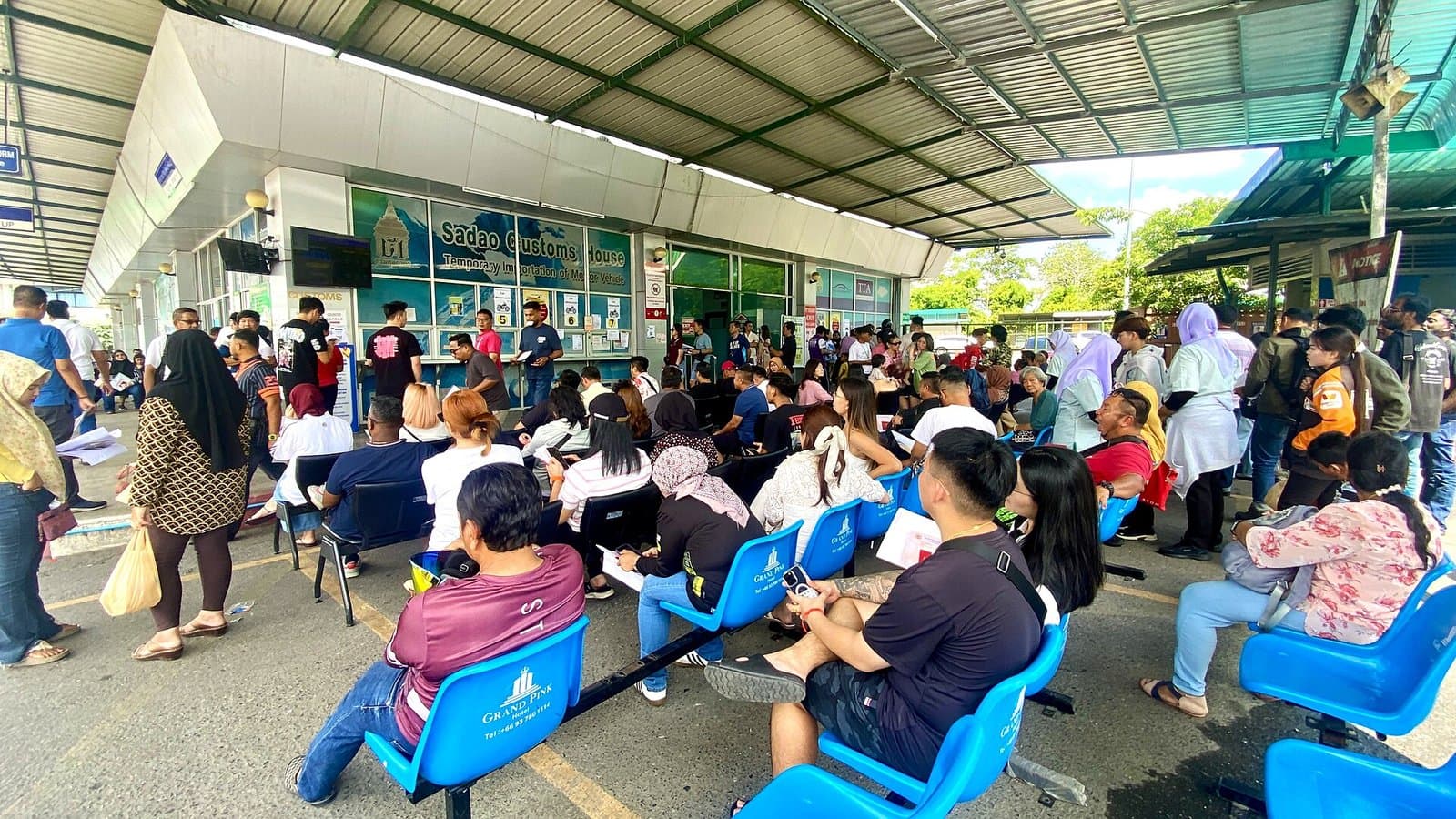
The year-end school break is when Malaysian cars pour north. Group A schools close from 4 December 2026 and Group B from 5 December, and both are off until 31 December. In December 2024 the queue at Bukit Kayu Hitam stretched over four days, and in September 2025 more than 500 cars were stranded at Sadao in what the NST called the worst congestion in the checkpoint's history.
If you are driving this year, two things are different from your last trip. Both matter more than the queue.
What changed in 2026
Your visa-free stay is now 30 days. Thailand's new visa exemption framework took effect on 15 September 2026, after it was published in the Royal Gazette on 31 August. Malaysia sits on the list of 60 countries and territories that get 30 days for tourism. It used to be 60. The Tourism Authority of Thailand's notice also sets a limit of two visa-free land entries a year for this group, but Malaysians, Bruneians, Indonesians and Singaporeans are exempt from that cap, so border-hopping families are not affected. Malaysia's ambassador in Bangkok advised anyone planning a longer stay to apply for an e-Visa before leaving.
Your car's clock follows yours. This is the part most people miss. The Thai Customs manual for temporary vehicle imports, updated in 2026 (B.E. 2569), allows a car in for up to one month per declaration, extendable a month at a time to six months, but never beyond the period Immigration lets the driver stay. With a 30-day stamp, that is 30 days.
Bukit Kayu Hitam has a new road. Since 6am on 11 July 2026, traffic from ICQS Bukit Kayu Hitam runs to the new Sadao customs and immigration complex, which has 11 vehicle lanes each way and 14 immigration counters on each side. The old Bukit Kayu Hitam to Danok crossing closed. One wrinkle: local Hat Yai media reported that from 22 July the counter for car declarations moved, temporarily, to the old Sadao checkpoint building at Danok. Follow the signs for foreign private vehicles once you clear immigration.
Step 1: Passports and a TDAC for everyone
Check that every passport is valid for the trip. Then fill in the Thailand Digital Arrival Card (TDAC), compulsory for all non-Thai arrivals by air, land or sea since 1 May 2025. The Royal Thai Embassy in Kuala Lumpur says it must be submitted online within the 3 days before you arrive, at tdac.immigration.go.th.
Every person in the car needs one, including children. The only exemptions are transit passengers who never pass immigration and holders of the border-resident Border Pass.
The TDAC is free. In March 2026 Thailand's Immigration Bureau said at least 10% of foreign arrivals had used fake TDAC websites, which charge a fee for the same form. If a site asks for payment, you are on the wrong one.
Step 2: Insurance, on both sides
Thai compulsory insurance (Por Ror Bor). A copy of this policy is on Thai Customs' document list for your car, so you need it before the declaration. Insurers sell it at the border, and some Malaysian brokers sell it in advance. Thailand's Office of Insurance Commission fixes one rate per vehicle type and charges foreign cars a short-term rate, but it does not publish a ringgit figure for Malaysian visitors, so we are not quoting one. Note that it is basic injury cover. It does not cover damage to your car.
Your Malaysian policy. The insurers' association PIAM has said a standard comprehensive policy does not automatically cover Thailand. An endorsement (commonly Endorsement 101) extends cover for 1 to 30 days, reported at about 0.2% of the sum insured. On a car insured for RM80,000, that works out to roughly RM160. Ask your insurer for the exact premium and make sure the dates cover your whole stay.
Step 3: The customs declaration for the car
At the Thai side you complete a simplified customs declaration for a temporarily imported vehicle. The Thai Customs manual says:
- Fee: none. Processing is listed at about 40 minutes in total.
- Bring: your passport and a copy, the original vehicle registration document (geran or VOC) and a copy, and a copy of the Thai compulsory insurance.
- Not your car? The driver needs the owner's original letter of authorisation with a 10-baht duty stamp and a signed copy of the owner's ID.
- Keep the form. You hand it back when the car leaves. You may exit at a different checkpoint as long as the car matches the declaration and is within its time limit.
- Extending? Do it before the declaration expires, at a customs house, with the car present.
- Overstaying: a fine of 1,000 baht a day, capped at 10,000 baht.
Malaysian cars do not need a separate Department of Land Transport permit, because Thailand waives it for countries it has road transport agreements with, Malaysia, Singapore and Laos among them. If your car is still under a hire-purchase loan, neither government publishes a rule requiring a bank letter, but your financier's contract may restrict taking the car abroad, so check before you go.
Step 4: Your licence
Malaysia and Thailand are both parties to the 1985 ASEAN Agreement on the Recognition of Domestic Driving Licences, so your Malaysian licence is recognised. Carry the physical licence card. JPJ has said the digital renewal slip in MyJPJ is not valid abroad, and our IDP guide records a Malaysian driver fined in Thailand in July for showing only the app. An International Driving Permit is not strictly needed, but rental firms and insurers sometimes ask for one; our IDP guide covers the RM150 JPJ fee and process.
Border hours on the Malaysian side
The Home Ministry gave these figures to the NST in October 2025: Bukit Kayu Hitam 6am to midnight, Padang Besar 6am to 10pm and Wang Kelian 8am to 7pm. For Kelantan, Thai media reported that from 15 March 2026 Rantau Panjang and Sungai Golok open at 6am and close at 9pm, and Bukit Bunga and Pengkalan Kubor close at 6pm, without saying whether those are Thai or Malaysian times. Thailand is one hour behind Malaysia. We could not find an official 2026 figure for Pengkalan Hulu to Betong or Durian Burung, so check locally before you plan a late crossing there.
One rumour to ignore
There is still no Thai entry fee for drivers. The 300-baht tourism fee plan announced in April 2026 applied to air arrivals only, and nothing on any fee had been published in the Royal Gazette when we checked on 21 October 2026.
*Sources: Royal Thai Embassy Kuala Lumpur (visa exemption list, status as of 31 August 2026; TDAC notice of 21 April 2025); Tourism Authority of Thailand newsroom (1 September 2026; 13 July 2026); Thai Customs Department manual on temporary import of cars and motorcycles (updated 2026); The Star (11 July and 10 September 2026); RTM (10 July 2026); NST (December 2024, September and October 2025); Khaosod English (29 March 2026); Hatyai Focus (19 July 2026); PIAM via carz.com.my (December 2025); NUS Centre for International Law ASEAN treaty database. Read 21 October 2026.*
Related reads
- Malaysia School Holidays 2026 and 2027
- International Driving Permit in Malaysia: JPJ fee and how to apply
- KTM's Hat Yai Executive Coach, if you would rather not drive
- Making a car insurance claim in Malaysia
*Cover image: Slleong, CC0, via Wikimedia Commons (Thai Customs hall at the Sadao checkpoint, July 2026).*