> Quick view: what happens to a non-Muslim Malaysian's estate when there is no will, read directly from Laws of Malaysia Act 300, the Distribution Act 1958, and from the State of Sabah's Intestate Succession Ordinance 1960 (Sabah No. 1 of 1960), both read on 9 September 2026. This is a factual explainer, not legal advice. Estates with property in more than one jurisdiction, or with a business in them, need a lawyer.
There is a sentence Malaysians say to each other at funerals, and it is wrong. "It will all go to your mother anyway."
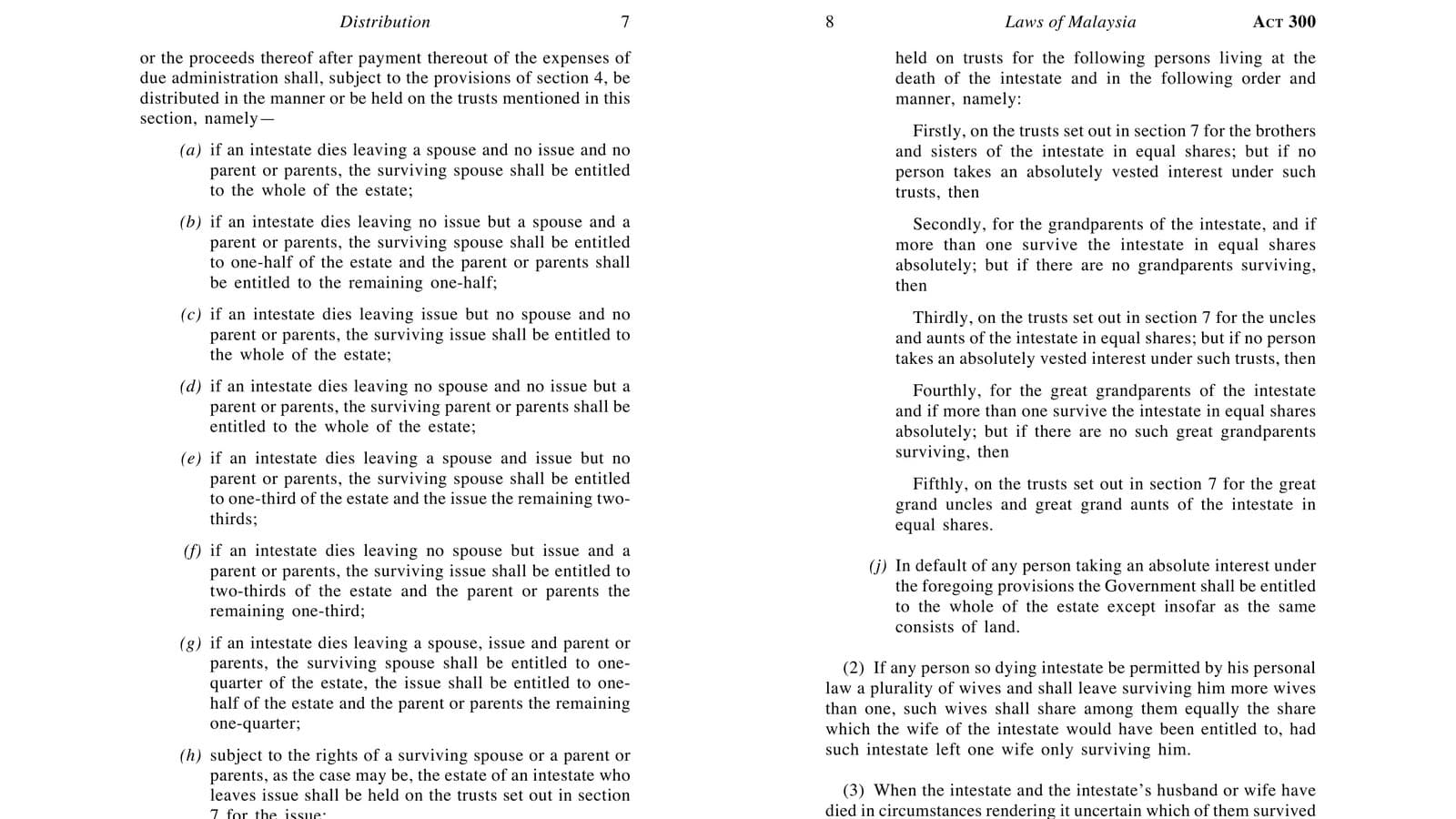
If the person who died was a non-Muslim domiciled in Peninsular Malaysia or Sarawak, and left a spouse, children and one surviving parent, section 6(g) of the Distribution Act 1958 divides the estate three ways: the surviving spouse takes one quarter, the issue take one half, and the parent or parents take the remaining one quarter. The widowed spouse gets a quarter, exactly as much as the dead person's mother. Nobody plans for this, because nobody reads the Act until they have to.
Here is the whole of it, in the order the statute sets out, and then the part that surprises people from Sabah.
The shares, in full
Section 6(1) of Act 300 runs through every combination. In plain terms, and assuming there is no will at all:
- Spouse, no issue, no parent: spouse takes the whole estate.
- Spouse and parent, no issue: spouse one half, parent or parents one half.
- Issue, no spouse, no parent: issue take the whole estate.
- Parent, no spouse, no issue: parent or parents take the whole estate.
- Spouse and issue, no parent: spouse one third, issue two thirds.
- Issue and parent, no spouse: issue two thirds, parent or parents one third.
- Spouse, issue and parent: spouse one quarter, issue one half, parent or parents one quarter.
"Issue" is defined in section 3 as children and the descendants of deceased children, so a grandchild steps into a dead parent's place. Where the estate goes to issue it is held on the trusts in section 7 rather than handed over on the day.
If there is no spouse, no issue and no parent, section 6(1)(i) sets a queue: brothers and sisters first, then grandparents, then uncles and aunts, then great grandparents, then great grand uncles and great grand aunts. Only if nobody in that list takes an absolute interest does the estate go to the Government, and even then, section 6(1)(j) carves out land.
Two more provisions rarely mentioned. Section 6(2) says that where a man's personal law permits a plurality of wives and he leaves more than one, they share equally the single share a wife would have taken. Section 6(3) covers the case where spouses die together in circumstances that make it impossible to say who died first: the section applies as if the husband or wife had not survived the intestate.
And section 5 removes three distinctions people often assume exist. There is no difference between relatives through the father and through the mother, none between full blood and half blood, and none between a child born before the death and a child conceived before it who is subsequently born alive.
Sabah is a different country for this purpose
Section 1(2) of the Distribution Act says it applies to Peninsular Malaysia only. It was extended to Sarawak on 12 December 1986 by P.U. (A) 446/1986. It has never been extended to Sabah.
Sabah has its own statute, the Intestate Succession Ordinance 1960, in force since 7 April 1960, and section 2 states that nothing in it applies to the estate of any Native or any Muslim, nor affects Native law and custom or Muslim law on distribution. For everyone else domiciled in Sabah, the rules in section 7 apply, and they are not the Peninsular rules with a different font.
Take the same family: a spouse, two children, one surviving mother, and an estate worth RM900,000.
Under section 6(g) in Peninsular Malaysia or Sarawak, the spouse receives RM225,000, each child RM225,000 and the mother RM225,000.
Under Sabah's Rule (2), a spouse who survives with issue is entitled to one third, so RM300,000. Rule (3) then distributes the rest equally among the children, RM300,000 each. The mother receives nothing, because Rule (5) gives the parents the estate only where there are no descendants. Same family, same money, and the grandmother's quarter of a million ringgit disappears.
The gap runs the other way too. Where there is a spouse and a parent but no issue, the Peninsular rule is a flat half each. Sabah's Rule (4) gives the surviving spouse all the personal chattels of the estate and one half of the remaining property. Personal chattels are defined in section 3 and the list is long: motor cars and accessories not used for business, furniture, jewellery, plate, linen, china, glass, books, pictures, prints, musical and scientific instruments, domestic animals, garden effects, wines and consumable stores. It excludes anything used for business, and excludes money and securities. On an estate where a large slice of value sits in a car and household possessions, that is materially more for the spouse than half.
The Sabah rule about married daughters
Rule (3) of section 7 of the Sabah Ordinance is one sentence long and worth reading twice. The estate of an intestate who leaves issue is distributed in equal portions among the children and those who legally represent deceased children, "save that where any child is or was a married woman the amount of her portion shall be reduced by the amount of any money or other property given, paid or settled by the intestate on account of her marriage."
So a daughter's share is reduced by whatever her parent gave or settled on her at the time of her marriage. A son's is not, because the clause names married women only.
The clause is not dead letter by omission elsewhere either. Section 9 of the same Ordinance says that where a child or a descendant claims a distributive share, no money or property given during the intestate's life for the advancement of that child shall be taken into account. But it opens with the words "Subject to the provisions of Rule (3) of section 7". In other words, the general rule is that gifts to children are ignored, and the single carve-out is the money given on a daughter's marriage.
The Ordinance dates from 1960, when Sabah was the Colony of North Borneo, and it has been amended three times, in 1961, 1966 and 1975. The Sabah State Attorney-General's Chambers still lists it as the state's intestate succession law. If your family's estate is in Sabah and there are married daughters, this is a reason to write a will rather than a reason to argue after the fact.
The adoption trap, and it is a big one
Section 3 of the Distribution Act 1958 defines "child" as a legitimate child, including a child by any wife where a plurality of wives is permitted, "but does not include an adopted child other than a child adopted under the provisions of the Adoption Act 1952 [Act 257]".
Malaysia has two adoption statutes with almost identical names. The Adoption Act 1952 (Act 257) provides for adoption by court order and applies to non-Muslims. The Registration of Adoptions Act 1952 (Act 253) provides for the registration of an adoption that has already happened in fact, and it is the route commonly used where an adoption order is not available.
Only the first one puts a child inside the Distribution Act's definition. A child raised from infancy, registered under Act 253, carrying the family name and known to everyone as a son or daughter, is not "issue" for the purposes of section 6, and takes nothing on an intestacy. The same section 3 defines "parent" as the natural mother or father, or the lawful mother or father under the Adoption Act 1952, so the asymmetry runs both ways.
Sabah drew its definition more widely. Section 3 of the Intestate Succession Ordinance defines child to include "any child adopted or registered as such under any written law for the time being in force in Sabah". Registered counts there. It does not count in Peninsular Malaysia or Sarawak.
If there is an adopted child in your family, find out which Act the paperwork was done under before you decide whether a will is urgent. It probably is.
Muslims, and what applies instead
Section 2 of the Distribution Act 1958 says nothing in it applies to the estate of any person professing the Muslim religion, or affects any rules of Muslim law as varied by local custom. The Sabah Ordinance carries the same exclusion, and adds Natives. A Muslim estate is distributed according to faraid, and a Muslim may make a wasiat, with limits on how much can be left to a non-heir. Those limits are a matter of state Islamic law rather than the Acts described here, so the correct place to ask is the state religious authority or a syariah practitioner, not this article.
Section 2 also preserves one historical exception on the Peninsula: estates governed by the Parsee Intestate Succession Ordinance of the Straits Settlements are outside the Distribution Act.
Where the paperwork actually goes
Two routes, and the dividing line is value.
The Small Estates (Distribution) Act 1955 (Act 98) handles the smaller ones, and it was widened. A small estate now means an estate of a deceased person consisting of any property situated in any State and not exceeding RM5 million in total value, and the old requirement that the estate include immovable property has been removed, so an estate made up entirely of bank accounts and a car can now go through it. The amending law, the Small Estates (Distribution) (Amendment) Act 2022 (Act A1643), came into force on 15 July 2024. These applications go to the Estate Management Division of the Department of Director General of Lands and Mines, JKPTG, at the land office rather than to a court, which is cheaper and does not need a lawyer.
Above RM5 million, or where the estate is contested, the route is the High Court: a grant of probate where there is a will, or letters of administration where there is not. Letters of administration ordinarily need sureties, which is one of the practical costs of dying intestate that nobody mentions in advance.
Section 4 of the Distribution Act is worth knowing if the family has assets abroad. Movable property is distributed according to the law of the country where the deceased was domiciled at death. Immovable property in Malaysia is distributed under Malaysian law wherever the deceased was domiciled. Domicile is not the same as citizenship or residence, and a Malaysian who has lived overseas for decades may not be domiciled here.
What the land office route costs, and the two shortcuts beside it
The small estate application itself. JKPTG's own FAQ, read on 13 September 2026, says the application is made on Form A under section 8 of Act 98, either at the Estate Distribution Unit in the state where the property sits or online through MyLAND (myland.gov.my) after registering an account. Heirs can apply, and so can creditors, a purchaser under a valid sale agreement, a chargee, Amanah Raya Berhad and a state Islamic religious council. JKPTG lists the papers it wants: the death certificate, the MyKad of the applicant and every heir (birth certificates for heirs under 18), the marriage certificate, a copy of any land title or sale and purchase agreement with an official land search, quit rent receipts where relevant, current statements for movable property, and any debt statements. It puts the processing time at four to six months from the application date.
The fee is charged on the order, not the filing. JKPTG charges 0.2% of the estate's value where the estate is under RM2 million, and 0.3% from RM2,000,001 to RM5 million. Its own worked example: an estate of RM100,000 pays RM200. On the RM900,000 family above, that is RM1,800. On a RM3 million estate it is RM9,000. Compare that with a High Court application, where lawyers' fees and sureties come on top.
Shortcut one: Amanah Raya for small, movable-only estates. The government portal malaysia.gov.my describes a "simple inheritance" as one worth RM600,000 or less made up of movable property only, such as bank money, shares, unit trusts and vehicles, and routes it to Amanah Raya Berhad (ARB), which issues a declaration of summary administration under section 17 of the Public Trust Corporation Act 1995 instead of a court grant. The moment the estate contains land, this route closes and the land office or the court takes over.
Shortcut two: nominations sit outside the estate altogether. The EPF says that for non-Muslim members the nominee is the direct beneficiary who receives the savings when the member dies. The Distribution Act shares above never touch nominated EPF money, which is why a stale nomination (an ex-spouse, a parent who has since died) can matter more than the intestacy rules. If the nominee is under 18, ARB holds the money as trustee. For Muslim members the nominee is a wasi, an administrator who must still distribute the money by faraid. Nothing in this article's tables changes either rule, so check your nomination on i-Akaun the same day you think about a will.
What to do about it
Find out which rulebook applies to you. Domicile in Sabah means the Intestate Succession Ordinance 1960. Peninsular Malaysia or Sarawak means the Distribution Act 1958. Being a Muslim means neither, and faraid instead.
Then run your own family through the shares above. If the answer includes a name you did not expect, or excludes one you did, that is the whole argument for writing a will. A will overrides all of section 6 for a non-Muslim estate.
Check the adoption paperwork. Act 257 or Act 253 decides whether an adopted child inherits at all on an intestacy in Peninsular Malaysia and Sarawak.
Keep the estate findable. An intestacy is slow mostly because the family does not know what exists. Our guide to checking unclaimed money on eGUMIS covers the other half of that problem, which is money that was never collected in the first place.
And if the estate is under RM5 million, do not assume you need to go to court. The land office route under the Small Estates (Distribution) Act 1955 exists precisely for that, and now covers estates with no land in them at all.
Related reads
- Writing a will in Malaysia 2026: the Wills Act 1959 two-witness rule, why marriage revokes an existing will, and what a will costs to draw up.
- Unclaimed money on eGUMIS: how to find money a relative never collected.
- EPF Akaun Fleksibel withdrawals in 2026: what you can take out of EPF while you are alive.
- Hire Purchase Amendment Act 2026: the Rule of 78 ending and what it means for settling a car loan early.