For sixty years, buying a car in Malaysia meant learning one number and one folk rule. The number was the flat rate, a figure like 3% a year that sounded almost free. The folk rule was that if you settled early you would get a rebate, so the loan was not really as long as it looked.
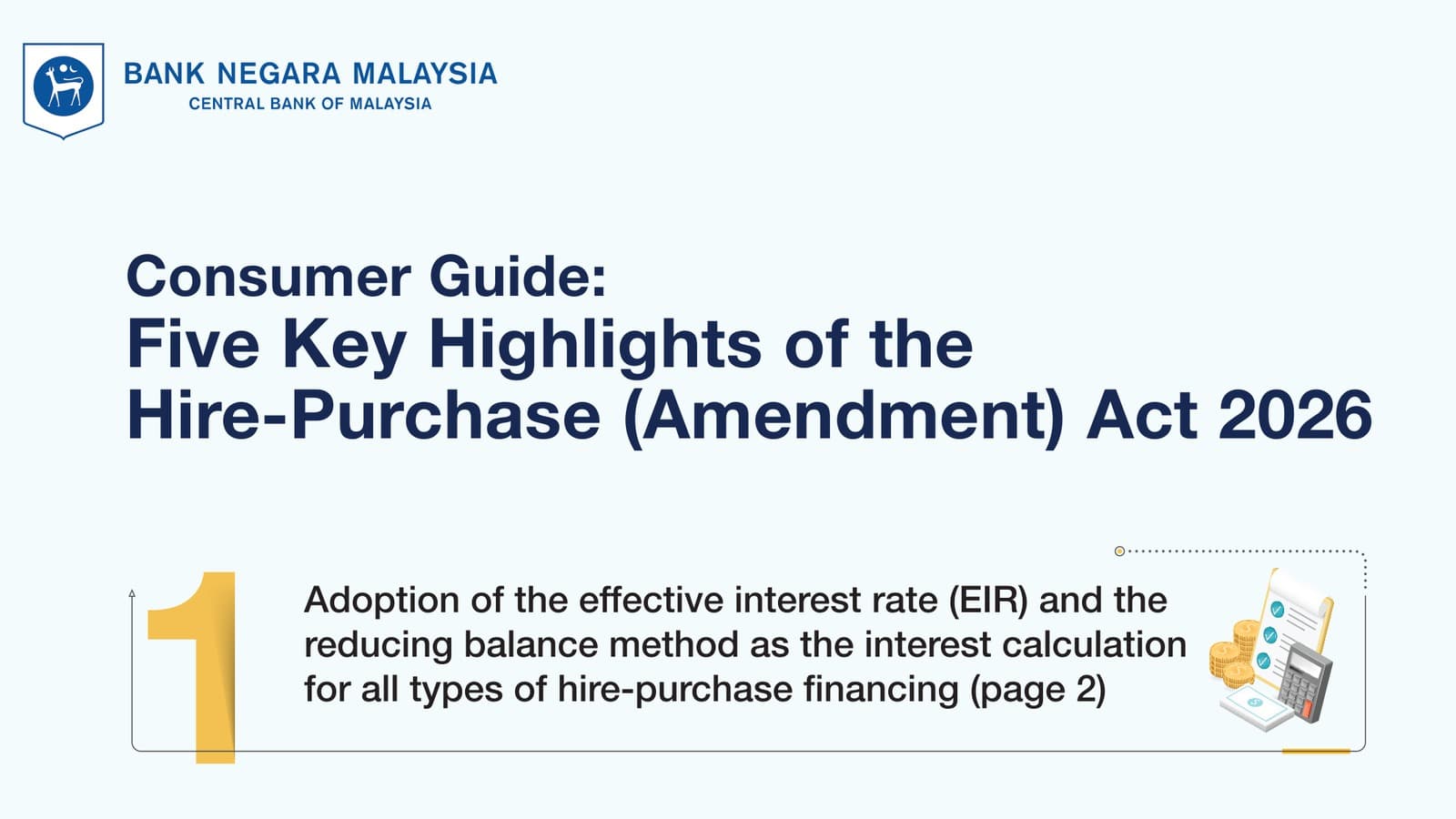
Both of those are now history. The Hire-Purchase (Amendment) Act 2026 came into force on 1 June 2026, and the Hire-Purchase (Term Charges) Regulations 2026, gazetted as P.U.(A) 171/2026, took effect the same day. The Ministry of Domestic Trade and Cost of Living, which remains the regulator for every hire purchase agreement in the country, announced both. What follows is what actually changed, taken from Bank Negara Malaysia's own consumer guide on the Act and from KPDN's statement of 31 May 2026.
The flat rate was never the rate
Start with the arithmetic, because it is the whole point.
BNM's guide sets out a single worked example. Borrow RM100,000 over nine years, which is 108 months. Bank A quotes a flat rate of 3% a year. Bank B quotes an effective interest rate of 5.5% a year. Bank C quotes an EIR of 5%.
Bank A and Bank B produce exactly the same result: a monthly instalment of RM1,175.93 and total interest of RM27,000. Bank C produces RM1,151.76 a month and RM24,390 in interest.
In other words, on a nine year tenure, a flat 3% is an EIR of 5.5%. The flat number is not a lie, but it is calculated on the original loan amount for the whole tenure rather than on what you still owe, so it makes the product look roughly half as expensive as it is. That is why the Act abolishes it. From now on providers quote the EIR, which lets you compare two offers directly for the first time.
The reducing balance method underneath it is the other half. Interest is charged on your outstanding principal, which falls every month, so a larger share of each instalment goes to the principal as the loan runs. Variable rate hire purchase in Malaysia has worked this way all along under the 1967 Act. As at December 2024 it was only 15% of what banks offered. The change is that fixed rate loans, the other 85%, now work the same way.
Why losing the early settlement rebate is a good thing
This is the part that reads like bad news and is not.
Under the Hire-Purchase Act 1967, settling early meant asking the provider to waive the interest on the remaining months, the statutory rebate. It existed because of the Rule of 78, which front-loads interest so that in the early years of a nine year plan most of your payment is interest and the principal barely moves. Settle in year three and the outstanding balance was far higher than a customer expected, which is exactly the complaint KPDN cites as its reason for the reform.
Under the amended Act there is no rebate, because there is nothing left to rebate. Interest is charged on the balance you still owe. Pay the balance off and interest simply stops. BNM states it plainly: the need for a waiver does not arise.
The Rule of 78 has been banned in many countries on the same reasoning, and KPDN frames the change as aligning Malaysia with that practice, alongside the Consumer Credit Act 2025 introduced through the Ministry of Finance.
What the ceiling is now
The maximum rates moved with the method, set out under the revised Term Charges Regulations.
For fixed rate financing, the old maximum flat rate of 10% a year has been converted into its EIR equivalent, which depends on tenure. The cap is now 17% a year for tenures of up to five years and 16% a year for tenures longer than five years. For variable rate financing, the existing cap of 17% a year carries over unchanged for all tenures, since variable loans were already on reducing balance under the 1967 Act.
BNM notes the 17% ceiling is a safeguard rather than a target and is subject to periodic review. In practice a new car loan will be nowhere near it.
Your existing loan is untouched, unless you both agree
The single most common question deserves a direct answer. If you signed your hire purchase agreement before 1 June 2026, nothing changes. The amendments apply only to new agreements secured after the Act took effect, and your loan continues on its original contractual terms, flat rate and Rule of 78 included.
There is one door left open. The Act allows you and your provider to mutually agree to elect the new method of calculating the net balance due, which is the number that matters if you want to settle early. That is subject to the provider having the systems to do the calculation. It is worth asking if you are close to settling a long tenure loan.
Settling an old loan early? Ask for the goodwill discount
The law leaves old agreements alone, but the banks did not. In a joint statement on 16 March 2026, the Association of Banks in Malaysia (ABM), the Association of Islamic Banking and Financial Institutions Malaysia (AIBIM) and the Association of Development Finance Institutions of Malaysia (ADFIM) said that from 1 June 2026 banks give a goodwill discount to eligible customers who settle an existing fixed rate, Rule of 78 hire purchase loan early. The stated aim is an outstanding balance "more comparable" to what it would have been under the reducing balance method.
Who qualifies: individuals and micro and small businesses whose fixed rate, Rule of 78 agreement was signed before 1 June 2026, or during the transition period ending 31 March 2027 at a bank that had not switched yet.
Who does not: at the moment you apply to settle, the account must not be more than 90 days in arrears, must not be under legal action or a repossession order, and must not be under an existing restructuring and rescheduling (R&R) or a formal debt management programme.
How much: there is no fixed formula. Each bank calculates the discount from the agreement's own features, mainly the tenure and how early you settle, and tells you the figure only when you request early settlement. The associations' earlier statement of 2 December 2025 said the programme runs until every Rule of 78 agreement has matured or been settled, estimated at nine years, the maximum vehicle financing tenure.
Two practical points follow. If you simply keep paying to the end of the tenure, the Rule of 78 never costs you anything and there is nothing to do. And if you are thinking of settling, ask for the settlement figure in writing with the goodwill discount shown as its own line, so you can see what the reform is worth on your loan before you pay. This applies to banks; a non-bank hire purchase company is not a member of these associations, so ask it directly whether it offers anything similar.
The date that decides whether you get the new rules
Here is the trap in the middle of all this, and it is a timing trap.
The Act took effect on 1 June 2026, but providers were given a grace period until 31 March 2027 to finish the systems and infrastructure work needed to run reducing balance and price in EIR. Early adopters could start any time from 1 June. KPDN's minister, Datuk Armizan Mohd Ali, said on 31 May 2026 that 11 financial institutions and hire purchase companies were ready on day one, and that a second phase of implementation was targeted to begin in September 2026. No formal phase two launch followed, but on 19 September 2026, at the closing of KPDN's Consumer Festival (CONFEST 2026) at Stadium Batu Kawan, the minister gave the first progress figure since day one. 14 of the 20 banks that offer hire purchase financing had begun offering the reducing balance method as at 18 September, and the remaining six are expected to finish the switch by 31 December 2026 at the latest. Across the wider market, 429 banks and hire purchase companies are registered with the Malaysian Association of Hire Purchase Companies (AHPCM), and the ministry is targeting 80% of hire purchase providers to be offering compliant financing by the end of 2026. Anyone still not ready keeps the adjustment period to 31 March 2027, and full compliance is mandatory from 1 April 2027.
The practical consequence is uncomfortable and simple. Two people can walk into two showrooms on the same afternoon in September 2026, sign for the same car at the same headline rate, and end up on two different legal regimes, because one financier has switched and the other has not.
BNM's own advice is to ask, and it is the right advice. The question is short: have you switched to the reducing balance method, and what is the effective interest rate on this offer? If the answer is a flat rate, you are being quoted under the old system, and you can compare it against a provider that has already moved.
Which banks have already switched
You do not have to take the showroom's word for it. Four of the biggest car lenders have published their own switch dates for fixed rate hire purchase on the reducing balance method, all checked on 13 September 2026:
- Public Bank: effective 1 June 2026, in a notice dated 29 May 2026.
- AmBank and AmBank Islamic: available to all customers from 3 June 2026, covering Fixed Rate Hire Purchase and Fixed Rate Arif Hire Purchase-i.
- CIMB Bank and CIMB Islamic: effective 2 July 2026, quoted in EIR for conventional loans and effective profit rate for Islamic financing.
- Maybank: effective 1 August 2026 for Maybank Hire Purchase Loan/Financing, as stated on its hire purchase product page.
For everyone else, the best public guide is the readiness table the three associations published on 17 March 2026. It is a plan, not a confirmation, and it has already proved conservative: it put Public Bank, AmBank, CIMB and Maybank down for September 2026, and all four went live earlier. As printed, it lists fixed rate readiness as follows:
- June 2026: MBSB Bank.
- August 2026: Bank Rakyat.
- September 2026: Hong Leong Bank and Hong Leong Islamic Bank, plus the four above.
- December 2026: Affin Bank, Affin Islamic Bank, Bank Muamalat, RHB Bank and RHB Islamic Bank.
- January 2027: Bank Islam and Bank Simpanan Nasional.
- April 2027: Agrobank.
Two things to read from it. First, if you are financing through RHB, Affin, Bank Muamalat, Bank Islam or BSN before the end of 2026, expect a flat rate quote unless the bank tells you otherwise, which is exactly when the goodwill discount above matters. Second, Agrobank's April 2027 entry falls after the 31 March 2027 grace period as printed; ask it directly. The table covers banks only. KPDN's figure of 11 institutions ready on day one included hire purchase companies, which do not appear on it.
One update overtakes part of the table. On 19 September 2026 the minister said 14 of 20 hire purchase banks had switched as at 18 September and that the other six are expected to finish by 31 December 2026, which is earlier than the table's January and April 2027 entries. KPDN did not name the six, so this list is still the only bank-by-bank guide, and the question at the counter still settles it. If you are financing through a non-bank hire purchase company, the odds are lower: the ministry's own year-end target is 80% of providers, not all of them.
Three smaller changes worth knowing
You can sign electronically. Hire purchase agreements may now be signed with an electronic or a digital signature and delivered electronically. The distinction matters: an electronic signature can be as simple as a typed name, and BNM notes the signer's physical presence may still be required for the initial signing, while a digital signature uses a certificate under the Digital Signature Act 1997. The method of delivery, softcopy or hardcopy, must be stated and mutually agreed in the agreement itself, and you can still ask for paper.
You will be identity checked twice. KPDN says the amendments introduce a requirement for two due diligence checks. In practice that means verification by thumbprint on a biometric reader or by facial recognition, not only when the agreement is signed but again for any change to an existing agreement that needs your explicit consent. It is an anti-fraud measure, and it means a hire purchase variation can no longer be done entirely over the phone.
Base Lending Rate is now Reference Rate. A terminology change in the Act that aligns it with BNM's Reference Rate Framework as revised in 2015 and 2022. Nothing about your instalment changes because of it.
If something goes wrong
KPDN remains the regulatory and supervisory authority for all hire purchase agreements, including bank ones. Complain to your provider first. If the answer is unsatisfactory and your provider is regulated by Bank Negara Malaysia, escalate to the Financial Markets Ombudsman Service or to BNMLINK. If your provider is a non-bank, lodge it with KPDN through eaduan.kpdn.gov.my, the toll free line 1-800-886-800, the address e-aduan@kpdn.gov.my, or at any KPDN office.
One last figure from the BNM guide that has nothing to do with the Act and everything to do with the decision. Before you sign anything, it says, make sure you can cover not only the 10% down payment but the instalments across the whole tenure, plus insurance or takaful, road tax and maintenance. The reform makes the price honest. It does not make the car cheaper.
Sources
Bank Negara Malaysia, Consumer Guide: Five Key Highlights of the Hire-Purchase (Amendment) Act 2026, published 17 March 2026. KPDN statement of 31 May 2026 as carried by BERNAMA. BERNAMA report of 19 September 2026 on the minister's CONFEST 2026 remarks at Batu Kawan. Hire-Purchase (Term Charges) Regulations 2026, P.U.(A) 171/2026. KPDN media statement archive for 2026, checked 8 September 2026. ABM, AIBIM and ADFIM joint media statements of 2 December 2025 and 16 March 2026, and their Summary of Banks' Readiness to Adopt the Reducing Balance Method dated 17 March 2026. Hire purchase notices from Public Bank (29 May 2026), AmBank (3 June 2026) and CIMB (2 July 2026), and Maybank's hire purchase product page, all checked 13 September 2026.
Related reads
- Buy now pay later in Malaysia 2026: the real cost: the other half of the Consumer Credit Act 2025 story.
- Car ownership transfer fees in Malaysia 2026: what changes hands when the loan is finally settled.
- Six cost of living measures for Malaysia in September 2026: what else moved this quarter.
*Cover image: Bank Negara Malaysia*