On 30 September 2026, Grab Malaysia started offering booster seats on airport rides for children aged 4 to 12. It is a small beta, but it brought back a question many Malaysian parents never quite settled: is a child car seat actually compulsory here, and what happens if you do not use one?
The short answer is yes, it has been the law in private cars since 1 January 2020. The longer answer, which matters more for the drive home from school, is in the gazette.
The rule and where it comes from
The requirement sits in the Motor Vehicles (Safety Seat-Belts) (Amendment) Rules 2019, P.U.(A) 375/2019, made under section 66 of the Road Transport Act 1987 and gazetted on 30 December 2019. It renamed the 1978 rules the Motor Vehicles (Safety Seat-Belts and Child Restraint System) Rules and added rule 4B, which says every child in a motor vehicle "shall be placed in an appropriate child restraint system". The same amendment made rear seat belts compulsory under rule 4A.
Who counts as a child. The rules define a child as a person under 12 years old, weighing less than 36kg and shorter than 136cm. All three conditions must be met. Many news reports and MIROS material round this to 135cm, but the gazette says 136cm. The Malaysian Institute of Road Safety Research (MIROS) says in its FAQ that height is checked first: a child taller than the limit no longer needs a seat, even one who still weighs less than 36kg.
What "appropriate" means. Rule 4B(5) says the seat must suit the child's age, weight and height. A baby in a booster or a 9-year-old in a toddler seat does not meet it.
Can a child sit in the front seat?
The rules do not ban children from the front seat outright. They say:
- A forward-facing child seat may be fitted in a front passenger seat that has an airbag.
- A rear-facing child seat must not be fitted in a front passenger seat with an airbag unless the airbag is turned off. An airbag inflating against the back of a rear-facing seat is the danger.
Who gets fined, and how much
Rule 4B(4) makes the driver guilty of the offence, not the vehicle owner or the parent sitting beside the child. On a first conviction, the penalty is a fine of up to RM2,000 or up to six months' jail. On a second or subsequent conviction, it is up to RM4,000 or up to 12 months' jail, or both. The same scale applies to selling a child seat that does not meet the approved standards.
Those are the maximums a court can impose. In practice, enforcement has never been about court cases. When the rule began, the then Transport Minister said no summonses would be issued for six months. In August 2020 his successor extended the advocacy approach. In June 2023 the deputy minister said the ministry was focusing on advocacy rather than enforcement, and in November 2025 Bernama reported that enforcement was being carried out in stages, beginning with education. Reports since then cite an RM300 compound, which matches the general cap on traffic compounds. We could not find a JPJ schedule listing a compound for this specific offence, or any announcement that routine summonses have started.
The Road Transport (Amendment) Act 2026, passed by the Dewan Rakyat in June 2026, raises the general maximum compound from RM300 to RM500 from 1 January 2029. It does not change the RM2,000 court fine in the child seat rules.
The four exceptions
Rule 4C says the driver commits no offence if:
- the vehicle's construction makes it impossible to install an appropriate seat (MIROS says this covers older cars without three-point rear belts);
- the number of passengers makes it impossible;
- a registered medical practitioner has certified that the child is medically unfit for a child seat;
- in a public service vehicle or tourism vehicle, such as a taxi or bus, the operator or owner has not provided one.
Ministers have said e-hailing drivers are only encouraged to carry seats. The rules do not say whether e-hailing cars count as public service vehicles.
Which seats are legal
The Schedule lists two standards for rule 4B: UN Regulation No. 44 and UN Regulation No. 129 (i-Size, the newer standard that sizes seats by the child's height). JPJ issues the component type approval. MIROS says that since 1 January 2021, every child seat on sale in Malaysia must carry a MIROS QR label, which you can scan to check the approval. A seat already fitted before 1 January 2020 was deemed compliant. MIROS also suggests replacing a seat around six to eight years after it was made.
Is there any help with the cost?
Not at the moment. The MyCRS subsidy from Budget 2022 gave B40 households 50% off a seat priced up to RM300, or RM150 off a dearer one, with one seat per household. Bernama reported 63,248 recipients in 2022 and 66,959 in 2023, and it has not continued since. There is no income tax relief for child seats, and the Budget 2027 speech of 9 October 2026 does not mention one.
Grab's new kid-friendly rides
Grab's Kid-Friendly Rides (Beta), launched on 30 September 2026, puts one booster seat in the car for a child aged 4 to 12. It is advance booking only, for trips to and from KLIA Terminal 1 and Terminal 2. A Standard 6-Seater costs an RM10 add-on, and Grab EV Exec carries Koopers booster seats at no extra charge. Grab says the Klang Valley comes next, then Penang and Johor Bahru. Infant and toddler seats are not offered.
Why it matters
MIROS has said only about 30% of Malaysian children travel in a car seat. International studies cited by MIROS put the reduction in deaths at up to 71% for infants and up to 54% for children aged 1 to 4. Police figures quoted by the Transport Ministry in 2023 counted 1,252 fatal crashes involving children aged 10 and under between 2012 and 2021.
Sources: P.U.(A) 375/2019 on the Attorney General's Chambers legal portal (lom.agc.gov.my); MIROS child restraint FAQ and MyCRS subsidy FAQ (miros.gov.my); Grab Malaysia press release, 30 September 2026; Bernama, 19 November 2025; paultan.org, 20 November 2019 and 27 June 2023; Free Malaysia Today, 12 August 2020; New Straits Times, 23 and 24 June 2026.
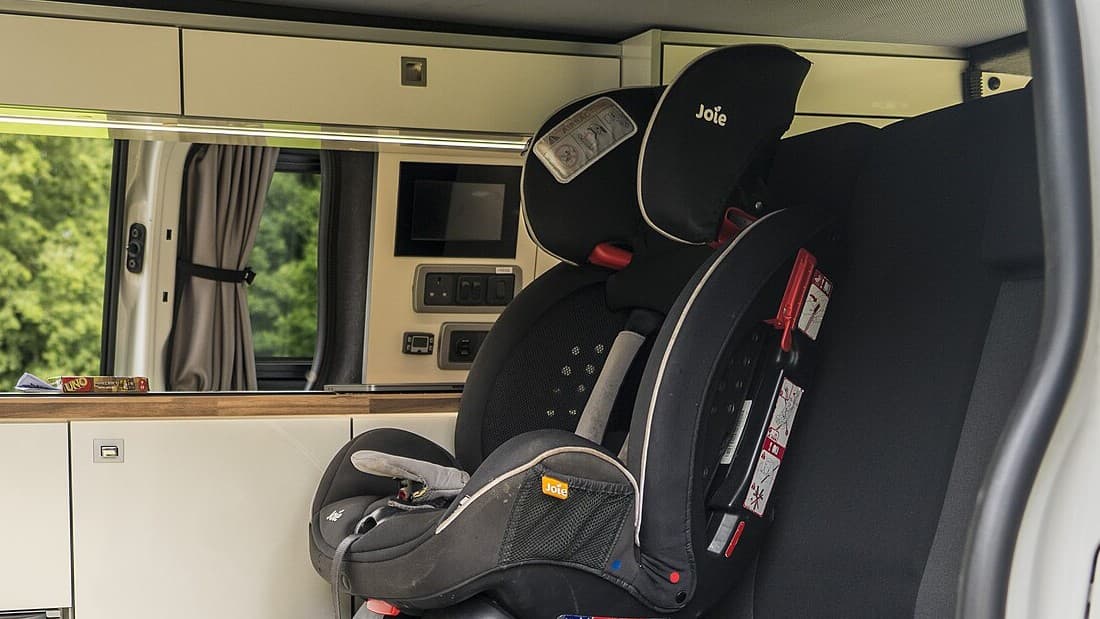
*Cover image: CruiseAmerica, Wikimedia Commons, CC BY-SA 4.0 (cropped).*