> Quick view: since 1 January 2026, JPJ and PDRM compound traffic summonses on one standardised nationwide schedule — 50% off within 15 days, 33% off from day 16 to day 30, full rate from day 31 to day 60, and court action plus blacklisting past day 61. Campaign discounts are gone. Non-compoundable offences, including no insurance and no valid LKM, get no discount at all. Parliament then passed the Road Transport (Amendment) Bill 2026 — Dewan Rakyat on 24 June 2026, Dewan Negara on 21 July 2026 — raising the maximum compound from RM300 to RM500 with enforcement stated for 1 January 2029, raising minimum court fines from RM300 to RM500 as a separate change, and creating standalone offences for street racing and for acting as a lookout. The Act was gazetted on 15 September 2026 as Act A1794 (royal assent 30 August 2026) and, the Ministry of Transport announced, came into force on 16 October 2026. The racing and lookout offences apply from that date; the RM500 compound ceiling is held back to 1 January 2029.
The rule that replaced the discount season
For years, the Malaysian summons calendar had a rhythm. A discount campaign would be announced — Merdeka, the year end, a department anniversary — queues would form, and everyone who had been sitting on a summons would clear it at 50% or 70% off. If you paid promptly, you paid more than the person who waited.
That ended on 1 January 2026.
At a joint Ministry of Transport and Ministry of Home Affairs press conference at Parliament on 22 October 2025, Transport Minister Anthony Loke announced that from the start of 2026 the rates and methods for compounding traffic summonses would be standardised between JPJ and PDRM. He said the Cabinet had taken the decision on 17 October 2025, after finding significant differences in how the two agencies compounded offences and enforced action. Present alongside him were Home Minister Saifuddin Nasution Ismail, Bukit Aman traffic investigation and enforcement department director Mohd Yusri Hassan Basri, and JPJ director-general Aedy Fadly Ramli.
The replacement principle is a sentence rather than a schedule of campaigns: "the less you delay, the less you pay". In the minister's own framing, the compound rate is lower when payment is made earlier, precisely to reward the people who settle promptly.
The four windows
The schedule has four bands, and the boundaries matter more than the percentages:
- Days 1 to 15 — a 50% discount. Pay inside the first fortnight and the compound halves.
- Days 16 to 30 — a 33% discount. Two weeks later, a third of the reduction is gone.
- Days 31 to 60 — the full compound rate. Loke's own example: RM300 if the maximum rate is RM300.
- Beyond day 61 — court action and blacklisting of the vehicle owner.
Read that as a countdown rather than a menu. The expensive mistakes in this system are not made by people who decide to fight a summons; they are made by people who mean to pay it and let a fortnight slide. On a RM300 compound, letting day 15 become day 16 costs RM51. Letting day 30 become day 31 costs RM100.
Before the new schedule started, the government ran one last campaign-style clearance: 50% to 70% off compoundable summonses issued by JPJ and PDRM, from 1 November to 30 December 2025, described at the time as a transition offer ahead of full implementation in January.
The offences that get no discount at all
The incentive rates apply only to compoundable offences. Loke was explicit that they do not apply to the non-compoundable (NC) category, and gave three examples: driving without insurance, driving without a valid motor vehicle licence (LKM), and displaying a fake LKM.
Non-compoundable means what it says — there is no compound offer to discount, and the matter is dealt with through the courts. If your summons falls into that category, the 15-day clock is not a discount window; it is simply the period before the paperwork moves.
What Parliament did in June 2026
Six months into the new schedule, the government came back with the underlying law.
The Road Transport (Amendment) Bill 2026 was tabled for its first reading in the Dewan Rakyat on 22 June 2026, with Loke saying the second reading would follow in the same sitting. It was debated from 23 June by 43 MPs from both government and opposition benches, and passed by the Dewan Rakyat on 24 June 2026. It went to the upper house a month later. The Dewan Negara took the second reading on 21 July 2026, delivered by Deputy Transport Minister Datuk Hasbi Habibollah, and passed the Bill the same day on a majority voice vote. It was one of 12 Bills cleared in that meeting, which sat for ten days from 20 July and adjourned on 4 August 2026. Passing both Houses is not the last step, though, and the section below sets out where the Act actually stands today.
The changes below are as reported by Bernama, which read the Bill's blue copy on the official Parliament portal, and by RTM and Berita Harian from the minister's statements in the House.
The compound ceiling: RM300 to RM500, from 2029
Clause 37 amends section 120 of the Road Transport Act 1987 to raise the maximum compound for compoundable offences from RM300 to RM500.
Loke told the House the government intends to enforce the new maximum from 1 January 2029, and framed the gap as a deliberate transition period so road users have time to change their habits. He also made a point that is worth repeating whenever the RM500 figure is quoted out of context: raising the ceiling does not mean every offender is automatically compounded RM500. The actual rate still depends on the type of offence, its seriousness, the settlement period and the prescribed procedure. The stated purpose, in his words, is to increase compliance rather than to burden the public or raise government revenue — the same offences, with penalties reviewed so they stay relevant and deter more effectively.
Berita Harian reported that more than 700 road offences are expected to come under the higher ceiling.
The other RM300-to-RM500, and why it is the one people mix up
There are two separate RM300-to-RM500 changes in this Bill, and they are constantly reported as if they were one. Telling them apart is the difference between knowing what a summons costs and knowing what a courtroom costs.
The first is the compound ceiling above: clause 37, section 120, a maximum, stated for 1 January 2029.
The second is the minimum fine a court can impose, which the Bill raises from not less than RM300 to not less than RM500. Free Malaysia Today headlined it as a minimum-fine change on the day of the first reading, and The Edge and Bernama reported it the same way. The offences named are the ordinary ones: failing to display a vehicle registration number, having no motor vehicle licence, driving without a valid driving licence, speeding, breaching requirements on vehicle construction, equipment and use, using a vehicle class without a valid inspection certificate, ignoring traffic directions and signals, and illegal racing.
The distinction is not academic. A compound is an offer — the amount the department will accept to close the matter without a charge, and a maximum means the department may ask for less. A minimum court fine is a floor — the least a magistrate may impose once you are convicted, and a floor means the court may not go below it however sympathetic your circumstances. So the two numbers move in opposite directions from the driver's point of view, and they meet at day 61, which is where an unpaid compound stops being an offer and becomes a charge.
The 1 January 2029 date attaches to the compound ceiling, not to this. When the Act came into force on 16 October 2026, the Ministry of Transport named only the compound ceiling as deferred; its statement did not mention the minimum-fine change either way. We could not read the commencement notification itself, so treat the RM500 court floor as applying to offences from 16 October unless an official notice says otherwise. It only bites if a case goes to court, which under the current schedule happens after day 60.
Section 42A: racing becomes an offence by itself
Clause 15 inserts a new section 42A making racing or a speed trial on a road an offence in its own right.
Loke described the gap it closes directly: enforcement in certain cases had been difficult because the authorities first had to prove an element of danger or a consequence that had already occurred. Under section 42A, the act of racing or testing speed is itself a specific offence, so action can be taken without waiting for an accident, injury or death. The section provides that any person who races on a road involving two or more motor vehicles, including cars, commits an offence. The racing limb is not the whole section, though. When the Bill reached the Dewan Negara, The Star and Free Malaysia Today both reported that section 42A(2) reaches a speed trial involving one or more motor vehicles — meaning a driver alone on an empty stretch, with nobody to race against, is still inside the section. Hasbi Habibollah put it to the senators in one line: public roads, straight stretches included, are not for testing a vehicle's speed, and that belongs on a racetrack.
The penalties: a first offence carries a fine of not less than RM2,000 and not more than RM10,000, or imprisonment of up to two years, or both. A second or subsequent conviction carries not less than RM5,000 and not more than RM20,000, or up to five years' imprisonment, or both.
Loke also said the government was considering proposals that extensively modified racing vehicles not be returned to their owners, while noting that any such action must follow the law.
Will ordinary fast driving be charged as racing?
This was the question MPs pressed hardest, and Loke answered it directly in his winding-up speech on 24 June 2026, replying to Tebrau MP Jimmy Puah Wee Tse, who had challenged how broad the definition of racing was. Loke said section 42A is not intended to penalise isolated speeding or ordinary overtaking. It targets, in his words, "racing or speed trials involving competitive conduct, challenge based speeding, reckless behaviour, or situations that clearly indicate dangerous activity", and each case will turn on "facts, evidence, recordings, witnesses, driving patterns, and surrounding circumstances". He said enforcement guidelines will be issued so the section is applied fairly and consistently.
Two things follow that are worth keeping. Section 42A is not a motorcycle law. Loke confirmed it applies to all motor vehicles including high-performance and luxury cars, citing incidents such as Simpang Renggam, and said enforcement would be guided by behaviour and level of risk rather than by the type or value of the vehicle. And it is not the dangerous-driving section. Loke drew the line explicitly between section 41, which covers causing death by dangerous driving, and section 42A, which is about racing — and said the ministry would work with the Attorney General's Chambers so the charging provisions do not leave loopholes.
He also said the government had noted calls for harsher punishment, including lifetime licence revocation, but that the immediate priority is to establish the offence, strengthen enforcement and assess whether it works before amending further.
So a single burst of speed remains the speeding offence it always was. What section 42A adds is a charge for the conduct around it — the challenge, the trial, the pattern — without waiting for a crash.
Section 110B: the lookouts
A new section 110B was introduced to deal with "tonto" activity — the lookouts who warn illegal racers and other offenders of approaching enforcement — and to protect JPJ and police enforcement operations. In its 16 October 2026 statement the Ministry of Transport gave the penalty as a fine of RM10,000 to RM50,000 or one to five years' imprisonment, or both, and classed it as an arrestable offence. Bernama also reported that the amendments introduce an offence of obstructing or assaulting enforcement officers.
Driving while suspended, and false statements
Clause 13 raises the penalty for driving while a driving licence is suspended to imprisonment of up to three years or a fine of between RM3,000 and RM10,000, against a previous maximum of one year's imprisonment or a RM5,000 fine.
Clause 28, with its sub-clauses, tightens the penalty for making a false statement to a fine of up to RM200,000 or imprisonment of up to ten years.
The two amendments that will affect more people than street racing
Electric vehicles. Section 10 is amended so that all electric motor vehicles in the country can be registered. The Bill clarifies that such a vehicle must have an electric motor vehicle serial number and a chassis number that is clear, legible and untampered — a necessary fix, because EVs do not carry an engine number in the way conventional vehicles do.
Where your road tax is priced. Amendments to sections 16 and 17 tie the motor vehicle licence (LKM) fee to the area where the vehicle is actually used. Loke was specific that this involves no increase in LKM fees and no new fees: a vehicle used regularly in the Peninsula is charged at the Peninsular rate, and a vehicle used regularly in Sabah, Sarawak, the Federal Territory of Labuan or Langkawi is charged at the rate in force in that territory, with those existing lower rates unchanged for vehicles used there. The stated target is revenue leakage — vehicles renewed in a lower-fee area while being used elsewhere.
Two further changes round out the Bill: Clause 22 amends section 66 to give the minister power to prescribe fees for issuing a foreign motor vehicle entry permit, and the amendments set out definitions and rules for micromobility vehicles, including procedures for their detention and disposal. Loke said the use of micromobility by students, the B40 group and persons with disabilities had been taken into account, with priority given to safety and to the authorities' ability to regulate.
The border provision almost nobody covered
At his media briefing on 18 June 2026, Loke set out 11 scopes across 42 provisions, and one of them is enhanced cross-border movement control. As reported from that briefing by paultan.org, foreign vehicles may be barred from entering Malaysia if they lack a valid permit including VEP, or have outstanding summonses — and Malaysian-registered vehicles may be prevented from leaving the country while traffic summonses are pending. The law firm ADILLEGAL, reading the Bill, places this in a new section 119C inserted by clause 36, and reads the power as attaching to the vehicle rather than to the person. The gazetted Act A1794 confirms it: clause 36 inserts section 119C, under which a Malaysian-registered vehicle may be prohibited from entering or leaving Malaysia while any case under the Act is outstanding.
If that sounds abstract, make it concrete: it is the Singapore run, the Hat Yai drive, the Songkhla weekend. Today an unpaid summons is a problem you meet at a JPJ counter, on your own schedule. Under this provision it becomes a problem you can meet at a checkpoint, in a queue, with the family in the car and a booking at the other end. The Act has been in force since 16 October 2026. Of everything in it, it is the change most likely to reach an ordinary household, and it got a fraction of the attention that street racing did.
From passed to in force: the dates
For six weeks after it was gazetted, every penalty in the section above was law that had been passed but had not started. That changed on 16 October 2026, when the Ministry of Transport announced that the amending Act was in force. One piece was held back, and it is the one most drivers had heard about: the RM500 compound ceiling.
A Malaysian Act arrives in stages. Both Houses pass it; the Yang di-Pertuan Agong gives royal assent; it is published in the federal gazette and given an Act number; and then it comes into operation — sometimes on publication, more often on a date the minister appoints in a separate commencement order.
The Attorney General's Chambers' Laws of Malaysia register is where that record lives, and anyone can check it. The 2026 amendments have now cleared all four:
- Royal assent: 30 August 2026.
- Published in the Gazette: 15 September 2026, as Act A1794, the Road Transport (Amendment) Act 2026. It runs to 20 pages and is downloadable from the register.
- Commencement: 16 October 2026. Section 1(2) of the Act says it "comes into operation on a date to be appointed by the Minister by notification in the Gazette". On 1 October the register still read "NOT YET IN FORCE"; on 16 October the Ministry of Transport announced that the Act had come into force that day, with the higher compound ceiling starting on 1 January 2029.
The gazetted text confirms the figures this article has been reporting from Parliament. Clause 37 changes "three hundred ringgit" to "five hundred ringgit" in section 120(1), the compound ceiling. Clause 15 inserts section 42A exactly as described above. Clause 13 lifts the suspended-licence penalty in section 32(3) to up to three years or RM3,000 to RM10,000. Clause 30 inserts section 110B on obstructing, tailing or harassing police and road transport officers. Clause 36 inserts section 119C, which lets the Director General, a police officer or a road transport officer stop a Malaysian-registered vehicle from entering or leaving Malaysia while any case under the Act is outstanding. All of these apply to conduct from 16 October 2026; offences committed earlier are dealt with under the old wording.
The wait was a month, which is quick by recent standards: the Passports (Amendment) Act 2026 and the Immigration (Amendment) Act 2026, both gazetted on 13 March 2026, were still marked "NOT YET IN FORCE" on 1 October. And the ceiling shows that the Minister can bring different provisions into force on different dates, so "the Act is in force" does not mean every number in it applies today.
So what governs your summons today? The 15/30/60-day compound schedule at the top of this article. That is an administrative decision JPJ and PDRM adopted from 1 January 2026, and it did not need this Bill: it is still the part of this article that decides what an ordinary driver pays this week. Section 42A, section 110B, the suspended-licence penalty and the border provision are now live too, but they only reach drivers who race, act as lookouts, drive while suspended or leave the country with a case outstanding. The RM500 compound ceiling is not live until 1 January 2029.
What this means for an ordinary driver
Diarise the summons, not the campaign. The single behavioural change the new schedule demands is that you stop waiting. There is no discount season to wait for, and every fortnight you wait costs money on a fixed, published curve.
Check both authorities. PDRM and JPJ issue separately. PDRM's own website links its traffic summons portal at trafik.rmp.gov.my; JPJ is checked through the department's own channels. A clean record with one says nothing about the other.
Know whether yours is compoundable. If it is not — no insurance, no valid LKM, a fake LKM — there is no discount to chase and no counter payment that makes it go away.
Do not treat RM500 as your compound. There are two different RM500s. The compound ceiling starts on 1 January 2029, and even then a ceiling is a maximum rather than a default. The RM500 minimum court fine sits in the Act that came into force on 16 October 2026, but it is a floor for a magistrate after conviction, so you only meet it if you let a summons run past day 60 and the case goes to court.
And if you are the registered owner of a vehicle somebody else drives, the blacklist follows the owner. That is worth a conversation with whoever borrows the car, before a road tax renewal turns into a bad afternoon at a JPJ counter.
Sources, and what we could and could not verify
The policy details in this article come from Portal Berita RTM, the official news portal of Radio Televisyen Malaysia, reporting the 22 October 2025 press conference and the 24 June 2026 passage of the Bill; from Bernama, the national news agency, reporting the Bill's first reading on 22 June 2026 and reading its blue copy on the Parliament portal; and from Berita Harian's report of the minister's second-reading speech on 23 June 2026.
The 1 October 2026 re-check found the Act in the Attorney General's Chambers' register of amendment Acts as A1794 (royal assent 30 August 2026, published 15 September 2026, "NOT YET IN FORCE"). The 20-page gazetted English text was read directly, and the clause and section numbers above now come from it rather than from reporting on the Bill. A search then found no commencement order or start date. The 20 October 2026 re-check found the Ministry of Transport's statement of 16 October 2026, carried by Bernama in Malay and English, that the Act came into force that day, with the RM500 compound ceiling deferred to 1 January 2029 and the section 42A and 110B penalties as set out above. The register itself did not load from this machine on that date, so the commencement notification's own number is not quoted here.
The earlier update of 26 August 2026 resolved the two things the first version could not. The Dewan Negara passage date is confirmed as 21 July 2026 by The Star and Free Malaysia Today reporting on the day, and by Bernama's 4 August report listing the Bill among the twelve passed in that meeting. The gazette position was checked directly against the Attorney General's Chambers' Laws of Malaysia register of amendment Acts, with the result and its caveat set out above. The minimum-fine change is reported by Free Malaysia Today, The Edge and Bernama; the border provision comes from paultan.org's report of Loke's 18 June 2026 briefing, and the section 119C and clause 36 numbering, first taken from the law firm ADILLEGAL's reading of the Bill, is now confirmed against the gazetted Act A1794. The section 42A clarifications are from Malay Mail's report of Loke's winding-up speech on 24 June 2026.
jpj.gov.my did not respond to any request from this machine during the original run, and rmp.gov.my and trafik.rmp.gov.my did not respond on this update either, so no figure here is taken from JPJ's or PDRM's own compound rate tables, and we have not reproduced a departmental schedule of offence-by-offence rates. Where a figure here is a ministerial statement rather than a gazetted rate, it is described as such.
This article explains published rules and penalties. It is not legal advice, and a summons you intend to contest is a matter for the court named on it.
Related reads
- Renewing Your Road Tax and Driving Licence Online in 2026 — and Why an Expired Licence Now Costs You at the Pump — the counter where a blacklist actually stops you, and how to avoid meeting it there
- BUDI95 Is Back to 300 Litres: What the Cap Is Worth This Week, and Exactly What Happens at Litre 301 — the other 2026 rule change that lands on the same dashboard
- 7 Best Car Workshops & Service Centres in KL & Klang Valley (2026) — the construction, equipment and use rules are the ones a modification can quietly break
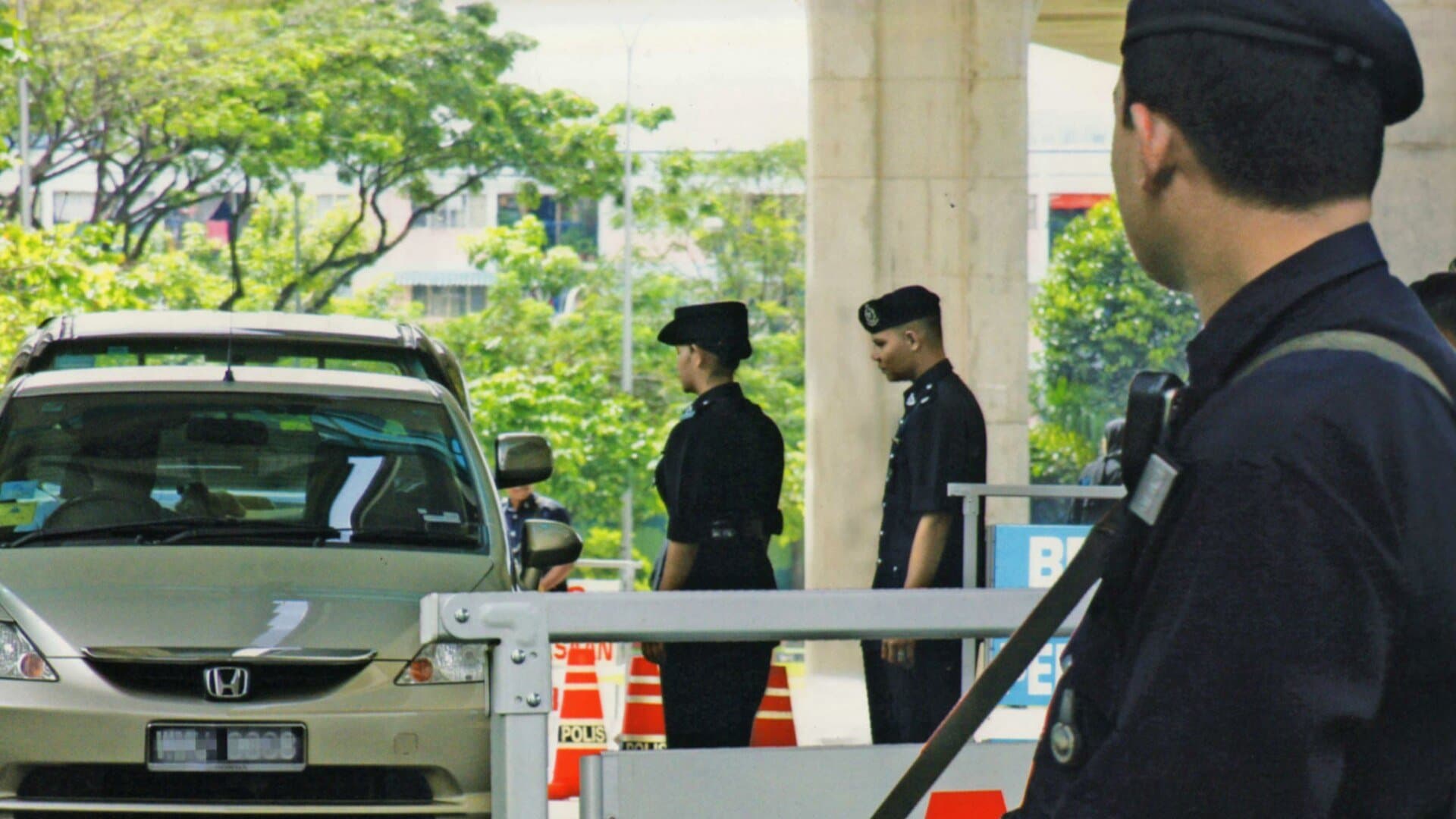
*Cover image: PDRM roadblock — public domain, via Wikimedia Commons*