Every year the pattern repeats. The rain starts on the east coast some time in November, the water comes up somewhere between Kelantan and Johor or across Sarawak and Sabah, and a great many people find out for the first time that there is an app they should already have installed.
None of the systems below are secret. All of them are free, all of them are run by federal agencies, and NADMA links to every one of them from its own front page. This is what each one actually shows, and what the numbers mean.
Start with the two agencies that do different jobs
MetMalaysia forecasts the sky. The Drainage and Irrigation Department, Jabatan Pengairan dan Saliran, measures the river. Those are not the same warning, and a lot of people only ever check the first one.
Rain that falls in the hills of Hulu Selangor or the Kelantan interior does not flood anything on the spot. It arrives downstream hours later, sometimes long after the sky has cleared where you are. A MetMalaysia warning tells you rain is coming. A JPS river gauge tells you the water is coming, which is a more useful thing to know if you live near a river.
How MetMalaysia grades a rain warning
MetMalaysia issues warnings under five headings, which it lists on its own front page: thunderstorm, continuous rain, strong wind and rough seas, tropical cyclone, and earthquake or tsunami.
The one that matters in the monsoon is continuous rain, and the department publishes its issuance criteria in three tiers:
- Alert: continuous rain is expected to occur within one to three days, or present rain or thunderstorm activity is expected to continue
- Severe: continuous heavy rain is expected to occur
- Danger: continuous torrential rain is expected to occur
Notice that Alert covers a three-day forward window. It is not a statement that something is happening now, it is a statement that you have up to three days. That is the level at which you move things off the floor, not the level at which you leave.
The warnings are published on met.gov.my, in the myCuaca app, and on the department's social channels. The hotline is 1-300-22-1638. MetMalaysia also runs a public MET API web service, which is how most third-party weather apps in Malaysia get their Malaysian data in the first place.
The four numbers beside every river
Public InfoBanjir, at publicinfobanjir.water.gov.my, is run by JPS under the Ministry of Energy Transition and Water Transformation. It carries a rainfall page and a river water level page, and the river page is the one to learn.
Pick a state and a district and you get a table: station ID, station name, river basin, the time the reading was taken, the live water level in metres, and then four threshold columns, Normal, Alert, Warning and Danger.
Here is the part that trips people up. Normal is a reference level, not a safety floor. On the morning of 19 September 2026, in the middle of a dry stretch, Sungai Selangor at Ampang Pecah in Hulu Selangor read 50.36 metres against a Normal of 50.10. Sungai Serendah at Serendah read 34.09 against a Normal of 34.00. Sungai Buloh at Parit Mahang read 2.85 against a Normal of 1.00. All three were sitting above Normal, and none of them were anywhere near trouble.
The number that matters is the gap to Alert. At Ampang Pecah, Alert is 51.30, so the river had nearly a metre of room. At Parit Mahang, Alert is 3.50 and the river was at 2.85, so it had 65 centimetres. Same "above Normal" reading, very different margins.
Do this once, now, while nothing is happening. Find the two or three stations nearest your house, write down their Alert and Danger figures, and you will spend the monsoon reading a number that means something instead of a colour that means nothing to you.
NADMA's own list of dashboards
NADMA does not run most of these systems. It coordinates them, and its front page links to each one. The full set is worth bookmarking:
- weather warnings, thunderstorm, continuous heavy rain, strong wind and rough seas, tropical cyclone and earthquake or tsunami, from MetMalaysia at met.gov.my
- the Air Pollutant Index, from the Department of Environment at apims.doe.gov.my
- flood information, from JPS at publicinfobanjir.water.gov.my
- drought information, from JPS at infokemarau.water.gov.my
- road closures, from the Public Works Department at bencana.jkr.gov.my
- temporary evacuation centres, from the Welfare Department at infobencanajkmv2.jkm.gov.my
The last one is the one to check when the water is already up, because the evacuation centre list is also the gateway to the money.
The RM1,000 and how it is actually claimed
Bantuan Wang Ihsan is a federal payment of RM1,000 to the head of a household affected by a disaster. The rules are set out in NADMA Guideline No. 2 of 2025, on the procedure for paying BWI through the banking system, published by the agency itself.
The eligibility conditions are tighter than the headline suggests:
- the disaster must have been declared by the central, state or district disaster management committee
- the application window runs from the day the evacuation centre in the affected area opens until the day it closes
- the applicant must be a Malaysian citizen
- the payment is made once only within a three-month period of being hit
- the application must be made through the MyIBJKM system
- the applicant must be the head of household occupying a private dwelling at the time of the disaster
- one head of household only, regardless of how many family members live in the house
- one house only per head of household, regardless of how many houses they own or how many were affected
- one address counts as one house, except for longhouses in Sarawak and Sabah, where each bilik kelamin counts as a separate house
That last line is a genuine East Malaysia provision and it is easy to miss. A longhouse is not one household for this purpose.
The mechanism is where preparation pays. Under the guideline, an applicant downloads MyIBJKM from Google Play or the App Store, registers with their identity card number, sets a password, fills in email, phone number, disability status where relevant and a full home address, then logs back in to complete household member details and bank account details. When a disaster happens, the app shows the nearest evacuation centre, and the applicant taps the scan button to scan a QR code at that centre, choosing whether they are staying overnight and which family members are with them at check-in and check-out.
The list recorded through MyIBJKM at the evacuation centre is what goes to the paying bank. Payment is by electronic funds transfer to the bank account registered in the app, and where a head of household has no bank account, the payment can be collected in cash at a counter of the paying bank.
Read that sequence again and the practical advice writes itself. Register now. Fill in the bank account now. Make sure the house number or lot number is correct, which the guideline specifically tells applicants to check. Standing in an evacuation centre hall at midnight with a wet phone is the wrong time to be creating an account.
If the app fails, the guideline says staff at the evacuation centre can help you register through the MyIBJKM website.
The second payment, and the one that is not an app
BWI Kematian is RM10,000 paid to the next of kin of a person who died as a direct result of a disaster, which the guideline illustrates with drowning in a flood and being buried in a landslide.
It works differently from the RM1,000. It is claimed once only by one next of kin, and further applications from other family members will not be considered. It is paid according to the number of family members who died. Both the deceased and the applicant must be Malaysian citizens. The applicant must be an immediate relative, a husband, wife, mother, father, child or sibling, with supporting documents such as a marriage certificate or birth certificate, and must produce a death certificate, a police report, or a death report certified by a medical officer.
The route is not the app. The applicant completes a declaration form, a community leader completes a confirmation form, and the community leader submits it to the district disaster management committee for checking and verification. The guideline defines community leader broadly: a penghulu, village head, residents' association chairman, joint management body chairman, village development and security committee chairman, or another representative appointed by the Government.
What false information costs
The guideline is unusually blunt about this. An applicant who submits false details for personal gain can be charged under section 18 of the Malaysian Anti-Corruption Commission Act 2009, carrying up to 20 years' imprisonment and a fine of not less than five times the value involved or RM10,000, whichever is higher. Cheating or using a document with intent to deceive can be charged under section 420 of the Penal Code, carrying one to ten years plus whipping and a fine, or section 468, carrying up to seven years and a fine. NADMA also reserves the right to blacklist an applicant from future BWI payments.
The community leader signing the death-payment confirmation form signs the same declaration and carries the same exposure.
RM1,000 is the floor, not the loss
The Department of Statistics Malaysia puts a number on what a bad monsoon actually costs. Its Special Report on the Impact of Floods in Malaysia 2024, released in March 2025, counted RM933.4 million of flood losses across the country in 2024, up from RM755.4 million the year before, and equal to 0.05 per cent of nominal GDP.
The breakdown is the part worth knowing before you decide what to insure:
- living quarters: RM372.2 million, more than double the RM168.3 million of 2023, and the single largest category
- public assets and infrastructure: RM303.4 million, down from RM380.7 million
- agriculture: RM185.2 million, up from RM120.6 million
- business premises: RM54.1 million
- vehicles: RM17.3 million
- manufacturing: RM1.2 million
By state, Kelantan led with RM139.0 million, then Terengganu at RM103.1 million and Kedah at RM54 million.
Set the household payment against the household loss and the shape of the thing is obvious. BWI is RM1,000, once in any three-month period. Damage to living quarters alone came to RM372.2 million. The payment is emergency cash to get a family through the week, not compensation for what the water took, and nothing in the guideline pretends otherwise.
The insurance sentence most Malaysians get wrong
A standard comprehensive motor policy in Malaysia does not cover flood damage. That is the industry's own wording rather than ours: PIAM, the General Insurance Association of Malaysia, states plainly that standard motor insurance does not cover flood damage, and that a flooded vehicle is payable only where the comprehensive policy carries a Special Perils extension.
Special Perils is an optional add-on covering damage from floods, storms, landslides and other natural events. PIAM puts the cost at typically less than 0.5 per cent of the insured value, which it works out at around RM42 a month on a vehicle insured for RM100,000. You can check whether you already have it by reading the "Additional Coverage" section of your policy schedule, or by asking your agent.
How few people have it is where the two sets of official figures meet. Insurance Services Malaysia recorded 89 vehicle flood claims incurred in 2024, totalling a little over RM3 million. DOSM counted RM17.3 million of vehicle flood damage in the same year. Most of the cars Malaysia lost to water in 2024 were never claimed on a flood cover, because there was no flood cover on them.
Houses work the same way and the gap is wider. A basic fire policy covers fire, lightning and domestic gas explosion; flood and storm require a separate extension, which PIAM prices at as little as RM14 a month for a building insured at RM200,000. A Houseowner and Householder policy, sold in the market as home insurance, carries flood and storm protection as standard instead. Take-up is thin either way: of Malaysia's 9.1 million households, DOSM and ISM data show roughly 3.87 million held a home insurance policy in 2023 to 2024, and fewer than that carried a flood extension.
Buying Special Perils in October costs a fraction of one flooded footwell. Buying it in December does nothing for damage that happened before the extension existed, which is the whole argument for doing it now.
What has not been announced yet
MetMalaysia had not published an onset date for the 2026/2027 northeast monsoon as of 19 September 2026. Its most recent seasonal material on the site is the Kuala Lumpur Monsoon Activity Centre report for May 2026 and the January to June 2026 outlook. For the previous season, Malay Mail reported on 10 November 2025 that MetMalaysia expected the 2025/2026 northeast monsoon to begin on 13 November 2025 and run to March 2026, with five to seven episodes of continuous heavy rain.
Treat that as the shape of a normal season rather than a forecast for this one, and watch met.gov.my for the announcement, which usually lands in late October or early November.
Related reads
- Malaysia Public Holidays 2027
- Water Tariffs in Malaysia 2026, by State
- Scammed in Malaysia? Call 997 First
*Sources read on 19 September 2026: MetMalaysia's continuous rain warning issuance criteria and front-page warning list at met.gov.my; live river data on JPS Public InfoBanjir at publicinfobanjir.water.gov.my; NADMA's own disaster information link list at nadma.gov.my; and NADMA Guideline No. 2 of 2025 on the procedure for paying Bantuan Wang Ihsan through the banking system; PIAM's "Stronger Storms Ahead: How Malaysians Can Prepare for the Monsoon" briefing of 14 November 2025 at piam.org.my; and the Department of Statistics Malaysia Special Report on the Impact of Floods in Malaysia 2024.*
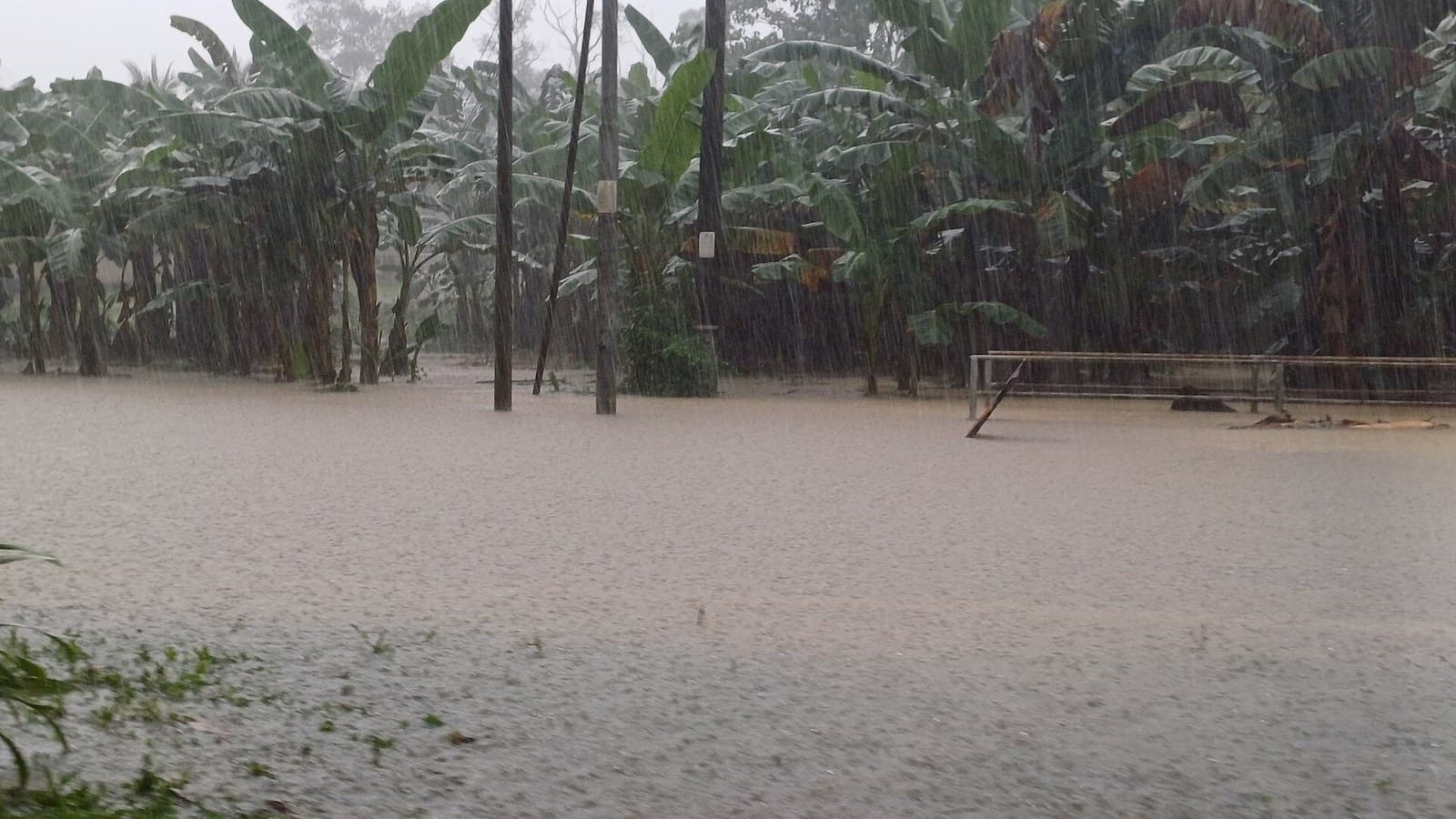
*Cover image: flooding in Sandakan, Sabah, January 2025. Photo by Tofeiku, CC BY-SA 4.0 via Wikimedia Commons.*