> Quick view: what the Gig Workers Act 2025 (Act 872) changed for platform riders and drivers in Malaysia, the exact PERKESO figures, and the four provisions worth knowing by heart. Sources: PERKESO's FAQ Bil. 2/2026 dated 31 March 2026, and the Gig Workers Bill 2025 (D.R. 27/2025) as tabled in the Dewan Rakyat.
Malaysia's gig economy spent a decade in a legal gap. A p-hailing rider was not an employee, so the Employment Act did not reach them; they were not quite an independent business either, because the terms, the rates and the account itself belonged to somebody else. The Gig Workers Act 2025 — Act 872 — is the law that closes that gap, and it came into force on 31 March 2026. The Human Resources Ministry has put the number of people affected at 1.64 million; when the Cabinet approved the accompanying commission a few weeks earlier, the figure quoted was more than 1.2 million, so treat any single count as an estimate rather than a census.
Most riders noticed the Act the same way: a new line on the earnings screen. Here is what that line is, and what else came with it.
The deduction: 1.25 per cent, and what it buys
PERKESO's own FAQ, published the day the Act took effect, is unusually plain about the mechanics. The platform provider deducts 1.25 per cent of every completed job transaction, accumulates it in the worker's gig wallet, and pays it to PERKESO until the total covers the annual contribution plan. There is no separate registration to do: the platform registers you, deducts, and reports.
The default is Plan 1, and the four plans are these:
- Plan 1 — insured monthly income RM1,050, contribution RM13.10 a month / RM157.20 a year. This is what you are on unless you change it.
- Plan 2 — insured monthly income RM1,550, contribution RM19.40 a month / RM232.80 a year.
- Plan 3 — insured monthly income RM2,950, contribution RM36.90 a month / RM442.80 a year.
- Plan 4 — insured monthly income RM3,950, contribution RM49.40 a month / RM592.80 a year.
The plan you are on decides every benefit figure below, because benefits are calculated against the insured monthly income, not your real earnings. A rider clearing RM3,000 a month who stays on the default Plan 1 is insured as if they earned RM1,050. Upgrading is allowed — you either let the wallet accumulate enough or top up through the PRIHATIN portal or app — and it is the single most useful thing an active full-time rider can do with ten minutes.
Three details that catch people out. If your job volume is low and the 1.25 per cent does not reach the plan amount, PERKESO says you will be notified to top up the shortfall. If you work across several platforms, all the deductions are consolidated into one gig wallet and you contribute under one sector only. And if you change plan part-way through a coverage period, benefits are paid at the plan in force at that moment, with no pro-rating, because contributions are prepaid.
Coverage begins from the first job you accept, not from the day the paperwork clears.
When does the deduction stop? Not the moment you have paid RM157.20. PERKESO's FAQ says that once the accumulated deduction has covered the current annual plan, the deduction keeps running for a maximum of twenty-four months, provided the existing plan contribution has been settled — and you will get a notification asking whether you want to move up a plan, on the reasoning that your job volume is clearly above the minimum the deduction was sized for. That also applies if you already had an active LINDUNG Kendiri contribution before the Act: the platform deduction still runs, and stops once your contributions reach the 24-month mark.
And if nothing is being deducted at all, the FAQ puts the first move on you — contact your platform directly so it can register you and switch the automatic wallet deduction on. Where a platform is not ready to run the API integration at all, PERKESO's answer is that the platform must approach PERKESO for manual bulk registration, with contributions then paid one-off directly to PERKESO. The obligation does not lapse because the plumbing is late.
Who is actually covered — and who is only half covered
This is the part most coverage skips, and it decides whether any of the money above applies to you.
Act 872 defines a gig worker widely: a Malaysian citizen or permanent resident who enters into a contract for service with a *contracting entity* — which includes, but is not limited to, a platform provider — and is paid for the service provided. A *platform provider* is narrower: any provider of a digital intermediary system that connects a gig worker's service to the person using it. On the day the Act commenced, BERNAMA reported that its protections reach not only e-hailing drivers and p-hailing riders but also non-platform gig workers in the film, music, translation and journalism sectors.
The mandatory 1.25 per cent is narrower than the Act itself. PERKESO's FAQ answers this twice, in question 5 and again in question 13: only gig workers who work and receive income through a platform provider are required to contribute under Act 872 and LINDUNG Kendiri. A gig worker without a platform provider is not mandated — they may still contribute voluntarily through the existing LINDUNG Kendiri route under the Self-Employment Social Security Act 2017 (Act 789), which means registering and paying themselves, as before.
So a freelance translator or session musician invoicing clients directly gets the Act's contract, payment and dispute protections, but no automatic injury cover appears on their behalf. If they want it, RM157.20 a year is the same price — they just have to go and buy it. Budget 2026 softened that: the government said it would subsidise 70 per cent of the Self-Employment Social Security Scheme contribution for first-time registrants in non-mandatory sectors, and 50 per cent in their second year — so a first-year Plan 1 policy works out to roughly RM47 of your own money.
One more wrinkle if you do several things at once. If all of your self-employment runs through platforms, you contribute under one sector only, the Service Provider sector. If you also run self-employment activity *outside* that sector, PERKESO says you must contribute separately for that activity under its own LINDUNG Kendiri sector.
What the contribution actually pays for
This is the Self-Employment Employment Injury Scheme under LINDUNG Kendiri, and PERKESO lists eight benefits. The money ones, at the rates published in the FAQ:
- Medical benefit — treatment at government clinics and hospitals, cost borne by PERKESO within the limits of the Fees Act 1951.
- Temporary disablement benefit — 80% of insured monthly income, minimum RM30 and maximum RM105.33 a day, and it requires a minimum of four days' sick leave including the day of the accident. Two days off with a sprained wrist gets you nothing; this is the threshold worth knowing before you decide whether to see a doctor.
- Permanent disablement benefit — 90% of insured monthly income, minimum RM31.50, maximum RM118.50 a day.
- Constant-attendance allowance — RM500 a month where the disablement is total and constant care by another person is needed.
- Dependants' benefit — paid monthly to eligible dependants on death, at 90%, minimum RM31.50 and maximum RM118.50 a day.
- Funeral benefit — RM3,000.
- Education loan benefit for the children of a worker who dies or receives periodic permanent-disablement payments.
- Physical and vocational rehabilitation — physiotherapy, occupational therapy, reconstructive surgery, prosthetics, orthotics and vocational retraining.
The definition that governs all of it is "self-employment injury": injury caused by an accident or occupational disease arising out of and in the course of your self-employment, including travel connected to it. For a delivery rider, the ride between jobs is the job.
One honest caveat in the FAQ, worth reading before you assume you are covered: if contributions are short, the shortfall is set off against the benefit you would otherwise be paid. Claims go in on Form PS2, with supporting documents — a police report where relevant, the MC, and proof of the self-employment.
The provisions nobody talks about
The social security half of Act 872 has had the coverage. The rights half has not, and it is where the law does something genuinely new. The section numbers below are those of the gazetted Act 872, and they track the clause numbers of the Bill as tabled in the Dewan Rakyat: sections 8, 11, 12, 13, 14 and 17 carry these provisions in the Act as passed. Conciliation sits at sections 18 to 23, the Tribunal at sections 24 to 45, the Director General's oversight at section 70, and the social security contribution obligation at section 82.
You get paid within seven days by default. If your service agreement says nothing about when income is paid, section 11 requires the contracting entity to pay within seven days of the service being completed. Failing to do so is an offence, not a customer-service issue.
Deductions from your income and your tips are restricted. Under section 12, a contracting entity cannot deduct from your income, tips or rewards unless the deduction is recovering an overpayment made by its own error and made no earlier than three months before, is permitted by law, or is authorised by the Director General. Your tips are named in the statute.
You can demand an income slip. Section 13 lets you request one from any contracting entity that is not an individual, and the entity commits an offence if it does not provide it in the prescribed form.
A suspension has a clock and a price. This is the one to remember. Under section 14, a platform may modify or suspend your access for no more than fourteen days in order to investigate, and must give you written notice of it. If it then finds there was no reason to deactivate you, it must reinstate your access and pay you half of your average daily income for the period you were suspended — calculated on the income from the days you actually worked in the thirty days before the suspension. A wrongful lockout is no longer free for the platform.
Complaints have a deadline. Section 17 requires a platform's internal grievance mechanism to start and resolve a written dispute within thirty days. Deactivation disputes are excluded from that route — they go to the Tribunal set up under the Act, which can award consequential loss and damages, and whose awards are binding with an appeal to the High Court.
And you must be told when an algorithm is judging you. Section 8 requires a platform to inform you of any automated monitoring system used to monitor, supervise or evaluate you and the consequences that follow from it, of any automated decision-making system used to allocate jobs and set your working conditions, and to provide a non-automated review mechanism for both. Any contract term that tries to waive these rights is void. For a workforce managed almost entirely by software, that is the most consequential sentence in the Act.
What it does not do
It does not cover EPF. Retirement savings were left out of Act 872 — the mandatory deduction funds PERKESO only. The deduction mechanism the Act creates could in principle be extended to EPF contributions later, and the government has said it is looking for a way to do that, but as the law stands a gig worker's retirement saving remains voluntary. It is no longer entirely unaided, though: under EPF's i-Saraan Plus, e-hailing and p-hailing drivers who make voluntary contributions through their platform provider get a government special incentive of 20 per cent, up to RM600 a year — so contributing RM3,000 in a year earns the full RM600 — capped at RM6,000 for life or until age 60. You must be a Malaysian under 60 registered for i-Saraan; enrolment in i-Saraan Plus is automatic once your platform pays a contribution for you.
It does not make you an employee. The Act regulates a contract *for* service, not a contract *of* service. There is no annual leave, no sick leave entitlement beyond the injury scheme, no notice pay and no minimum wage in it.
And enforcement is new. Act 872 sets up a Director General with investigation and enforcement powers, a Tribunal, and a Consultative Council; the government separately established the Malaysian Gig Economy Commission, SEGiM, to coordinate implementation, its council members reported as appointed from 1 April 2026, with complaints routed through the ministry's eAduan platform. Penalties are real on paper — failing to comply with a Tribunal award carries a fine of up to RM50,000, imprisonment of up to two years, or both, plus RM500 a day for a continuing offence, and the Act's general penalty is the same RM50,000 and two years — but a law is only as good as the first few cases brought under it, and those are still working through the system.
What changes on 1 October 2026
For the first six months the Act was mostly plumbing. PERKESO gave platforms roughly three to six months to wire their systems to its API, and progress was uneven: in May 2026 PERKESO said seven of the fourteen major platforms — AirAsia Ride, Kiddocare, GoGet, ShopeeFood, Troopers, Fastgig and Foodpanda — had integrated and started the automatic 1.25 per cent, while the other seven had yet to hand over worker data.
That grace period runs out at the end of September 2026. On 22 September 2026, during its nationwide Op Kesan 2.0 sweep (159 inspections and 14 compound notices by late morning, under Acts 4, 800 and 789), PERKESO said it had registered 1.17 million gig workers and would begin enforcement against platform providers from 1 October 2026. For a rider, the practical meaning is simple: if your earnings screen still shows no PERKESO deduction in October, that is now your platform's compliance problem rather than a teething issue — and a gap you should raise with the platform and PERKESO, because until you are registered, there is no injury cover behind you.
What to do this week if you ride or drive
- Open your platform app and find the deduction line. Confirm 1.25 per cent is being taken and that you are registered. If nothing is being deducted, PERKESO's instruction is to contact your platform directly to register.
- Check your contribution status yourself on the PRIHATIN portal or app, or at a PERKESO office. Do not assume the platform has filed it.
- Look at which plan you are on. If you are full-time and earning well above RM1,050 a month, Plan 1 insures you at a fraction of your real income. Upgrading costs RM19.40 to RM49.40 a month.
- Screenshot everything if you are suspended. Note the date and time of the notice, keep the written notification, and count the days. Fourteen is the ceiling, and if the investigation clears you, half your average daily income for that period is owed.
- Ask for an income slip if you have ever needed proof of earnings for a loan, a rental or a claim. You now have a statutory right to one.
- Switch on EPF saving in the app if your platform offers it. Contributions routed through the platform under i-Saraan Plus earn the 20 per cent government match, up to RM600 a year; you must be registered for i-Saraan first.
Related reads
- Renewing Your Road Tax and Driving Licence Online in 2026 — and Why an Expired Licence Now Costs You at the Pump — the other paperwork that decides whether you can legally be on the road earning
- LHDN's e-Invoice Grace Period Now Runs to 31 December 2027: What Malaysian Businesses Still Need to Fix — the tax side of gig and freelance income, and the deadline attached to it
- The New MyKad: Nobody Has One Yet, and What Replacing Yours Really Costs — you need a valid MyKad for the PERKESO registration behind all of this
*Sources: PERKESO, "Soalan-Soalan Lazim: Perlindungan Skim Keselamatan Sosial Pekerjaan Sendiri (LINDUNG Kendiri) kepada Pekerja Gig di bawah Peruntukan Akta Pekerja Gig 2025 [Akta 872]", Bil. 2/2026, 31 March 2026; Gig Workers Act 2025 (Act 872), Laws of Malaysia, gazetted 31 December 2025; Gig Workers Bill 2025 (D.R. 27/2025), Parliament of Malaysia; BERNAMA and Ministry of Human Resources statements on the Act's commencement, 31 March 2026; New Straits Times, 12 May 2026 (platform integration); The Star and Borneo Post, 22–23 September 2026 (Op Kesan 2.0 and 1 October enforcement); EPF, i-Saraan Plus page (kwsp.gov.my, checked 27 September 2026); Malay Mail, 10 October 2025 (Budget 2026 subsidies).*
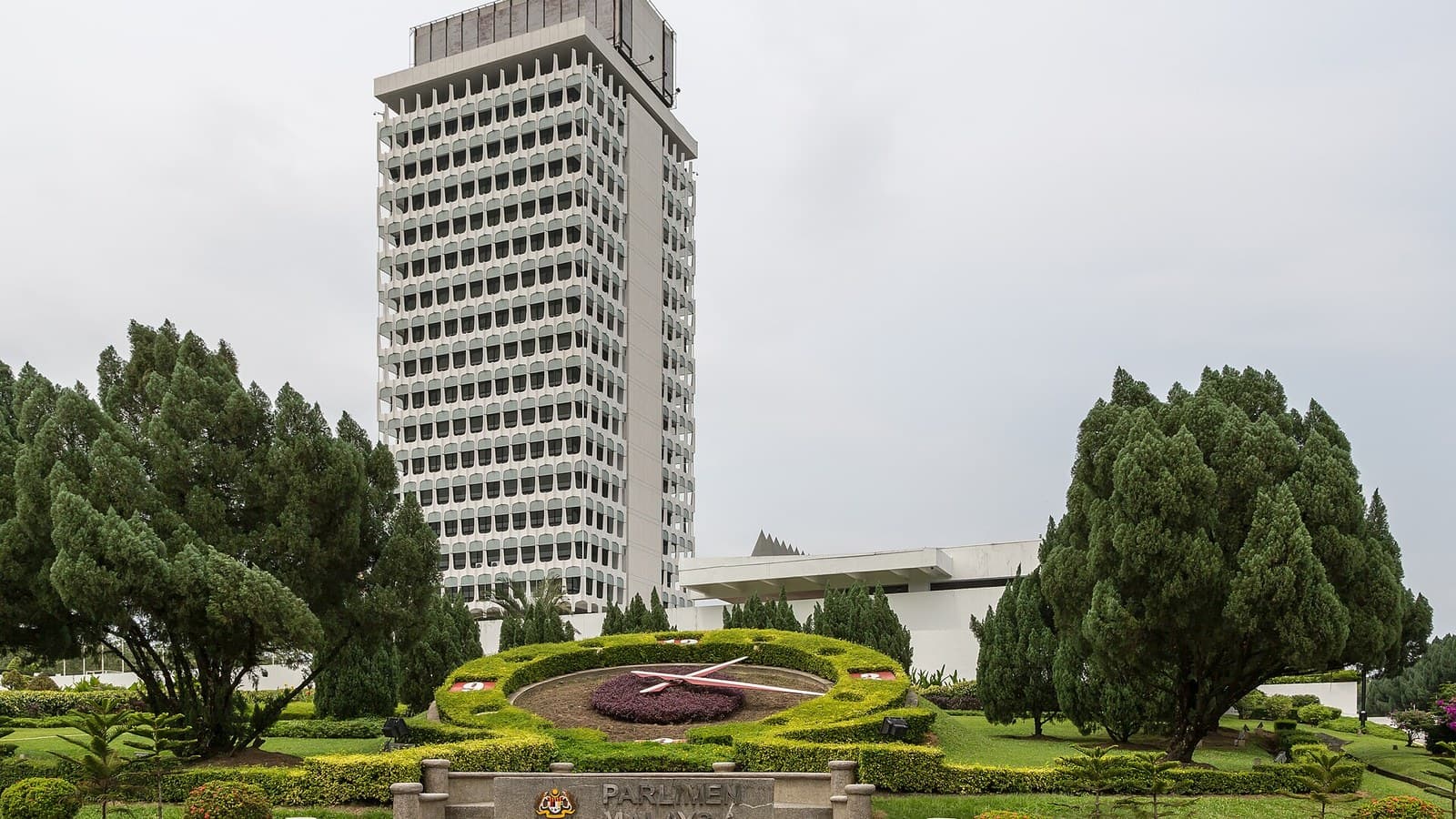
*Cover image: Bangunan Parlimen Malaysia, photo by CEphoto, Uwe Aranas, CC BY-SA 3.0, via Wikimedia Commons*