Malaysia's e-Invoice system is now fully phased in, and the questions that still come up in every Malaysian small-business group chat are the same three: do I have to, when did I have to, and what happens if I got it wrong. Here is what the Inland Revenue Board of Malaysia (LHDN, or HASiL) actually publishes, read from the e-Invoice Guideline (Version 4.8, issued 30 August 2026) and the e-Invoice Specific Guideline (Version 4.9), both re-checked on hasil.gov.my on 1 October 2026.
The timeline, and what it is based on. LHDN's implementation page sets out four phases by annual turnover or revenue: more than RM100 million from 1 August 2024; more than RM25 million and up to RM100 million from 1 January 2025; more than RM5 million and up to RM25 million from 1 July 2025; and up to RM5 million from 1 January 2026. Version 4.8 of the guideline reproduces the same four phases unchanged.
The part that gets skipped is how your bracket is decided. It is not this year's turnover. LHDN determines it from financial year 2022: the annual turnover or revenue in the statement of comprehensive income in your audited financial statements for FY2022, or, if you have no audited accounts, the annual revenue reported in your tax return for year of assessment 2022. If you changed your accounting year end in FY2022, the figure is pro-rated to a twelve-month period — the guideline works through an example where an eighteen-month FY2022 with RM60 million of turnover becomes a RM40 million twelve-month average, putting that company in the 1 January 2025 phase.
And then it is fixed. In LHDN's own words, once a taxpayer's e-Invoice implementation timeline has been determined, any changes to annual turnover or revenue in subsequent years will not change the obligation. A business that has since grown past RM25 million does not move up a phase, and one that has shrunk does not move down.
The RM3 million floor. Section 1.6.1 of the guideline lists the persons currently exempted from issuing an e-Invoice, including a self-billed e-Invoice. The list runs: a foreign diplomatic office; an individual who is not conducting business; a statutory body, statutory authority or local authority in relation to statutory collections such as fees, charges, levies, summonses, compounds and penalties, and for goods sold or services performed before 1 July 2025; an international organisation for transactions before 1 July 2025; and — the one that covers most Malaysian micro-businesses — taxpayers with an annual turnover or revenue of less than RM3,000,000. Until Version 4.8 was issued on 30 August 2026, that line read less than RM1,000,000.
Three qualifications sit immediately under it, and all three matter. Receipts and existing documents issued by an exempt person remain valid proof of expense for tax purposes. Suppliers who sell goods or services to an exempt person are still required to issue an e-Invoice on their own timeline. And any entity owned by an exempt person — a company, an LLP — is still required to implement e-Invoicing on its own schedule; the exemption attaches to the person, not to everything they own.
Three carve-outs that are new in Version 4.8. Section 1.6.10 says the under-RM3,000,000 exemption applies to every category of taxpayer — individuals, partnerships, companies, co-operatives — and then takes three groups back out. It does not apply to a taxpayer with a non-individual shareholder (or equivalent) whose annual turnover or revenue is at least RM3,000,000; to a subsidiary of a holding company at that level; or to a taxpayer with a related company or joint venture at that level, with "related company" taking its meaning from section 2 of the Promotion of Investments Act 1986. In plain terms: a RM2 million sole proprietorship is out of the obligation, while a RM2 million Sdn Bhd owned by a RM50 million group is not.
New businesses get their own rule. The same guideline sets dates for businesses that did not exist in FY2022. One that started operating between 2023 and 2025 with annual turnover or revenue of at least RM3,000,000 implements from 1 July 2026. One starting in 2026 or later implements from 1 July 2026 or its commencement date — but if its first year's turnover is expected to be under RM3,000,000, its date becomes 1 January of the second year after the year in which turnover first reaches RM3,000,000.
What needs no e-Invoice at all. Separately from the exempt persons, LHDN lists income and expense types where no e-Invoice, including self-billed, is required: employment income, pension, alimony, distribution of dividends in specified circumstances, zakat, the contract value for buying or selling securities or derivatives traded on an exchange in Malaysia or elsewhere, the disposal of shares in an unlisted company (except where the disposer is a company, LLP, trust body or co-operative society), and donations or contributions as specified in the relevant FAQ. The guideline adds that these exemptions will be reviewed and updated from time to time.
Getting it wrong, and the 72 hours. Once an e-Invoice is validated, both sides have a short window. A buyer who spots an error — a wrong SST number, a wrong business registration number, wrong business information — can request rejection within 72 hours of validation through the MyInvois Portal, stating the reason. The supplier is notified and, if it agrees, may cancel within the same 72 hours from validation. If the supplier does not accept the rejection or simply does not act, no cancellation is allowed once the 72 hours have elapsed, and the only remaining fix is to issue a new credit note, debit note or refund note e-Invoice. A supplier who spots its own error can cancel within 72 hours of validation directly, with a justification.
The free option. For businesses that do not want to buy accounting software for this, LHDN provides MyInvois e-POS, a digital point-of-sale platform it supplies free of charge to micro, small and medium enterprises. Alongside sales management, accounting, inventory and financial reporting, it generates e-Invoices at the point of transaction, or lets a buyer request one after the fact. That page was last updated on 14 August 2026.
How the floor moved, twice. Guidance written before September 2026 is now wrong, and guidance written before 2026 is wrong twice over. Until the end of 2025 the floor sat at RM500,000. It was raised to RM1,000,000 with effect from 1 January 2026, which made the 1 January 2026 group the last mandatory phase. Then, in the 30 August 2026 National Day address, the government raised it again to RM3,000,000 with effect from 1 September 2026, and LHDN issued Version 4.8 of the guideline the same day; LHDN put the number of businesses now outside mandatory implementation at more than 1.1 million — the detail is in our write-up of the six cost-of-living measures. A business turning over RM2 million that has been issuing since January no longer falls under the obligation, unless one of the three carve-outs catches it. It can keep issuing voluntarily, which section 1.6.6 explicitly welcomes, and some will, because their larger customers prefer it.
Being inside the final phase is not the same as being penalised inside it. The final phase — the 1 January 2026 group, plus new businesses on the 1 July 2026 date — has an interim relaxation period that now runs until 31 December 2027, a year longer than first announced (Table 16.1 of the e-Invoice Specific Guideline, Version 4.9). During it, LHDN permits consolidated e-Invoices and consolidated self-billed e-Invoices for all activities, any wording in the product or service description field, and no individual e-Invoice even when a buyer asks for one, and it will not prosecute under section 120 of the Income Tax Act 1967 where those conditions are met. The RM10,000 single-transaction rule (listed from 1 January 2026) and the e-Invoice Special Voluntary Disclosure Programme (7 July 2026 to 31 December 2027) are a different subject from who has to issue at all — see our grace-period explainer, updated for the 31 December 2027 end date.
Two honest caveats. The exemption clause states "less than RM3,000,000" without naming the year in the same sentence, while the phase-allocation rule elsewhere in the same document is explicitly anchored to FY2022 — if your turnover sits near that line, ask LHDN or your tax agent which year applies to you rather than assuming. And LHDN states plainly that the exemption lists are reviewed and updated from time to time, so a business that is exempt today is not exempt permanently.
This is a summary of what LHDN publishes, not tax advice. The sources are LHDN's e-Invoice Implementation Timeline page, the e-Invoice Guideline (Version 4.8, 30 August 2026), the e-Invoice Specific Guideline (Version 4.9) and the MyInvois e-POS page, all on hasil.gov.my. Confirm your own position with LHDN or a licensed tax agent before you act on it.
Related reads
- Six Cost-of-Living Measures from 1 September 2026 — where the RM3 million e-Invoice exemption was announced, with LHDN's 4 September FAQ on who qualifies
- LHDN's e-Invoice Grace Period Now Runs to 31 December 2027: What Malaysian Businesses Still Need to Fix — the enforcement half of this subject: the relaxation that now runs to 31 December 2027, the RM10,000 rule that survives it, and the voluntary disclosure window
- 8 Company Incorporation & Corporate Secretary Services Worth Knowing in Malaysia (2026) — the people who prepare the audited accounts your FY2022 phase was read from
- 7 Coworking, Serviced & Virtual Office Operators in Johor Bahru 2026 — the registered-address question that tends to arrive in the same conversation
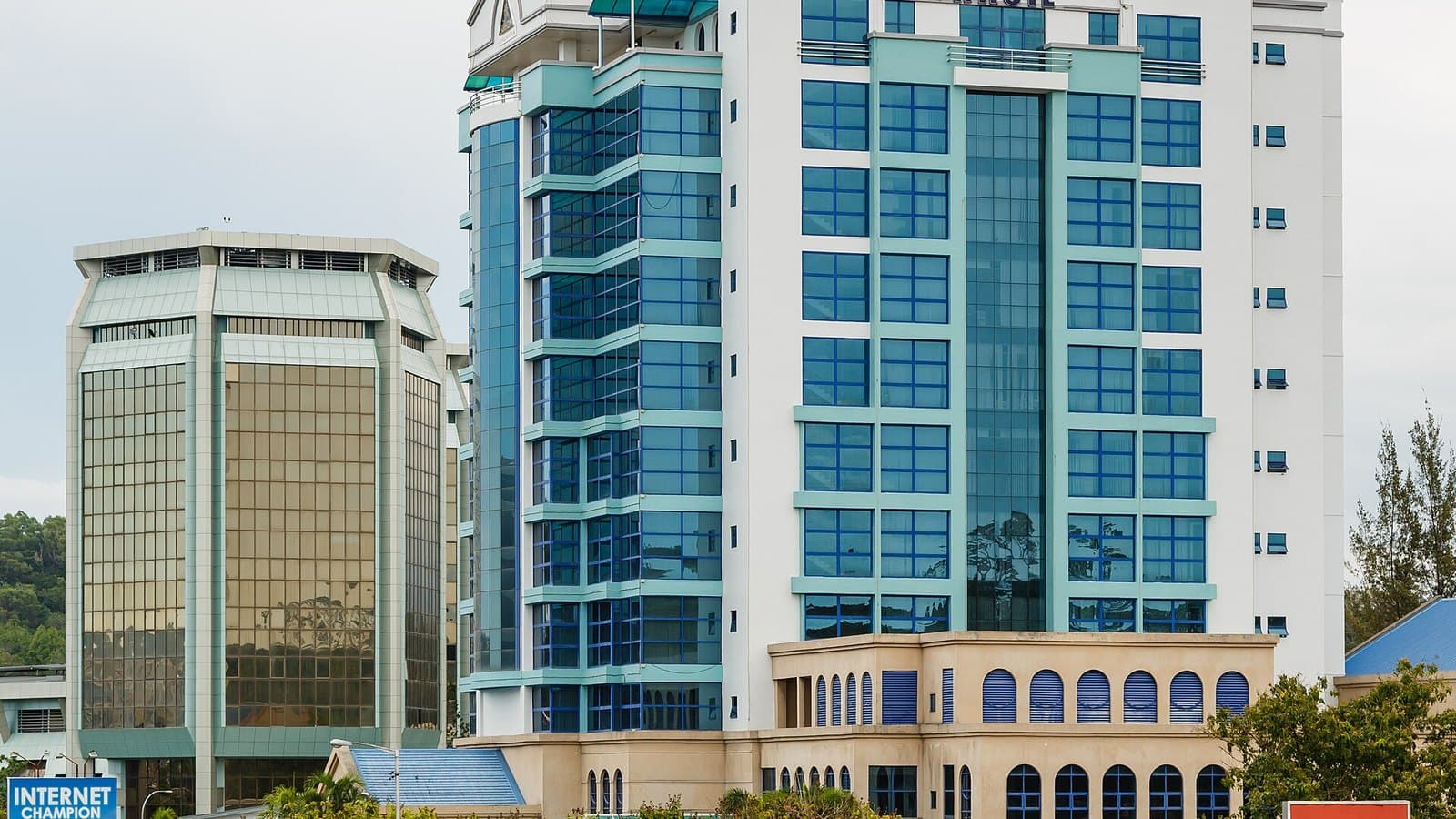
*Cover image: Wisma Hasil, the Inland Revenue Board office in Kota Kinabalu — CEphoto, Uwe Aranas, CC BY-SA 3.0, via Wikimedia Commons*