Almost every Malaysian graduate believes two things about PTPTN that stopped being true on 1 January 2026.
The first is that a first-class degree cancels the loan. The second is that PTPTN will tell you when to start paying. Neither holds. And a third change, published on 7 July 2026 with almost no coverage, is the one that will cost long-defaulting borrowers the most: PTPTN has handed its oldest arrears to seven appointed debt agencies, and every ringgit they collect carries a 15 per cent fee that the borrower pays.
Budget 2027: a deferment, an RM50 minimum and a 10 per cent discount, all from 2027
Budget 2027, tabled on 9 October 2026, carries four PTPTN measures, and PTPTN confirmed all four in a statement on its own portal dated 11 October 2026. None of them is in force yet. They apply in 2027, and PTPTN says the implementation details will be announced shortly.
- Gross monthly income up to RM2,500: repayment deferred for 2027. PTPTN's statement puts the reach at more than 400,000 borrowers.
- Gross monthly income of RM2,501 to RM3,000: a minimum repayment of RM50 a month.
- No arrears and repaying regularly: a 10 per cent repayment discount. PTPTN describes it as a reward for active borrowers who pay consistently and on schedule.
- Employers that repay PTPTN on an employee's behalf: a tax deduction, covering payments made from January 2027 to December 2028.
The Finance Ministry's Budget touchpoint document puts the whole package at RM196 million, and both income tiers are subject to verification by cross-checking income information with LHDN, the Inland Revenue Board.
What has not been published yet matters as much as what has. As of 14 October 2026, neither PTPTN nor the Finance Ministry has said how to apply, whether the deferment is automatic, whether ujrah keeps accruing during the 2027 deferment, or how the 10 per cent is calculated. That last point changes the value enormously. On a RM200 monthly instalment, 10 per cent off each instalment would be RM20 a month, or RM240 over 2027. Applied to a RM20,000 outstanding balance, the same 10 per cent would be RM2,000. Until PTPTN publishes the mechanics, plan on neither figure.
Two practical consequences follow now. First, keep paying through the rest of 2026: the deferment does not start until 2027, and the existing unemployment deferment below is still the only pause available today. Second, the discount is conditional on having no arrears. A borrower who lets an account slip in the last months of 2026 is putting the one benefit that rewards regular payers at risk.
What changed on 1 January 2026
The changes follow Budget 2026, tabled on 10 October 2025 under the title Belanjawan MADANI Keempat: Belanjawan Rakyat, and PTPTN sets them out on a single page on its own portal, Pelaksanaan Inisiatif Belanjawan 2026, dated 20 January 2026.
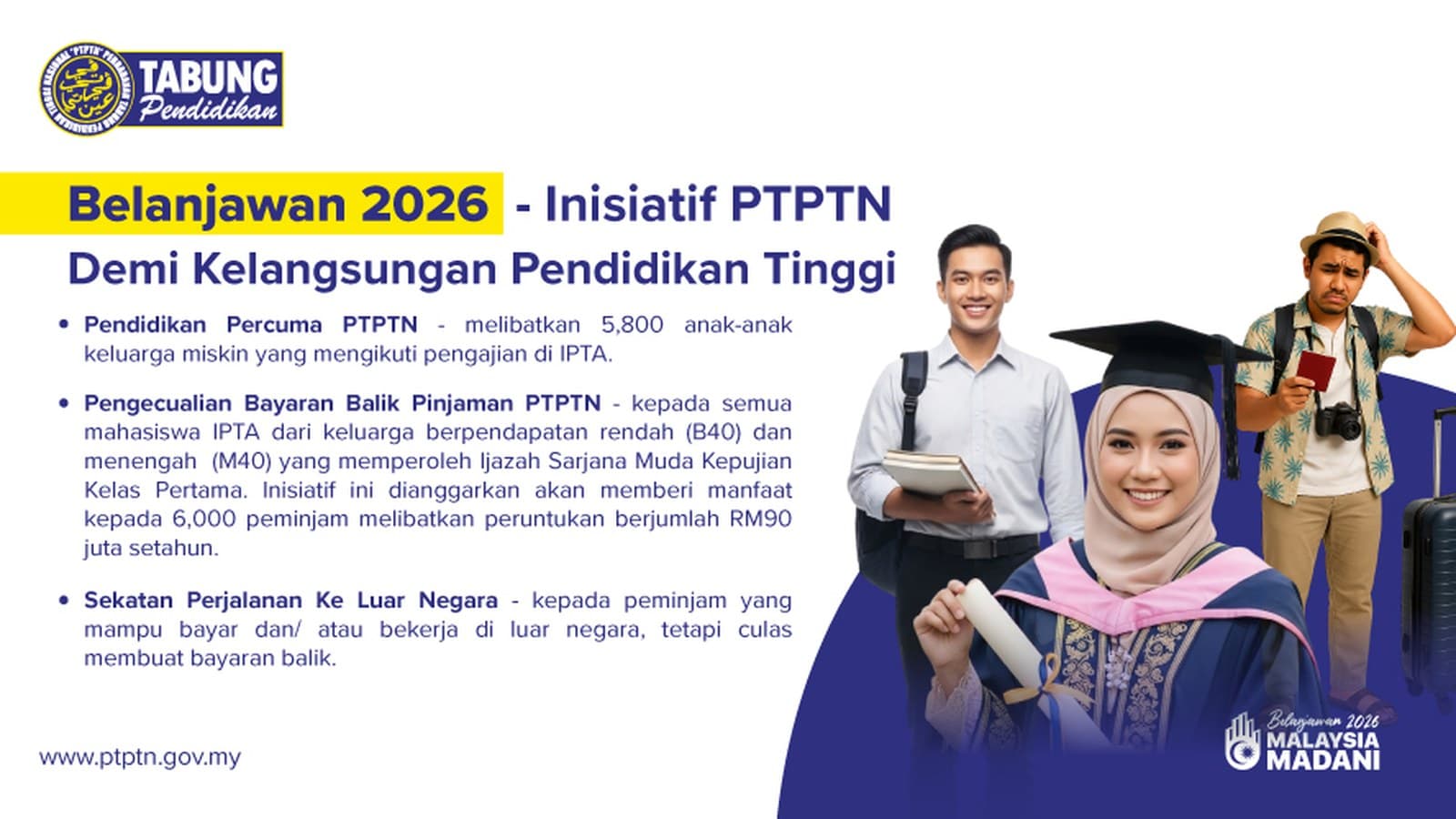
The first-class exemption became means-tested. Previously understood as a reward for academic performance, the write-off for a first-class Bachelor's degree from a public university now applies only to borrowers from B40 and M40 households, and only to those who complete their studies from 1 January 2026. Income category is assessed against the Department of Statistics Malaysia's Household Expenditure Survey. The household counted is not the same for everyone: a single borrower is assessed on the combined income of the borrower and their parents or guardian, while a married borrower is assessed on the borrower and their spouse. PTPTN's own Budget 2026 material puts the initiative at 6,000 borrowers and an allocation of RM90 million a year.
The trap is procedural rather than financial. The exemption is not applied automatically at graduation. It has to be claimed through the myPTPTN web application within twelve months of the convocation date, and PTPTN states that late applications will not be considered. A first-class graduate who assumes the paperwork happens on its own has one year to find out otherwise.
Its own FAQ sets six conditions, and three of them decide how much is actually written off. The degree must be a full-time Bachelor's with first-class honours from a public university, awarded by that institution's own senate. Studies must have finished inside the period stated in your PTPTN loan offer document. And the loan must not overlap with any other sponsorship.
Three further limits are worth knowing before you count on the money. If your Diploma and Degree loans were merged, only the Degree portion is exempted — you still repay the Diploma part. Loan money disbursed after you finished studying, sponsorship that overlaps, and any unsettled Wang Pendahuluan Pinjaman all reduce the amount written off. And PTPTN states plainly that granting the exemption is subject to the Government's current financial position, so meeting every condition makes you eligible, not guaranteed. Supporting documents have to be certified by a Management and Professional officer at the university that issued the scroll — not at whichever campus you happen to be at now.
A new scheme removes the loan entirely for the poorest students. Biasiswa Anak eKasih PTPTN, shortened to BAeK PTPTN, gives the PTPTN loan as a scholarship rather than a debt to students from hardcore poor and poor households listed in the eKasih database. The process is counter-intuitive and worth stating plainly: the student still applies for the ordinary PTPTN loan through the myPTPTN web application first, and those who qualify are then offered the scholarship, notified by email and by a notification in the app. PTPTN's Budget 2026 banner puts the reach at 5,800 children from poor families.
What most coverage leaves out is that being on eKasih is not enough on its own. PTPTN's dedicated BAeK page, published 21 July 2026, sets eight conditions, and two of them are hard gates people will fail without realising: the applicant must be no older than 25 on the date of application, and must already hold an active Simpan SSPN Prime or Simpan SSPN Plus account. The rest are Malaysian citizenship; full-time Diploma or Bachelor's study at a public university with the PTPTN loan approved from 1 January 2026; being listed in eKasih; a course registered in PTPTN's application system; no PTPTN loan account currently handled by a debt agency; and at least one semester of study still remaining when the loan application is made.
The scholarship equals the loan the student would otherwise have taken on. It is paid semester by semester straight into the student's own bank account, released against examination results confirmed by the university, so wrong or dormant bank details delay it. And the signed BAeK offer document cannot be submitted online: it has to be handed in physically at a PTPTN branch counter within 60 days of the offer letter date.
The overseas travel bar was narrowed to three groups. PTPTN describes enforcement as targeted, and lists the criteria: arrears of more than five years combined with the ability to repay, a court judgment already recorded, or working abroad while failing to repay. Any of the three can trigger it. Coming off the list requires settling the full debt or the arrears including all costs charged. Borrowers who cannot do that are directed to negotiate through myPTPTN, and PTPTN advises doing so at least five days before a departure date to avoid being stopped at the airport or a land border. Status can be checked independently on the Immigration Department's own portal at sspi.imi.gov.my.
The change nobody reported: seven debt agencies, and a 15 per cent fee
On 7 July 2026 PTPTN published a page titled Agensi Perunding Hutang (APH). For anyone already deep in arrears it is the most expensive document on the portal, and it is written in plain terms.
PTPTN has appointed seven external agencies under Section 35 of the PTPTN Act 1997 (Act 566) to negotiate with defaulting borrowers: Pasadana Sdn Bhd, Rural Capital Berhad, Maysky (M) Sdn Bhd, Chain Resources (M) Sdn Bhd, Hadra Sdn Bhd, Noble Nexus Sdn Bhd and MSM Midas Partners Sdn Bhd. Priority goes to accounts more than 120 months — ten years — in arrears, and to accounts with a court judgment recorded.
Three consequences follow, each stated by PTPTN itself.
Once an account is handed over, the borrower can no longer negotiate with PTPTN directly. Everything, restructuring included, runs through the agency.
Every payment the agency collects carries a fee of 15 per cent of the amount collected, and PTPTN says the fee is borne entirely by the borrower. On RM20,000 of arrears that is RM3,000 on top of the debt.
Restructuring is not available until the borrower has cleared at least 50 per cent of the arrears plus the agency fee. Only after the restructuring documents are completed and returned through myPTPTN does the account leave the agency and come back to PTPTN.
Two practical notes. An agency representative should carry a PTPTN letter of appointment or letter of authority; if you are unsure a caller is genuine, PTPTN's careline is 03-2193 3000 and there is a live chat on the portal. And an APH may not accept cash — payment still goes through PTPTN's own channels.
The inference PTPTN wants you to draw is the correct one: negotiating before your account reaches an agency is 15 per cent cheaper than negotiating after.
If you genuinely cannot pay, the deferment is what to ask for
The alternative to arrears is not silence, and PTPTN publishes two separate mechanisms that a lot of borrowers have never heard of. Both apply to ujrah-scheme loans; a conventional borrower has to convert to ujrah first.
The larger one is penangguhan bayaran balik, a formal deferment for borrowers who are unemployed or studying again. No ujrah is charged for the whole approved period. For unemployment it runs to a maximum of 24 months, but it is granted six months at a time and you have to reapply for each stretch. For further study the length follows the new course: two years for a foundation, professional, certificate or advanced diploma programme, three for a diploma, four for a bachelor's degree, and two each for a master's or a PhD. You apply on myPTPTN with an EPF statement and a statutory declaration, or with your new offer letter.
Two details catch people out. A salary deduction, direct debit or standing instruction does not stop when the deferment is approved — you have to cancel it yourself at a PTPTN counter or with your bank, and anything already collected is not refunded. And during the deferment you cannot apply for a restructuring, rescheduling or consolidation; those wait until it ends. Your repayment period is extended automatically by a restructuring, notified by email rather than by a fresh agreement, and your CCRIS record stays as it was.
The smaller one is the no-income update, found under Perkhidmatan > Bayaran Balik > Pengemaskinian Maklumat Tiada Pendapatan in the myPTPTN web app. If the cross-check confirms your details, PTPTN suspends enforcement action for six months and waives the monthly ujrah with it. It is given once per borrower and cannot be extended, and when the six months end every ujrah loan is restructured automatically and repayment resumes.
The prize campaign is 3.0, not 2.0 — and the door for new sign-ups is shut
PTPTN's current repayment campaign is Bayar Konsisten, Hati Senang 3.0. The confusion is easy to explain: the campaign sits on a version-neutral URL whose page title still reads "Bayar Konsisten Hati Senang 2.0" from last year's edition, which ran 1 June to 31 October 2025. The terms and conditions and the FAQ linked from that same page are both labelled 3.0, and PTPTN's promotions index lists 3.0 under 2026 and 2.0 under 2025.
Its two dates do not match. The campaign period runs 1 June to 31 October 2026. The application period for the salary deduction or direct debit that makes a new borrower eligible ran 1 June to 31 August 2026, and has closed.
For a borrower who already pays by salary deduction or direct debit, nothing needs doing: the terms state that no application form has to be signed or completed, and each successful deduction inside the campaign period earns one draw entry. What does need doing is keeping the arrangement alive — the deduction must stay active until the draw date with no failed transaction, unless the loan is settled in full. PTPTN staff and their spouses and children are excluded.
The pot is smaller than the publicity suggests: RM50,000 across 90 winners. Each of the two categories, salary deduction and direct debit, carries five main prizes of RM1,000 and forty consolation prizes of RM500. And the money never reaches your bank account — a cash prize is credited to the winner's loan account as a repayment within two months of the announcement, with any excess going into a Simpan SSPN Prime account. Prizes must be claimed within twelve months, and they do not count towards tax relief.
Anyone who missed the sign-up window has lost the draw, not the discount. Setting up a salary deduction or direct debit is still worth doing on its own terms, and can still be applied for through myPTPTN.
The repayment campaign that is still open
Kempen Setel PTPTN dengan CIMB runs the whole year, 1 January to 31 December 2026, with winners drawn quarterly. It is the only repayment-linked PTPTN campaign a borrower can still join today, and almost nobody writes about it.
It requires a CIMB Islamic DURIAN-i account and repayment of your own PTPTN loan; on a joint account only the primary holder qualifies. The base condition is a minimum average balance of RM100 in the DURIAN-i account each quarter. Entries then stack: opening a DURIAN-i account gives 10 entries, capped at 10 a year; each PTPTN repayment by JomPAY, Pay Bill or auto debit from that account gives 5, capped at 5 a month; each repayment through the myPTPTN app debited from that account gives 10, capped at 10 a month; setting up a scheduled auto-debit gives 5, capped at 5 a year; three consecutive months of repayment gives 5, capped at 20 a year; and a quarterly average balance of RM2,000 gives 10, capped at 20 a year.
The pot is RM500,000 across 144 winners a year — 36 per quarter, made up of one RM25,000 main prize, two of RM20,000, three of RM10,000 and thirty of RM1,000. As with the other campaign the cash is credited to the winner's loan account rather than paid out, and each customer can win only one quarterly prize across the campaign.
Attached to it is a smaller but far more certain reward. A separate CIMB term sheet, Setel PTPTN dengan CIMB – Ganjaran Pendaftaran RM30, runs 15 June to 31 December 2026 and pays RM30 in Touch 'n Go eWallet credit to the first 200 qualifying customers each campaign month, first come first served. It is open only to PTPTN borrowers who did not already hold a DURIAN-i account; the account must be opened online through the campaign's own link, because opening it by scanning a QR code at a branch does not qualify; and you must register a CIMB Clicks ID and download the CIMB OCTO app. Rewards are fulfilled within 90 working days of the end of each campaign quarter.
There is no repayment discount running right now — the next one is due in 2027
This is worth stating flatly, because a 10 per cent PTPTN discount is quoted constantly on Malaysian social media and in old blog posts.
Re-checked on 14 October 2026, PTPTN's promotions index still lists exactly two live repayment-side campaigns for 2026 — Bayar Konsisten, Hati Senang 3.0 (to 31 October) and Setel PTPTN dengan CIMB (to 31 December) — and neither is a discount. What has changed is that a discount now has a year attached. Budget 2027 gives a 10 per cent repayment discount to borrowers with no arrears who repay regularly, and PTPTN confirmed it on 11 October 2026, but it applies from 2027 and PTPTN has not yet published how it is calculated or how long it runs (see the Budget 2027 section above). Any discount figure quoted for a settlement made today is still historical. Confirm your balance inside myPTPTN or at a branch before planning a lump-sum settlement around a discount, and ask for the Surat Penyelesaian Hutang once a full settlement clears.
The rules that have not changed, and still catch people
Repayment begins twelve months after the loan ends, and PTPTN is explicit that borrowers do not wait for a repayment notice. Its own FAQ says there is no provision in the agreement making a notice a precondition. Ujrah, the service cost, is charged monthly from the thirteenth month, which means repayments made inside that first twelve-month window carry no ujrah at all. Paying early is the cheapest thing a borrower can do.
Payments must reach PTPTN by the 27th of the month to appear on that month's statement, except at a PTPTN counter or through a marketing executive, where transactions up to the end of the month still count for the current month. Paying less than the monthly instalment does not reduce the instalment, it creates arrears and can trigger enforcement; the correct route is a restructuring negotiation to lower the instalment formally.
The channel matters more than most borrowers notice, and three of them are free. Paying through the myPTPTN app, through JomPAY, or by debit or credit card at a PTPTN counter carries no listed charge at all. Everything else does, and the charge is not the same at a counter as it is online: a Bank Rakyat counter costs RM0.50 while Bank Rakyat internet banking costs RM1.00, and Bank Simpanan Nasional works the same way round. The dearest channel on the list is a Pos Malaysia counter at RM2.00. Most channels take three working days to update against one day at a PTPTN counter. On a monthly instalment paid for fifteen years a RM1 charge is RM180 — and the app costs nothing.
Salary deduction is not optional for everyone. Since September 2015 every public servant with a PTPTN loan has been required to repay by salary deduction, and since 1 November 2015 PTPTN has run those deductions itself rather than through LHDN. A borrower is not allowed to stop a salary deduction while a balance remains; it is cancelled only on full settlement, on bankruptcy confirmed by the Insolvency Department, or when PTPTN is told the borrower has left or changed employer. On the other side, an employer that fails to action a deduction after written notice commits an offence under Section 29 of the PTPTN Act, punishable by a fine of up to RM20,000, up to a year in jail, or both.
Direct debit has a trap of its own. If a deduction fails for insufficient funds, PTPTN does not double up the following month — that month simply has no repayment, and the account slips towards arrears. Direct debit also cannot run off a credit card, only a savings or current account, and two different people cannot both set up a direct debit against the same loan account.
Finally, PTPTN repayment can be made from an EPF Account II withdrawal, and the terms are better than most borrowers assume: there is no withdrawal limit, no processing charge, you can withdraw more than once while Account II still has a balance, and a parent can use their own Account II for a child's loan. The study level must be Diploma or above. The catch is procedural — the e-Pengeluaran application is submitted online through i-Akaun, but you then have to attend an EPF branch in person for thumbprint verification within 14 days of the security message, or the application is cancelled automatically. EPF processes a complete application within 15 working days of that visit.
Related reads
- EPF Akaun Fleksibel Withdrawals 2026: What You Can Take Out, and What It Costs You Later — the other side of using EPF money early
- Renew a Malaysian Passport Online 2026 — worth reading alongside the travel-bar section above
- Unclaimed Money in Malaysia 2026: How to Check Yours Free on eGUMIS — money already in your name, before you borrow more
*Cover image: PTPTN.*