> This explainer is built from two public sources: the Finance Ministry's official BUDI MADANI FAQ on budimadani.gov.my, and the weekly retail fuel price series published by the Department of Statistics Malaysia on data.gov.my. Re-checked on 1 October 2026: the FAQ is still the 30 June 2026 edition, so it predates the 1 September quota change and still prints 200 litres. Every rule below that comes from it is one the September announcements did not touch; the quota figures come from the government's 30 August and 16 September announcements as reported by the national press, labelled with the date and speaker.
The quota is 300 litres again
The cut to 200 litres a month took effect on 1 April 2026, presented as a temporary response to the oil price shock from the West Asia conflict. It lasted five months. In his National Day address on 30 August 2026, Prime Minister and Finance Minister Anwar Ibrahim announced that the BUDI95 quota would return to 300 litres a month from 1 September — the level the scheme launched with on 30 September 2025. The reasons the government gave were more orderly fuel-supply management, stronger enforcement against leakage, the economy's performance and the government's financial capacity, along with the needs of people who drive long distances every day and small traders who depend on a vehicle to earn a living. About 16 million BUDI95 users are covered.
Nobody had to do anything. The change was applied automatically to every eligible MyKad, and the BUDI Diesel side moved with it: the shared base is now 300 litres, and jeep and pick-up owners with the diesel top-up go to 400 litres. Owners whose 100-litre top-up was already approved did not have to reapply.
What the cap is actually worth
The argument about BUDI95 is always about the number of litres. It is easier to understand as a number of ringgit.
Subsidised RON95 under BUDI95 is fixed at RM1.99 a litre and has not moved. What moves is the unsubsidised price, which the government resets every week — and it has moved a lot since the quota came back. Unsubsidised RON95 was RM3.77 for 3 to 9 September, then rose for three straight weeks to RM4.57 for 24 to 30 September. For 1 to 7 October 2026 it is RM4.52 a litre, down five sen, with RON97 at RM5.00 and Peninsular Malaysia diesel at RM5.27.
So the subsidy on your MyKad this week is RM2.53 per litre — roughly 56 per cent of the pump price. Fill the full 300-litre quota and the government has paid RM759 of your monthly fuel bill. In the week of 20 August, when the cap was still 200 litres and unsubsidised RON95 was RM3.77, a full month was worth RM356. The extra 100 litres explains part of the jump; the market explains the rest, because the subsidy is the gap, and the gap moves every Wednesday night.
For scale: the Finance Ministry's own news page records that nearly 14.8 million people had benefited from BUDI95 as of 28 February 2026, and the Prime Minister said in July 2026 that fuel subsidy spending could reach RM40 billion this year — an estimate made when unsubsidised RON95 was still under RM4.
What happens at litre 301
Nothing dramatic, and this is the part most people get wrong. The pump does not refuse you. Under the ministry's FAQ, once your monthly entitlement is used up, further purchases are simply charged at the unsubsidised pump price until the quota renews at the start of the following month. Your receipt shows both the usage and the remaining balance every time you fill, so you can watch it run down. This week, litre 301 costs RM4.52 instead of RM1.99.
Four related rules from the same document, none of which changed in September, and all of which surprise people:
The quota is shared between petrol and diesel. You do not get 300 litres of RON95 *and* a separate diesel entitlement. There is one basic entitlement, now 300 litres, and only Malaysians who own a private diesel vehicle — plus specific target groups such as boat operators, genset users and water-pump users — can spend it flexibly across both fuels.
Unused litres expire. The balance is refreshed on the 1st of each month and anything left over is forfeited. There is no rollover, so a quiet month does not buy you a heavy one.
There is a RM250 ceiling per transaction — but no limit on how often you refuel in a day. At RM1.99 that ceiling is about 125 litres, more than any car tank. If you want to use only part of your entitlement on a given fill, you have to split it into two separate transactions: one on BUDI MADANI, one at the unsubsidised price.
You cannot borrow a MyKad. Purchases must be made by the cardholder in person. The FAQ points out that holding or using someone else's MyKad without authority is an offence under Regulation 25 of the National Registration Regulations 1990. A husband and wife may each use their own MyKad to fill the same car — as long as each is present for their own transaction.
The diesel half of the same 300 litres
BUDI Diesel went nationwide on 1 July 2026 at RM2.10 a litre, using the same MyKad mechanism and drawing on the same balance. The Finance Ministry put the reach at roughly 700,000 private diesel vehicle owners across Peninsular Malaysia, Sabah, Sarawak and Labuan, and says more than 500,000 of them own jeeps or pick-ups eligible for the extra 100 litres.
The arithmetic is the reason it matters. Unsubsidised diesel in Peninsular Malaysia is RM5.27 a litre for 1 to 7 October 2026 — 75 sen above unsubsidised RON95. So the subsidy on a litre of diesel this week is RM3.17, against RM2.53 on petrol. Spend the whole 300 litres on diesel and the government has covered RM951 of your month; a pick-up owner using all 400 litres on diesel is getting RM1,268.
Two conditions decide whether you actually get it.
Only some diesel counts. The ministry's FAQ names B10 as the base subsidised product, plus any other diesel the government approves for sale at the same subsidised price — B15 among them. B7 is not subsidised at all and has been running about 20 sen a litre above the B10 grade all year, so filling with B7 means paying the market rate on both counts. On the PETRONAS board the subsidised grade shows as Dynamic Diesel Euro 5 B10/B20 with a BUDI price beside it; B7 has no BUDI price.
East Malaysia barely moves. Retail diesel in Sabah, Sarawak and Labuan is still capped at RM2.15 for everyone. BUDI Diesel's RM2.10 is five sen better there, not RM3.17 better. That is why the take-up split so heavily — of the jeep and pick-up owners approved for the top-up by 5 July, over 174,000 were in the Peninsula and just over 22,000 across Sabah, Sarawak and Labuan.
What changed on 16 September: the subsidy can follow the driver. Announcing it at the Malaysia Day celebration in Kuching, Anwar widened the BUDI Diesel transfer facility. Until then an owner could pass eligibility only to an immediate family member. Now a registered owner with more than one diesel vehicle can transfer eligibility for up to three vehicles to three different Malaysians who actually drive them, family or not, provided each is a citizen with a valid MyKad who is eligible for BUDI95. Vehicle ownership does not change. According to the Finance Ministry statement as reported, each recipient gets their own monthly entitlement based on the vehicle type, usable for RON95, diesel or both; each vehicle's eligibility can be transferred only once, it cannot be transferred back except in specific circumstances, a recipient can receive a transfer from only one owner, and an owner who transfers all three keeps only their own BUDI95 entitlement. Jeep and pick-up owners should apply for the 100-litre top-up before transferring. Applications go through the BUDI MADANI portal. The change was aimed mostly at Sabah and Sarawak, where one household often owns several diesel vehicles that other people drive. The full rules, from the Finance Ministry FAQ of 16 September, are in our BUDI Diesel transfer explainer.
One more thing the weekly price table settles: RM4.52 is not what every non-BUDI95 buyer pays. DOSM publishes two fleet prices alongside it every week — RM2.05 for eligible commercial petrol vehicles under SKPS and RM2.15 for eligible diesel fleets under SKDS. Those are separate schemes with their own registration, not something a MyKad gets you.
Who qualifies, and what you never have to apply for
For BUDI95 alone, the conditions are short: hold a MyKad, and hold an active driving licence. The FAQ accepts a Competent Driving Licence (CDL), a Probationary Driving Licence (PDL) or a Learner's Driving Licence (LDL) — the learner's licence being the detail almost nobody knows.
The classes are not identical across the three, and this is where secondhand explainers go wrong. CDL and PDL qualify across vehicle classes A, A1, B, B1, B2, C, D and DA. An LDL qualifies for a shorter list — A, B, B1, B2 and C only — so a learner holding nothing but a class D lorry licence does not clear the bar.
No application is required. Eligibility is cross-checked automatically against the Road Transport Department's database. To use the entitlement for subsidised diesel as well, you additionally need a private diesel vehicle registered in your own name with valid road tax, in usage class AB, AD or IA — or a private diesel vehicle registered with an e-hailing operator on a valid EVP — or an approved transfer from the owner, as above.
Two exceptions worth knowing. A jeep or pick-up owner with a qualifying private diesel vehicle gets an extra 100 litres, now taking them to 400. The FAQ says this top-up is not granted automatically and must be applied for at budimadani.gov.my — except for approved BUDI Individu recipients who took their final cash payment on 8 June 2026, who were migrated across automatically. By 5 July 2026 the ministry said nearly 200,000 jeep and pick-up owners had it. Those already approved kept it through the 1 September change without reapplying.
And e-hailing drivers and airport taxi drivers receive a tiered top-up activated mid-month based on the previous month's recorded distance: nothing extra below 1,500 km, an additional 400 litres between 1,500 and 5,000 km, and a further 200 litres above 5,000 km. The FAQ's printed totals of 600 and 800 litres were worked out on the old 200-litre base; the steps are what the FAQ actually defines. The tiers do not stack with the jeep and pick-up allowance — an active e-hailing driver on the distance-based top-up is not also eligible for the extra 100 litres.
Finally, vehicles not registered in Malaysia cannot buy subsidised fuel at all, and an individual may buy up to 20 litres without a vehicle present — for a genset or a fishing boat — with larger quantities requiring a KPDN special permit.
How to pay, and how to check your balance
Five methods are listed: the BUDI MADANI MyKad terminal, an in-store payment terminal (IPT), an outdoor payment terminal (OPT) at the pump, the Touch 'n Go eWallet app, and oil company apps. Every registered station in the country can process a MyKad terminal sale; the other methods depend on the individual station. The ministry estimates the whole verification takes about 20 seconds before the pump is released, and notes that system rounding can produce a difference of up to 0.05 litres or 2 sen between the terminal and the pump.
To check your balance without going anywhere, use the portal at budimadani.gov.my — the FAQ says transaction records are viewed after logging in with MyDigital ID — call 1300-88-9595, email tanya@budimadani.gov.my or WhatsApp +603-2631 4595. If you fill at PETRONAS, the Setel app shows the remaining monthly balance in real time, which is faster than either the portal or the receipt. The portal balance, not the 30 June FAQ, is the place to confirm your own 300- or 400-litre figure.
How the 200-litre months played out
For the record, because the 200-litre period is the one most explainers online still describe. On 27 April 2026 the Finance Ministry's political secretary, Muhammad Kamil Abdul Munim, said the quota would stay at 200 litres for now. In May a deputy finance minister said the government was even considering 150 litres. On 22 June 2026 Finance Minister II Amir Hamzah Azizan said it was too early to go back to 300 litres. In a parliamentary reply reported on 16 July 2026, Anwar said the 200-litre level was set on usage data from October 2025 to May 2026, which showed fewer than 1 per cent of users consistently used more than 200 litres of RON95 a month, against an average of about 100 litres. On 13 August 2026 Kamil Munim, writing as PKR Youth chief, urged a return to at least 300 litres. Seventeen days later Anwar announced it.
The usage numbers have not changed, and they are the useful part. The ministry's FAQ says nearly 90 per cent of users stay under 200 litres a month and average use is about 100 litres. For most households the 300-litre cap is a ceiling they will never see. If you drive around 1,000 km a month in an ordinary car, you are using roughly 70 to 100 litres. If you drive for a living, the e-hailing tiers matter more than the base quota. If you run a diesel pick-up, check that your station sells B10 rather than B7, because this week that one digit is worth RM3.17 a litre. And if you drive a diesel vehicle registered to someone else, the 16 September transfer rules are the change to act on.
Related reads
- The Six Measures That Started on 1 September 2026 — the National Day package that brought BUDI95 back to 300 litres, and the five other changes that started on the same day.
- Renew Road Tax and Your Driving Licence Online in 2026 — BUDI95 needs an active licence and BUDI Diesel needs live road tax, so this is the maintenance job behind the subsidy.
- The New MyKad in 2026: Replacement Rules and Fees — the card the whole scheme runs on, and what a damaged or lost one costs to replace.
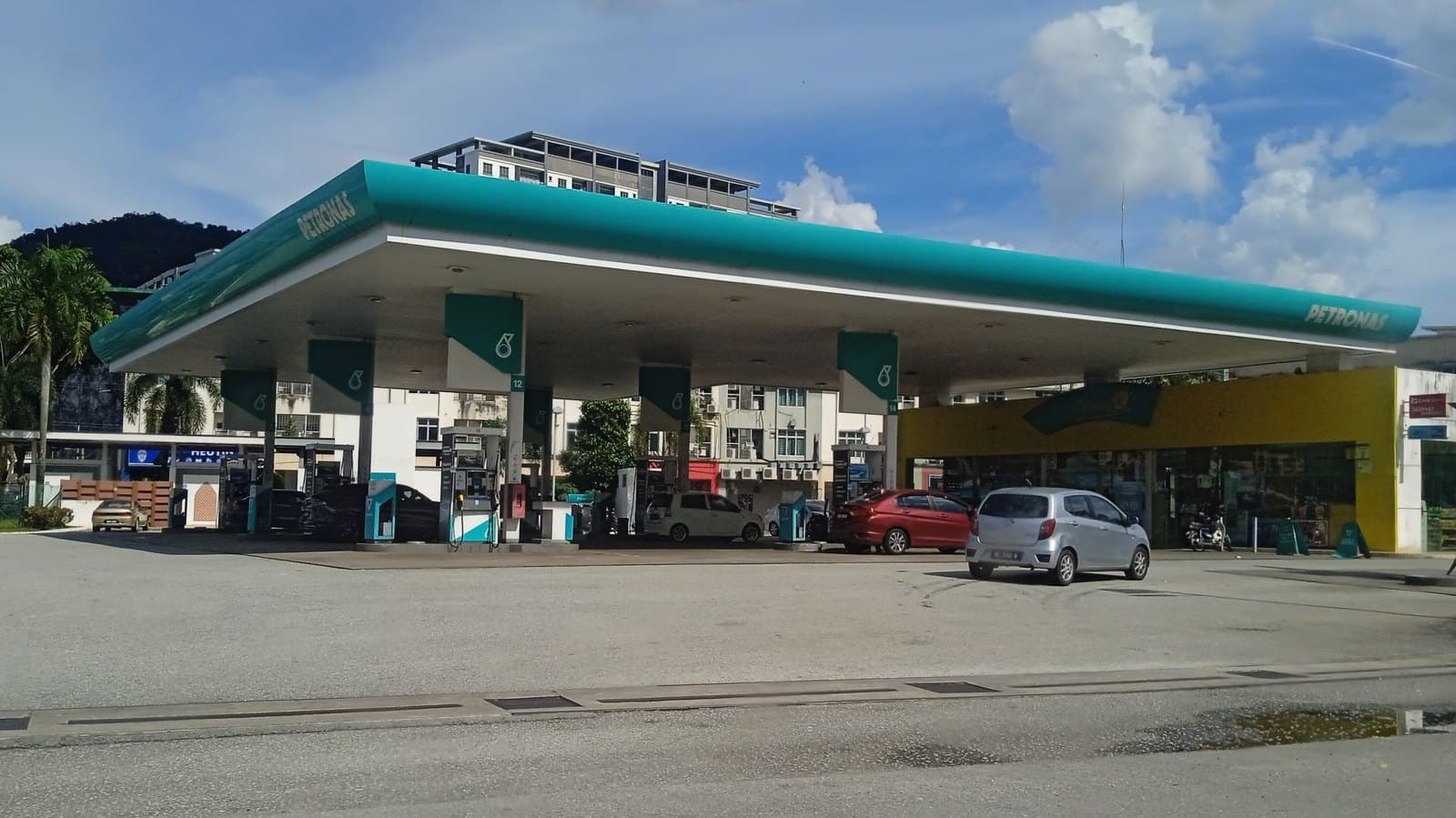
*Cover image: Petronas station on Jalan Sungai Tua, Taman Selayang, by Wiki Farazi, CC0, via Wikimedia Commons*