Malaysia has made registering a small business almost trivially cheap, and then attached one of the heavier penalties in consumer-facing law to forgetting about it.
Both halves of that sentence come from the same two places: the Companies Commission of Malaysia's published Table of Fees, and its own guideline documents for business registration and renewal. Both were read on 6 September 2026, and what follows is what they say, with nothing rounded and nothing assumed.
What SSM actually charges
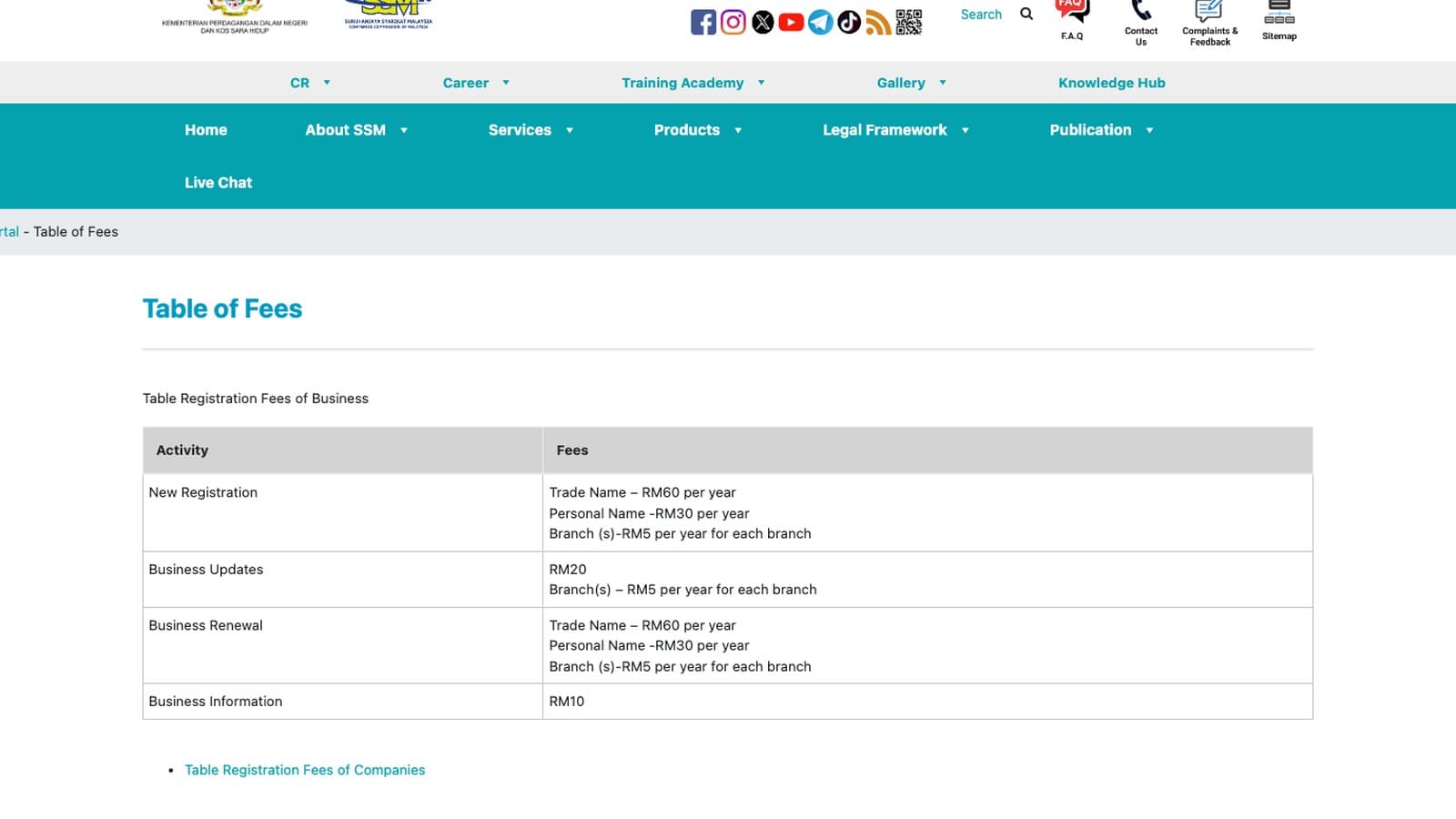
The fee schedule for a business, meaning a sole proprietorship or partnership registered under the Registration of Businesses Act 1956, has four lines and no hidden fifth one.
New registration costs RM60 per year for a trade name, RM30 per year for a personal name, and RM5 per year for each branch. Business renewal costs exactly the same three amounts. A business update, which is what SSM calls a change to your registered particulars, costs RM20, plus RM5 a year for each branch. A copy of your business information, the printout banks and suppliers ask for, costs RM10.
That is the entire published schedule. There is no application fee, no processing fee and no separate certificate fee.
The RM30 against RM60 decision, and what it actually buys
The only real pricing decision at registration is whether you trade under your own name or a trade name, and the difference is RM30 a year.
A personal name registration means the business trades under the name printed on your identity card, exactly as it appears. That is RM30 a year and it is the cheaper option, but the name is not yours to shape, and it is not a brand.
A trade name is any other name, and it is what most people actually want the moment they intend to print a receipt, open a business bank account or put a name on a delivery bag. It is RM60 a year, and the name has to be approved before the registration goes through, which is why SSM publishes a separate guideline for business name applications.
Over five years the difference is RM150. It is rarely the number that should decide it.
Three schemes make it free, and only one of them covers renewal
This is the part that is genuinely under-known, and the three schemes are not interchangeable. Two of them changed on 1 June 2026, so older write-ups describing SPPP as a one-year scheme are now out of date.
Skim Pendaftaran Perniagaan Percuma (SPPP) has been running since 15 February 2021, and SSM's page now also calls it Skim Pendaftaran Perniagaan Prihatin. It waives the registration fee for two groups: B40 entrepreneurs, defined as recipients or spouses of recipients of government aid including BPN 2.0, BPR, BKM and mySalam, and full-time students at any IPTA, IPTS, polytechnic, college or skills institute in the country. Both groups must be citizens aged 18 or above, and must have no business entity still active with SSM.
The exemption covers the RM30 personal name fee, the RM60 trade name fee and the RM10 business information fee. Until 31 May 2026 the exemption lasted one year. SSM's SPPP FAQ, updated in April 2026, now says the scheme covers two years of business, as a one-time application only, starting 1 June 2026, which is worth up to RM120 on a trade name. What has not changed is the other half of the same sentence: renewals and branches are charged as usual, so year three costs RM30 or RM60 like anyone else's. SSM also states plainly that SPPP runs only until the allocation for the grant is used up, so it is not a permanent entitlement.
Skim 1 OKU 1 Perniagaan (S1O1P) has been running much longer, since 23 October 2012, and is the best of the three if you qualify. It waives the same RM30 and RM60 fees for persons with disabilities registered with the Social Welfare Department (JKM), and unlike SPPP it applies to both new registration and renewal. Branch and business information requests are charged as usual. A partnership can be registered under it, but every partner must be OKU.
One detail in the S1O1P guideline is worth reading twice, because it is stricter than the general rule below: renewal under the scheme must be done within 30 days before the expiry date, for one year only.
Skim Pendaftaran Perniagaan Percuma Warga Emas (SPPWE) is the newest, in force from 1 June 2026 until the SPPP grant allocation runs out. SSM describes it as a new category under SPPP for citizens or permanent residents aged 60 and above by date of birth, trading in Peninsular Malaysia or the Federal Territories, with no other active business on SSM's records. A partnership qualifies only if every partner is a senior. It waives the same RM30, RM60 and RM10 fees, but for one year only: you may register for two years, and the second year is charged as usual. Two restrictions in SSM's FAQ are easy to miss. You cannot claim SPPP and SPPWE together even if you qualify for both, and anyone who has already used SPPP, even on a business that has since lapsed, cannot use SPPWE, because SSM treats the scheme as once in a lifetime.
Which one to use is simple arithmetic. A retiree who is also a B40 aid recipient gets two free years through SPPP and one through SPPWE, so SPPP is the better pick unless they are OKU, in which case S1O1P beats both because it keeps covering renewal.
All three schemes are applied for online at ezbiz.ssm.com.my (SPPWE is chosen under the SPPP category), and all need an ezBiz user account first. S1O1P applicants upload both sides of the identity card and the JKM-issued OKU card.
The 30-day clock that starts before you ever pay SSM
Almost every explanation of SSM registration begins at the moment you decide to register. The Act begins earlier.
Section 4 of the Registration of Businesses Act 1956 requires the person responsible for a business to apply for registration not later than thirty days from the date the business commenced. Not thirty days from when you decided to formalise it, and not from your first ringgit of profit — thirty days from when the business started operating. SSM's own responsibilities sheet for business owners puts it at number one on the list: register within 30 days of commencement, by submitting the Business Registration Form (Form A).
Two further 30-day duties sit beside it on the same sheet, and both are easy to miss:
- A change to your principal business address, type of business, branch particulars or owner information must be registered within 30 days of the change, on Form B. That is what the RM20 business update fee is for.
- Termination of the business must be notified within 30 days of the operation ending, on Form C. If the termination is because the owner has died, the window is four months from the date of death instead.
The registration itself is issued for a period not exceeding five years, which is why the renewal options run from one year up to five.
The renewal rule most people get wrong
Section 5A of the Registration of Businesses Act 1956 requires an active registered business to be renewed before the registration certificate expires — and SSM's renewal guideline is more specific than the version everyone half remembers, giving a window of 30 days before the expiry date. That is the duty, and it appears in the same terms as item 2 on SSM's responsibilities sheet.
What the guideline adds is the part that gets left out, and it is why the panic is usually misplaced. A business registration certificate can be renewed at any time before the expiry date and up to twelve months after it. You can renew for one year and up to five years at a time, which is the simplest way to stop the problem recurring. Only the owner or the Person Responsible may submit the renewal. And renewal through ezBiz Online is auto-approved, so there is no waiting period to plan around.
Read those two together carefully, because they are not the same thing. The twelve months is SSM still accepting your renewal application. It is not twelve months of being allowed to keep trading. SSM states the consequence without qualification: any person who continues to conduct business after the registration has expired commits an offence under the Act and is liable, on conviction, to a fine not exceeding RM50,000 or imprisonment for a term not exceeding two years, or both.
And that RM50,000 ceiling reaches further than most write-ups admit. On SSM's responsibilities sheet the RM50,000 and two-year penalty is attached to both item 1 and item 2 — failing to register within 30 days of commencing, as well as failing to renew. Anyone trading unregistered from day one sits in exactly the same penalty bracket as someone who let a certificate lapse.
That is not a late fee. Renewing costs RM30 or RM60. The exposure for trading without a live registration is three orders of magnitude larger.
The RM10,000 and RM2,000 penalties nobody quotes
The RM50,000 figure gets all the attention. SSM's responsibilities sheet sets out two lower tiers underneath it, and they cover things a one-person business does every week.
A fine not exceeding RM10,000, imprisonment not exceeding one year, or both applies to failing to:
- register a change of business particulars within 30 days;
- notify the termination of the business;
- put up a signboard showing the business name and registration number outside the place of business — and outside each place, if there is more than one;
- display the business name and the certificate of registration number on every business letterhead, invoice, bill or other document.
That last one is the one to act on today, because it costs nothing and almost nobody does it. If you invoice clients, your registration number belongs on the invoice.
A fine not exceeding RM2,000, imprisonment not exceeding six months, or both applies to failing to display the Certificate of Registration in a conspicuous place at the main business premises or branch.
One further item on that sheet is not a penalty, but it is the most common misunderstanding of all: registering with SSM does not replace a licence, permit or approval letter from any other authority. SSM says so directly — where a type of business requires approval before it commences, you still need that approval even though the business has been registered with SSM. Local council licensing, food handling and anything else regulated sits entirely outside SSM.
The rung between RM60 and RM1,000 that gets left off the list
Most comparisons jump straight from a sole proprietorship to a Sdn Bhd, as though there were nothing between them. There is: the limited liability partnership, registered as a PLT (Perkongsian Liabiliti Terhad) under the Limited Liability Partnerships Act 2012 rather than under the 1956 Act.
Registration costs RM500, once, and SSM states that figure on its own LLP page. It buys the one thing a sole proprietorship cannot give you — limited liability — without paying the RM1,000 incorporation fee. It is registered through the MyLLP portal at ssm4u.com.my, not through ezBiz, and the user account has to be activated at an SSM counter before you can file.
The recurring cost is the part to check before choosing it, because a PLT does not renew — it files:
- The Annual Declaration carries an application fee of RM200.
- The first Annual Declaration must be lodged not later than 18 months from the date of registration.
- Every one after that must be lodged within 90 days from the end of the financial year.
- An extension of time has to be applied for at least 30 days before the due date.
- Changes to the address, business address, nature of business, partners, compliance officer or the location of the accounting records must be updated in MyLLP within 14 days, at a fee of RM30.
So on SSM's fees alone, the annual ladder runs: sole proprietorship RM30 or RM60, PLT RM200, Sdn Bhd RM150 for the annual return plus RM50 audited or RM20 unaudited for financial statements. A PLT is not the cheapest entity to keep alive, and it is not a way to save money against a Sdn Bhd on SSM's charges. What it is, is the cheapest way to stop your business debts being your personal debts.
Note the 14 days as well. It is half the 30 days a sole proprietorship gets for the same kind of change.
When RM60 stops being the right entity
The reason so many Malaysian side businesses stay sole proprietorships is that the next rung costs meaningfully more, and SSM publishes that schedule too.
Incorporating a company limited by shares, the ordinary Sdn Bhd, costs RM1,000. A company limited by guarantee costs RM3,000 and an unlimited company RM1,000. Reserving a name in advance costs RM50 for every 30 days, to a maximum of 180 days, and changing a company name later costs RM100.
The recurring cost is the real difference. A private company lodges an annual return at RM150 every year, and lodges financial statements at RM50 if audited or RM20 if not. A sole proprietorship has no equivalent filing at all. It simply renews at RM30 or RM60.
The trade-off is liability, not paperwork. A sole proprietorship is you, with the debts attached to you personally. A Sdn Bhd is a separate legal person with its own balance sheet. The fee difference is small next to that distinction, which is why the decision should be made on what the business is exposed to rather than on what SSM charges.
What we checked
Every figure on this page comes from SSM's own material, nothing from a summary article or a company secretary's blog. The fee schedules and the SPPP and S1O1P guidelines were read on 6 September 2026: the published Table of Fees for Registration of Business and for Registration of Company, plus the guideline documents downloaded from SSM's document library.
The page was extended on 9 September 2026 from three further SSM sources: the Responsibility of Business Owner sheet published under Registration of Business, which is where the 30-day registration deadline and the RM10,000 and RM2,000 penalty tiers come from; the Guideline for Renewal of Business Registration, re-read for the 30-days-before-expiry duty; and SSM's Starting a Limited Liability Partnership page together with its MyLLP brochure, for the RM500 registration fee, the RM200 Annual Declaration and the 18-month and 90-day lodgement deadlines.
Where SSM does not publish something, this page says so rather than filling the gap. The SPPP guideline, for example, does not state a closing date, only that the scheme runs until the grant allocation is exhausted, so anyone relying on it should confirm availability at the point of application rather than assume it is still open.
On 30 September 2026 the page was re-checked against SSM's own FAQ documents for SPPP and SPPWE, both last modified on 14 April 2026, and its SPPP scheme page. That is where the two-year SPPP, the new SPPWE category and the 15 February 2021 start date come from. The fee tables had not changed.
For anything specific to your own case, SSM's contact centre is on 03-7721 4000 and enquiry@ssm.com.my, and its service counters open Monday to Friday, 8.15am to 4.15pm.
Related reads
- Decided a sole proprietorship is not enough? 8 company incorporation and corporate secretary services worth knowing in Malaysia covers who actually does the RM1,000 filing for you, and what they charge on top of SSM's fee.
- Putting your registration number on every invoice raises the next question. Malaysia's e-Invoice in plain terms: who must issue one in 2026 explains the RM1,000,000 floor, and why your FY2022 numbers rather than this year's decide the obligation.
- Registering a side business and driving for a platform are not the same status. The 1.25% coming out of every job sets out what the Gig Workers Act 2025 gives riders and drivers instead.
*Cover image: SSM's published Table of Fees for business registration (Image: Suruhanjaya Syarikat Malaysia)*