For Muslim taxpayers in Malaysia, the last quarter of the year is when two obligations meet. Zakat on income is due on what you earned, and income tax for the year is being settled through PCB. The two are linked by one of the most generous provisions in the tax code: zakat paid to an official authority comes straight off your tax bill. This guide explains how that works, using LHDN's rebate page and the published figures of three state zakat authorities, all read on 15 October 2026.
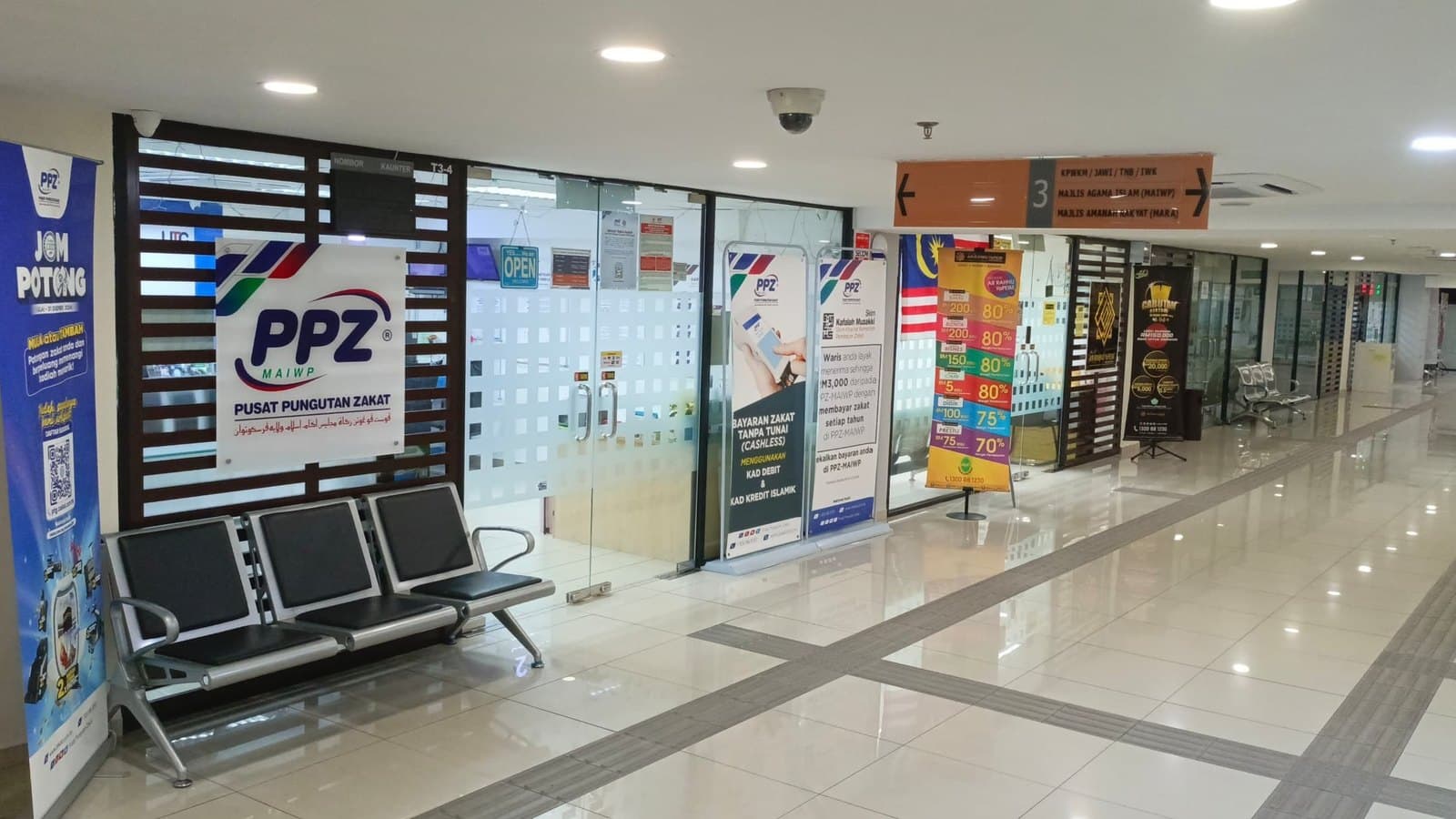
*Image: Pusat Pungutan Zakat-MAIWP (PPZ counter, UTC Pudu Sentral)*
A rebate, which is worth more than a relief
Most items Malaysians claim on the e-BE form are reliefs. They reduce your chargeable income, and the saving depends on your tax bracket. Zakat is different. Section 6A(3) of the Income Tax Act 1967 treats zakat, fitrah and other obligatory Islamic dues as a rebate, deducted from the tax itself after all reliefs are applied.
PPZ-MAIWP's own illustration makes the point: with tax payable of RM1,000, income zakat of RM500 and savings zakat of RM300, the balance of tax is RM200. Every type of zakat counts, including income, savings, gold, EPF, business and qadha (catch-up) zakat, and fitrah.
The two limits that catch people out
It stops at your tax bill. LHDN's rebate table lists Zakat/Fitrah as "subject to the maximum of tax charged". If you owe RM1,200 in tax and paid RM1,500 in zakat, your tax falls to zero, and the other RM300 brings no refund and does not roll into next year.
It must go to an official authority. LHDN only allows the rebate when zakat is paid to a zakat organisation established by law, backed by its receipt. Money given directly to someone in need is charity, but it is not claimable. Receipts should be in your own name (fitrah is the usual exception), and like all tax records they should be kept for seven years.
Why 31 December matters
The rebate follows the year of payment, not the year the income was earned. Zakat paid on or before 31 December 2026 reduces the tax on your YA 2026 return, filed in early 2027. Pay on 2 January and it waits a full year for the YA 2027 return. That is why the zakat authorities' counters and portals are busiest in December.
The 2026 nisab: whether income zakat applies to you
Income zakat applies once your annual income reaches the nisab, a threshold pegged to the value of 85 grams of gold, so it moves every year. The rate is 2.5%. The National Fatwa Council's muzakarah of 7 May 2003 set gross annual income as the basis, though some states allow deductions. The published thresholds differ by state:
- Federal Territories (PPZ-MAIWP): RM33,996 for 2026, based on gold at RM399.95 a gram. It was RM29,740 in 2025 and RM24,198 in 2024, so the threshold has risen by about 40% in two years.
- Selangor (Lembaga Zakat Selangor): RM38,748 for July to December 2026. LZS revises its figure twice a year.
- Penang (Zakat MAINPP): RM33,890 a year on its current calculator. Penang lets you deduct allowances first: RM3,000 for a wife, RM1,000 per child, plus money given to parents, EPF and Tabung Haji contributions.
Those gaps matter at the margin. A salary of RM3,000 a month is RM36,000 a year: above the Federal Territories nisab, but below Selangor's current figure. Whether zakat is obligatory for you is a religious ruling for your state authority, and each publishes an online calculator.
A worked example
Take a KL employee earning RM5,000 a month, or RM60,000 a year. That is above the RM33,996 nisab. On PPZ's gross-income basis, income zakat is 2.5% × RM60,000 = RM1,500 a year, or RM125 a month.
Suppose the employee's tax charged for YA 2026, after reliefs, works out at RM1,200 (an illustrative figure; yours depends on your reliefs). The RM1,500 of zakat wipes the tax out entirely. The extra RM300 is still zakat paid, but it brings no tax benefit. If the tax were RM2,000, the rebate would cut it to RM500.
Paying monthly through your salary
Rather than a lump sum in December, most employers can deduct zakat from payroll. PPZ calls its scheme Potongan Zakat Bulanan (PZB) and Penang calls its version Skim Sakinah. Your employer then reduces your PCB by the zakat amount each month. PPZ's examples: PCB of RM100 with RM70 of monthly zakat leaves RM30 of PCB; PCB of RM50 with the same RM70 zakat leaves none. You feel the rebate in your payslip all year instead of waiting for the tax return.
For business owners
Companies, cooperatives and trust bodies paying business zakat get a deduction, not a rebate, capped at 2.5% of aggregate income, according to PPZ's tax page. Labuan offshore companies get a rebate capped at 3% of net profit.
One Selangor scheme with a deadline this month
Lembaga Zakat Selangor runs Siddik, an education contribution of RM100 per child aged 7 to 17 (Standard 1 to Form 5) for members who paid between RM500 and RM5,000 of zakat harta in a year. The application window is 1 September to 31 October 2026, subject to LZS's terms. LZS reports collecting RM710 million from January to August 2026 (provisional, unaudited).
How to pay
Every state has its own authority, and each accepts payment at its counters, by online banking, e-wallet and its own portal. For the three above: zakat.com.my (PPZ-MAIWP, 1-300-88-5757), zakatselangor.com.my (LZS) and zakatpenang2u.com (Zakat MAINPP, 04-549 8088). Use the official receipt when you fill in the zakat line on your e-BE.
Related reads
- Budget 2027 income tax changes
- New personal tax reliefs for 2026
- EPF Akaun Fleksibel withdrawals explained
*Sources: LHDN, Rebates page (last updated 10 July 2026); Income Tax Act 1967, section 6A(3); PPZ-MAIWP, Zakat & Cukai page, Zakat Pendapatan page and Arkib Nisab Tahunan; Lembaga Zakat Selangor homepage (nisab July to December 2026, collection figures) and Siddik notice; Zakat MAINPP income zakat calculator. All read on 15 October 2026. This is a factual explainer; for your own zakat obligation, ask your state zakat authority.*