> Quick view: two of the biggest buy now pay later services in Malaysia both advertise 1.5 per cent, and the same number means two different things. Work out the total cost before you tap. And the bigger news is that BNPL in Malaysia now has a regulator, which the disclaimer on your screen has not caught up with.
Buy now pay later has become the default second payment button at Malaysian checkouts. It is on Shopee, on Grab, on the cinema booking page, at the counter of a phone shop and inside a QR code at a night market stall. It is genuinely useful and it is genuinely cheap when it is free, which it often is. The problem is that the pricing is quoted in a way that makes comparison difficult, and the differences are large.
Here is what the three services most Malaysians will actually meet were charging when we first read them on 8 September 2026 and re-checked them on 25 September 2026, taken from each provider's own Malaysian pages, alongside the rules that now sit over all of them.
BNPL is regulated now, and the line on your screen is out of date
If you have used SPayLater you have probably scrolled past this sentence in the footer: "BNPL products are not regulated by Bank Negara Malaysia." It was still there when we checked on 8 September 2026, and still there on 25 September 2026. It is literally true, and it is badly out of date as a description of your position.
BNPL is regulated. Just not by Bank Negara.
The Consumer Credit Act 2025 (Act 873) received Royal Assent on 22 December 2025 and was gazetted on 31 December 2025. Except for Part V, it came into force on 1 March 2026. Part V, which covers licensing and registration, came into force on 1 June 2026. Those dates are stated in that form in the Act's own FAQ published by the regulator.
The regulator is the Suruhanjaya Kredit Pengguna (SKP), the Consumer Credit Commission, and it describes itself as "the main regulatory body for non-bank credit". Under Phase 1 of the Act, running 2026 to 2027, SKP takes six business activities that were previously unregulated by anybody: buy now pay later, leasing, factoring, debt collection, impaired loan or financing acquisition, and debt counselling and management.
BNPL sits in the heaviest of the two categories. Leasing, factoring and BNPL are classified as credit businesses and must hold a licence from SKP. Debt collectors and debt counsellors only have to register.
The timetable matters, because we are inside the transition right now. Licensing took effect on 1 June 2026 with a six-month window for the industry to get authorised. That window closes at the end of November 2026, and SKP's own wording is blunt about what happens next: "Upon the expiration of this grace period, operating outside the authorised framework will constitute a regulatory breach."
Banks stay with Bank Negara. That is why ShopeePay's sentence remains technically accurate while giving you the wrong idea. The honest version is that BNPL was unregulated, and as of this year it is licensed and supervised by a different authority.
SPayLater, and the asterisk on 0 per cent
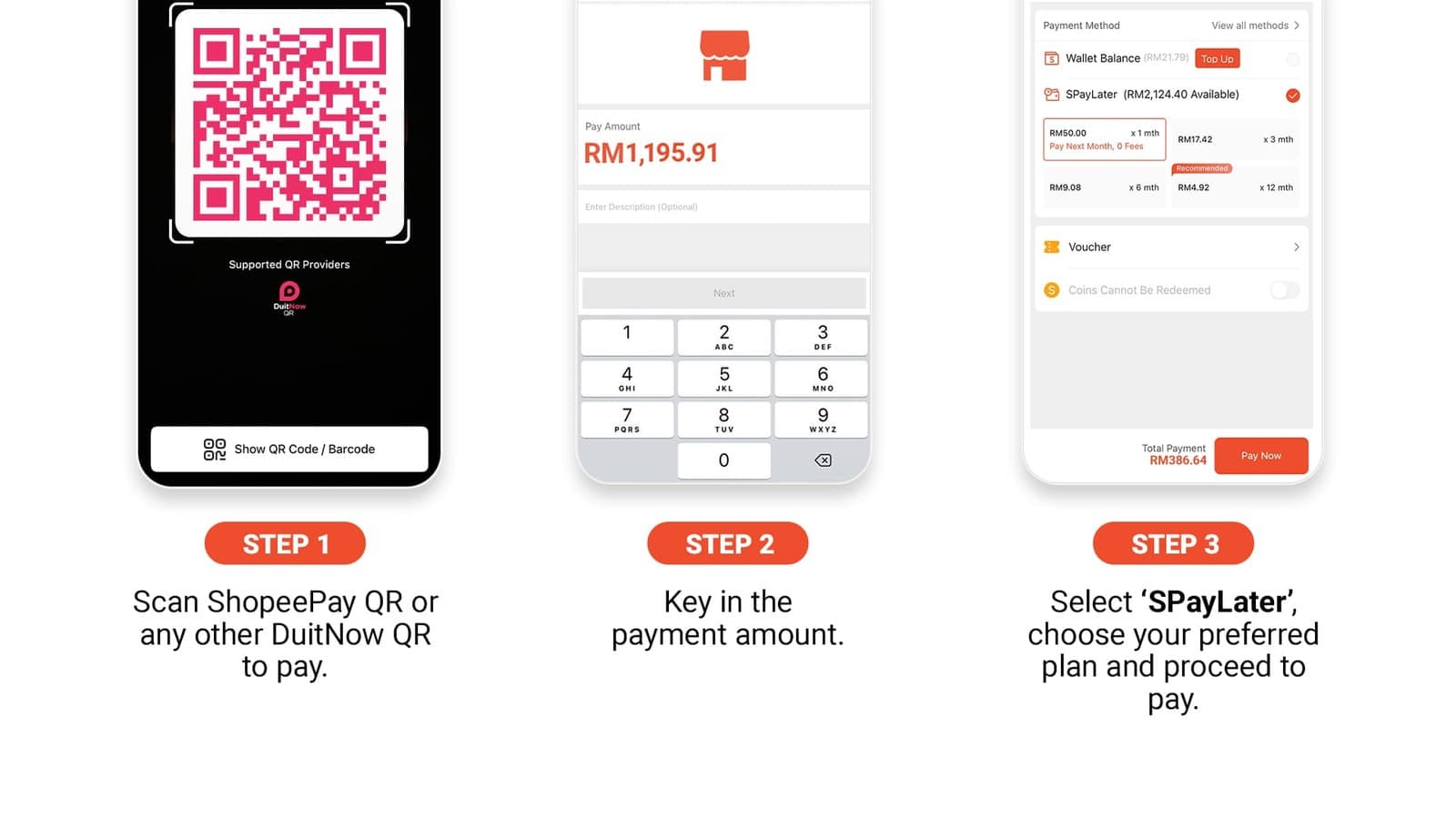
SPayLater is offered by Monee Capital Malaysia Sdn. Bhd. (202001010678) with ShopeePay Malaysia Sdn Bhd (201601007371) as its platform partner, and its public page now carries the Monee Malaysia branding rather than Shopee's.
The headline is two zeroes. The 1-month plan is 0 per cent, and the 3-month plan is 0 per cent. Then the footnote:
> "The 1-month installment can be used for all payments. The 3-month instalment with no processing fee is only applicable for payments on the Shopee platform (excluding ShopeeFood, Insurance, Prepaid, Bills & Tickets)."
So the 3-month free plan is not available for the two things Malaysians most often use SPayLater for outside the Shopee app: food delivery and bill or ticket payments. Take SPayLater to a merchant QR at a shop, or use it to pay a bill, and 0 per cent for three months is not on the table.
Where the free plans do not apply, instalments over 3, 6 and 12 months are charged at 1.5 per cent per month. Miss a payment and there is a flat RM10 late fee, which SPayLater lists under the heading "No hidden charges", accurately enough.
SPayLater is certified Shariah-compliant by Amanie Advisors.
PayLater by Grab, and why 1.5 per cent is not 1.5 per cent
Grab runs two different products under one name, and mixing them up is the most common mistake.
Postpaid puts a month of Grab spending on one bill that you settle the following month. Instalment splits a purchase over 4, 8 or 12 monthly payments.
Grab rebuilt its PayLater page on 24 September 2026, and the pricing now sits in a table instead of a single sentence. The page names the provider as GFin Services (M) Sdn Bhd. The table sorts merchants into three groups, and the rate depends on which group you are paying:
- Postpaid (pay next month): 0 per cent at Grab's VIP brands and at other brands. Not yet available when you pay a DuitNow QR code with PayLater.
- 4 instalments: 0 per cent at VIP brands. At other brands and on DuitNow QR it is 1.5 per cent of the total transaction amount per instalment.
- 8 or 12 instalments: 1.5 per cent of the total transaction amount per instalment everywhere, VIP brands included.
The VIP brands are not listed on the web page. Grab says to tap the PayLater icon in the app to browse them.
Until 24 September the same rule was one sentence: "An interest rate of 1.5% of total transaction amount per installment will apply after the promotional period." The table now repeats that wording in every cell that carries a charge.
Read it twice. The 1.5 per cent is calculated on the total transaction amount, and it is charged per instalment. On a 4-instalment plan outside the VIP brands that is 6 per cent of the purchase. On 8 instalments it is 12 per cent. On 12 instalments it is 18 per cent. The page's earlier version used an RM600 order over 8 monthly instalments as its example, and under the stated formula that adds RM72. The new table does not change that arithmetic.
That is not a hidden charge. It is stated on the page. But a shopper who reads "1.5%" and thinks of a monthly interest rate on a shrinking balance, the way a credit card works, will be out by a wide margin, because this rate does not shrink with the balance.
The table matters more now because of where Grab is pushing the product. The page's headline is "Scan ANY DuitNow QR. Pay with PayLater by Grab", for selected users. A DuitNow QR payment never falls under the VIP 0 per cent. Split one over 4 instalments at a shop counter and you pay 6 per cent. Split it over 12 and you pay 18 per cent.
Two practical details from the same page. You pay the first instalment at checkout, and it comes out of your GrabPay Wallet, so the wallet has to hold at least that amount. Grab's example is an RM400 purchase with RM100 instalments, which needs RM100 in the wallet. Later instalments are deducted from the wallet first and from your linked card if the wallet runs short.
The late payment charge is a flat RM10 for each overdue bill. There is no compounding penalty on top. A missed payment suspends the account straight away, and you reactivate it by clearing the outstanding balance. Eligibility is age 21 and above with a fully verified Grab account. Grab's page carries no statement about who regulates the product, either way.
The method behind that 12 per cent is being outlawed
This is the part worth knowing before you sign anything.
On 5 June 2026 SKP issued its Conduct Standards, which apply to every authorised BNPL provider. Chapter 18 sets requirements specific to BNPL, and paragraph 18.8 says a BNPL provider "must not offer credit products to credit consumers where the interest or profit charge is computed using flat rate and the Rule of 78 method."
Paragraph 18.9 spells out what is allowed instead: a fixed or variable rate on a reducing balance basis, where interest is charged on the principal still outstanding after the payments you have already made.
A rate calculated on the total transaction amount and charged again on every instalment is a flat rate. It is the thing that turns 1.5 per cent into 12 per cent, and it is the method the Standards prohibit. Once the transition window closes at the end of November 2026, an authorised BNPL provider has to price on a reducing balance instead. So the 12 per cent arithmetic in this article has a shelf life: either the number changes, or the way it is calculated does.
There is a matching rule on disclosure. Paragraph 8.5(d) requires an authorised entity to give consumers the effective interest or profit rate, and paragraph 8.6 defines that as "a rate that reflects the actual finance cost on annualised basis", which "must be disclosed prominently regardless of the type of the loan/financing rate", precisely so that consumers can compare products whose nominal rates are quoted differently. That is the rule written for the exact confusion this article exists to unpick.
Atome, and what is not on the page
Atome's Malaysian site advertises the simplest proposition of the three: three payments, 0 per cent interest. What it does not carry on those public pages is a fee schedule, a late-payment figure or the terms under which the 0 per cent stops applying. That absence is worth noting rather than assuming the worst, but it does mean the only place to price an Atome plan is inside the app, at checkout, before you confirm.
What the new rules actually give you
The Conduct Standards run to 94 pages. These are the provisions a shopper can use.
A limit on how much they can lend you without checking. Paragraph 18.10 requires a BNPL provider to run an affordability assessment once your credit limit goes above RM1,000. Below that it can approve you on the spot.
Late fees have to be justified. Paragraph 18.12 requires the late payment charge to cover only "the actual costs incurred from recovering overdue instalments", and 18.13 says a provider "must not set a predetermined minimum LPC". Both SPayLater's and Grab's RM10 are flat figures fixed in advance, so both will have to be defensible as real recovery cost.
They must cut you off rather than let you sink. Paragraph 18.14 requires the provider to suspend your account for new transactions once you have missed two consecutive payments, until the arrears and charges are settled. Paragraph 18.15 lets it act after a single miss.
BNPL cannot be the default button. Paragraph 18.17 requires providers to ensure merchants do not set BNPL as the default payment mode, and to take corrective action, up to suspending that merchant, where one has.
A complaint has a clock on it. The provider must acknowledge your complaint in writing no later than the next business day, and must give you a decision within 14 calendar days for a simple case or 30 calendar days for a complex one. It must also tell you where to go next if you are not satisfied.
And there is now a next step. Complain to the provider first. If you get no response, or you are unhappy with the outcome, you escalate to SKP through the SKP CARE portal at care.skp.gov.my. That is a route that did not exist when most of these apps launched.
One caveat: SKP has not published a public register of licensed BNPL providers, because applications are still open through the transition. That was still the case when we re-checked on 25 September 2026, and SKP had issued no press release since the Conduct Standards on 5 June. You cannot yet look up whether your provider is licensed.
A worked example, and how fast it went stale
When we first wrote this guide on 8 September 2026, both BNPL providers were competing at the same cinema chain. TGV Cinemas was running buy one free one with SPayLater, advertised for 1 September to 31 October 2026, capped at 100 promotional transactions a day nationwide and one free ticket per transaction. Grab's competing offer at TGV was up to RM5 off with GrabPay or PayLater by Grab. On a pair of RM25 evening seats, that was a whole free ticket against RM5 off.
By 25 September 2026 the SPayLater offer was gone from TGV's own site. It no longer appears on tgv.com.my/promotions, and its detail page sends you to TGV's not-found page, five weeks before its advertised end date. TGV gives no reason. Deal aggregators still list it as running to 31 October, so if you see it quoted, check TGV's own promotions page before you book on the strength of it.
The Grab offer is still up, but its own terms are narrower than its headline. It needs a minimum purchase of RM40. It is capped at 1,000 transactions each for GrabPay and for PayLater by Grab, and one promo transaction per customer per month. It ends on 30 September 2026. The page header says it started on 17 August, while the T&Cs say 17 September. Two RM25 seats clear the RM40 minimum. A single ticket does not.
So the lesson of this example is sharper than when we first wrote it. The answer is not "use BNPL", or even "use the BNPL with the bigger deal". It is "check the merchant's own promotions page on the day you pay". A deal a blog told you about three weeks ago, this one included, may already have been pulled, even when it was advertised for another month.
How to use these without paying for them
Five rules cover almost every situation.
Check whether the plan is actually 0 per cent for what you are buying. SPayLater's 3-month free plan excludes ShopeeFood, insurance, prepaid, and bills and tickets. That is a large share of everyday spending.
Multiply, do not read. For any plan quoted "per instalment", multiply by the number of instalments before you compare it to anything. From the end of November 2026 you should be seeing an annualised effective rate instead; if you are not, that is now a disclosure failure worth raising.
Treat the RM10 as the real risk. Both SPayLater and PayLater by Grab charge a flat RM10 on a missed payment, and on a small purchase that single fee can dwarf the interest. Automating the deduction removes most of the exposure.
Do not let it be the default. If a checkout has pre-selected BNPL for you, that is now something the provider is required to stop the merchant doing.
Know that the safety net has changed. The disclaimer saying BNPL is not regulated by Bank Negara is true and misleading at the same time. You have a regulator, a complaints deadline and an escalation route. Use the provider's channel first, then SKP CARE.
Related reads
- Tribunal Tuntutan Pengguna 2026: Claim Up to RM50,000 for RM5 — the other consumer redress route, and what it costs to use.
- PTPTN in 2026: Debt Agents Now Add 15% to What You Owe — debt collection is the other activity SKP took over this year.
- TGV's Grab RM5-Off Code Has Ended: 9 Ways to Pay Less at TGV in October 2026 — the other half of the cinema comparison above.
*Cover image: SPayLater (Monee Malaysia).*
*This is a factual comparison of published terms, not financial advice. Provider rates, caps and exclusions were read from shopeepay.com.my, grab.com/my and atome.my, and the legislation, Conduct Standards and commencement dates from skp.gov.my, on 8 September 2026. The providers' pages, skp.gov.my and TGV's promotions were re-checked on 25 September 2026. Terms can change without notice. Check the provider's current terms before you commit to a plan.*