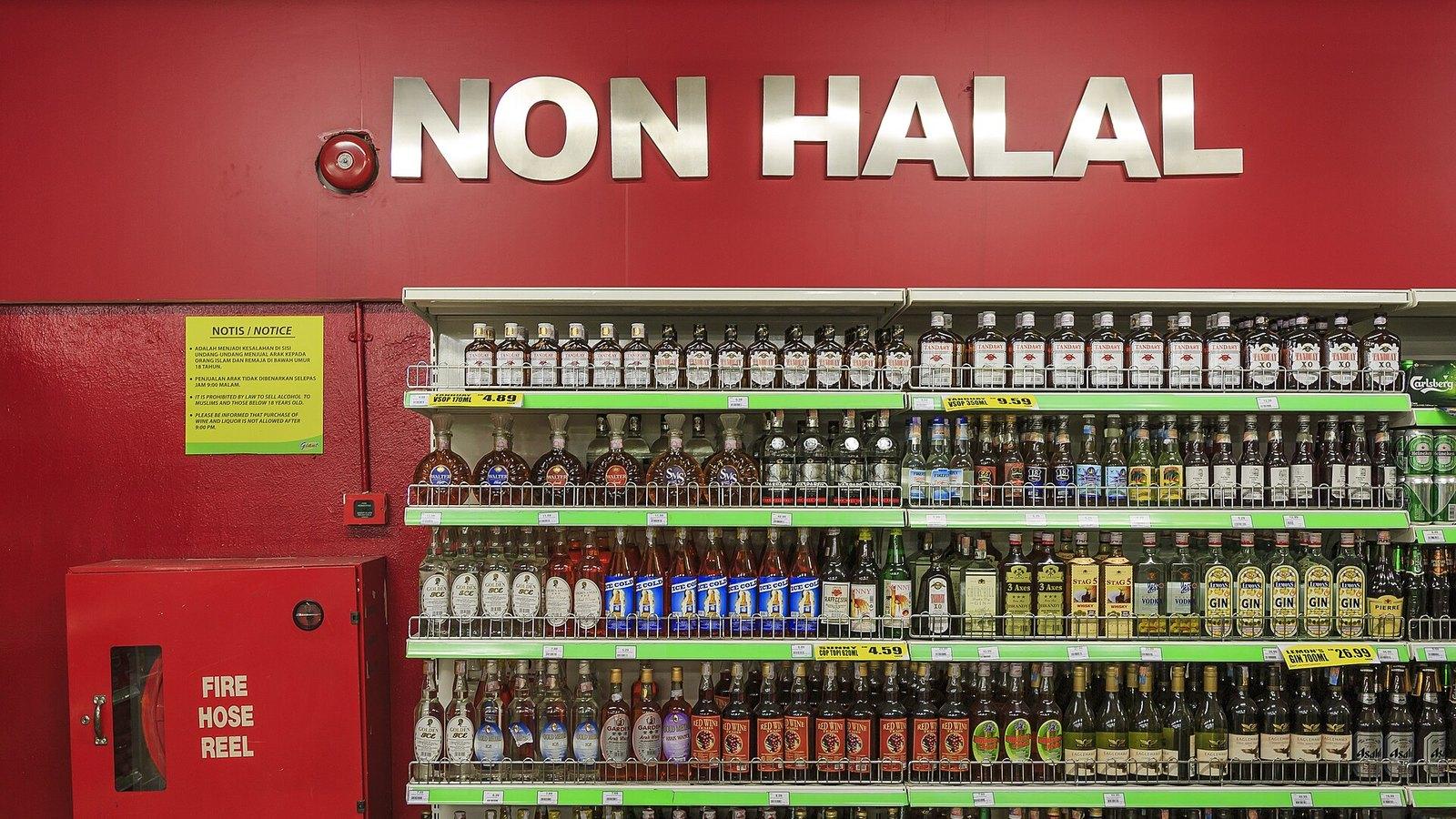
*Cover image: CEphoto, Uwe Aranas, CC BY-SA 3.0, via Wikimedia Commons (non-halal corner of a supermarket in Papar, Sabah)*
A framed certificate by the cashier, a green logo on the menu board, a sticker on a jar of sambal. In Malaysia these all claim the same thing, and you can check every one of them yourself in about a minute. This guide covers how to do it, what the law counts as halal, and why a "no pork" sign answers a different question.
Everything below was checked on JAKIM's portal on 7 November 2026.
Step 1: search the register
Go to the Halal Malaysia Portal, the official site of JAKIM's Halal Management Division. On the front page is a box called Verify Halal Status.
- Pick a category. The ones most people need are Premis Makanan (restaurants, cafes, bakeries, food courts, hotel kitchens) and Produk Makanan / Minuman (packaged food and drinks). There are also categories for consumer goods, cosmetics, pharmaceuticals, medical devices, contract manufacturing, logistics and abattoirs.
- Type the brand or company name and search.
- Narrow by state on the results page if the brand has many outlets.
Results are split into tabs: the company, hotels and resorts, food premises and menu items. When we searched a large fried-chicken chain on 7 November, it returned 228 food-premises records and 79 menu records, and the company line alone carried a column of expiry dates running from 15 November 2026 to 31 October 2028. That is the point to take away: a chain does not hold one certificate. Each outlet has its own, renewing on its own date.
On your phone, the Verify Halal app scans a product barcode or the QR code on a certificate. The National Security Council promoted it in 2022 as a way to check halal status, but the portal is the source to trust if the two ever disagree.
Step 2: read the certificate on the wall
If you are standing in the shop, look for three things:
- The name and address on the certificate match the outlet you are in, not the head office or another branch.
- The expiry date has not passed. Food premises and food products are certified for two years, abattoirs for one and most other categories for three, according to JAKIM's 2020 procedure manual as summarised by Malay Mail in September 2024. Long-standing holders with a clean record can be offered five years.
- The menu matches. The same manual requires the menu on display to be the one declared when the outlet applied, so new items need to be added to the certification.
Certified food premises must also have at least one Malaysian Muslim full-time worker on every shift, a halal supervisor and an internal halal control system, under the same manual.
What the law counts as halal
Two orders made under the Trade Descriptions Act 2011 set the rules.
The Trade Descriptions (Definition of Halal) Order 2011 defines halal food. It must not contain any part of an animal Muslims are forbidden to eat or one not slaughtered according to Islamic law, must not be intoxicating, must not be prepared with equipment contaminated by anything impure under Islamic law, and must not come into contact with non-halal food during preparation, processing or storage.
The Trade Descriptions (Certification and Marking of Halal) Order 2011 says goods and food cannot be described as halal unless they are certified by the competent authority and carry the halal logo. It also makes it an offence to supply food through any representation likely to mislead someone into thinking it is halal or can be eaten by a Muslim.
So what about "pork-free"?
A "pork-free" or "no pork, no lard" sign tells you one thing: there is no pork. It says nothing about cooking wine, beer batter, non-halal gelatin, how the chicken was slaughtered, or whether the kitchen shares equipment with a non-halal operation.
The legal position has moved. In February 2016, lawyers quoted by Malay Mail argued that a pork-free sign is only an offence if the outlet actually serves pork, while another said it depends on whether the sign is likely to mislead. In August 2025, the Selangor Islamic Religious Department (JAIS) said that "no pork, no lard" signs on businesses without halal certification can mislead consumers and are an offence under the certification order. That is the enforcement view in Selangor. We found no court ruling settling the question nationwide.
For diners the practical rule is simpler: if halal matters to you, look for the certificate and check it on the portal. Treat "pork-free" and "Muslim-friendly" as the operator's description, not certification.
Imported products
JAKIM recognises some foreign halal certification bodies, and the list changes. On 13 March 2025 it announced the withdrawal of recognition from bodies in France, Croatia and China. If an imported product's logo is unfamiliar, search the portal's International category.
Reporting a false claim
The portal has an E-Aduan complaint button. JAKIM's Halal Management Division can also be reached on 03-8892 5000 or pr_halal@islam.gov.my, with counters at Kompleks Islam Putrajaya open Monday to Friday office hours. Note the outlet's name, address, the date and a photo of the sign or certificate before you file.
*Sources: Halal Malaysia Portal (JAKIM), search and announcements read 7 November 2026; Malay Mail, 20 September 2024 (summary of JAKIM's 2020 Malaysian Halal Certification Procedure Manual) and 19 February 2016; SAYS, August 2025, on JAIS's statement; National Security Council, 11 May 2022. This is general consumer information, not a religious ruling.*