Petrol has one price at every pump in Malaysia. Electricity for your car does not. In a written reply to the Dewan Negara reported on 29 July 2026, MITI said the government has no price control mechanism for public EV charging and that operators set rates on commercial grounds, while it works with the Energy Commission and TNB on "a regulatory approach" to charging fees. The same reply put the network at 6,416 public chargers as of 31 May 2026, of which 2,143 are DC fast chargers, short of the 10,000 the government had targeted for the end of 2025.
So what you pay depends on whose charger you plug into, where it is, what time you start and whether you hold a plan. None of the big networks publishes a national price list; Gentari, chargEV, JomCharge, Shell and Tesla all show the rate for each site in their apps. We read every operator's own pricing, membership and promotion pages on 17 October 2026. Where a per-kWh figure comes from a site launch reported by the motoring press (mostly SoyaCincau, Carz and paultan.org) rather than an operator page, we say so.
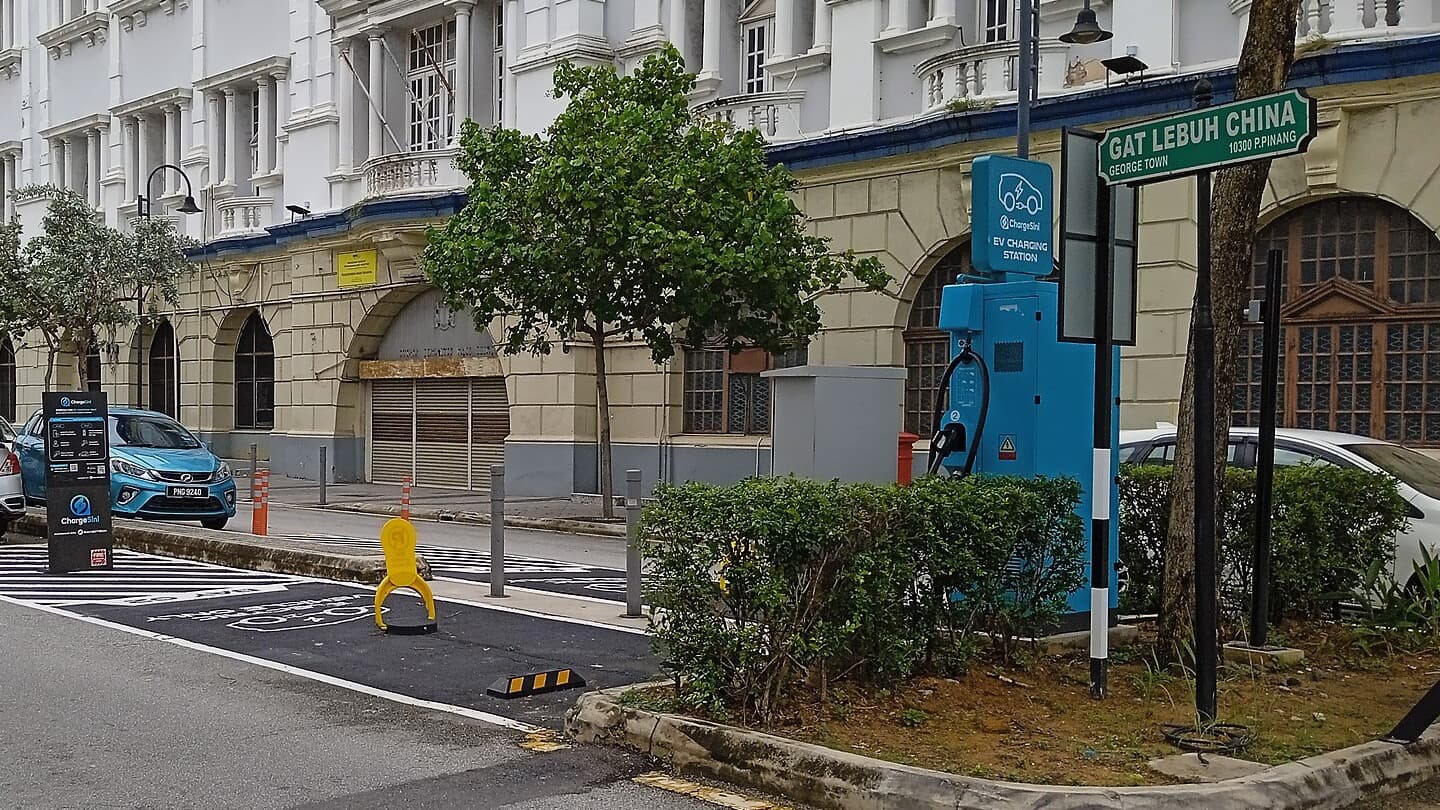
*Cover image: Wiki Farazi / Wikimedia Commons (CC0), a ChargeSini DC charger on Gat Lebuh China, George Town, Penang.*
How charging is billed
Almost every network now bills per kWh of energy delivered, plus an idle fee if you leave the car plugged in after the session ends. Card payments start with a pre-authorisation hold; chargEV's help centre puts it at RM100. Rates can differ between AC and DC, between a 60 kW and a 180 kW charger, and between a mall and a highway rest stop. Before you start, check the rate on the station page in the app, not a figure you saw online last month.
Network by network
Gentari (Petronas). Gentari says it has more than 600 licensed chargers. Recent price cuts at Petronas stations brought eight 50-120 kW sites from RM1.60 to RM1.40 per kWh and three 24 kW sites from RM1.50 to RM1.30 (SoyaCincau, 15 July 2026); its March 2025 revision set DC at RM1.60 to RM1.80 depending on the site type. Since 1 August 2026 selected DC sites give 15% off for sessions started between midnight and 6.59am. Gentari's terms say idle fees start after a 15-minute grace period with no cap; Setel's help centre gives the rate as RM0.40 a minute. Memberships, valid for a year, are GO Starter at RM350 and GO Plus at RM699, for "up to 30%" off depending on the plan (15% and 30% respectively, per SoyaCincau).
chargEV (Yinson GreenTech). Prices are set per site in the chargEV app. At its 2026 AEON mall rollouts, 120-180 kW DC was RM1.60 per kWh, 60 kW DC RM1.40 and 22 kW AC RM1.00 (SoyaCincau). Its general memberships have been discontinued, leaving car-brand plans for Zeekr, Denza, Leapmotor and BYD owners. From 13 to 31 October 2026 it gives 15% off DC charging at 30 selected locations, in the chargEV app only, excluding idle fees and roaming chargers, and not stackable with memberships.
TNB Electron. TNB's network has no public price page that we could reach. Site launches reported this year show RM1.50 per kWh for DC at BHPetrol Karak and RM1.00 for 22 kW AC in Putrajaya, while the 240 kW site at R&R Rawang northbound is RM1.80 (SoyaCincau, 28 September 2026).
Shell Recharge. Shell's own page offers pay-per-use at the standard rate or a Gold membership at RM835 a year for "up to 40% discount" at DC sites. It does not publish the standard rate. Carz reported in February 2026 that Shell charges up to RM2.80 per kWh at its high-power DC sites, the highest in Peninsular Malaysia, and that it was reviewing prices.
JomCharge and DC Handal. JomCharge's 2026 sites have been reported at RM1.30 to RM1.50 per kWh. DC Handal is the one network with a published range on its own site: RM0.90 to RM1.50 per kWh, DC only.
Tesla Superchargers. Tesla's Malaysian support page confirms that other EVs can use selected Superchargers, with rates shown per site in the Tesla app. Non-Tesla cars were reported paying RM1.80 per kWh at four Klang Valley sites from March 2026 (SoyaCincau). Tesla's AC destination chargers stopped being free on 28 July 2026 and now cost RM0.88 per kWh (The Rakyat Post).
ChargeSini, whose charger is on our cover, advertises RM1.19 per kWh for DC up to 40 kW and RM1.29 for 60-80 kW in its app, with exceptions at some sites (SoyaCincau, 1 September 2026).
What a top-up actually costs
Take a car with a 60 kWh battery charged from 20% to 80%, which is 36 kWh. Ignoring charging losses and idle fees:
- At RM1.80 per kWh (Gentari battery-storage sites, TNB Electron Rawang, Tesla for non-Teslas): RM64.80
- At RM1.60 (chargEV's 120-180 kW mall chargers): RM57.60
- At RM1.40 (Gentari's cut-price sites, chargEV 60 kW): RM50.40
- At RM1.30 (Gentari 24 kW, some JomCharge sites): RM46.80
- At RM1.60 with chargEV's October 15% off (RM1.36): RM48.96
- At RM2.80 (Shell's reported top rate): RM100.80
At home the same 36 kWh is far cheaper. TNB's published domestic tariff adds up to 44.43 sen per kWh for energy, capacity and network charges on the first 1,500 kWh a month, so about RM16 before the energy-efficiency incentive, the monthly fuel adjustment (AFA) and the 1.6% renewable energy fund levy. TNB has no separate EV tariff.
Tax relief and the Budget
LHDN's Public Ruling 7/2025 allows up to RM2,500 of relief for years of assessment 2022 to 2027 on buying, installing or renting EV charging equipment for personal use, and on charging subscriptions, so a Gentari or Shell plan counts. Since YA 2025 the same cap also covers food-waste composting machines. Budget 2027, tabled on 9 October, was reported to include 50 charging stations by the Highway Authority and an extended, reduced green investment tax allowance for charge point operators to 2030 (SoyaCincau). We found no change to the individual relief.