The biggest one-off cost of buying a home in Malaysia, after the down payment, is usually not the house. It is the stamp duty on two documents, plus the lawyer who prepares them. For a first home priced up to RM500,000, one of those costs disappears entirely. Just above that line, it all comes back.
This guide sets out what the law currently says, from primary sources: the Stamp Act 1949 First Schedule as published by LHDN, the Budget 2026 tax measures from the Ministry of Finance, the exemption orders as summarised in Malaysian Bar Circular 128/2026 (16 April 2026), and the Solicitors' Remuneration Order 2023. It is a cost explainer, not advice on whether or what to buy.
The two documents that pay stamp duty
When you buy a property with a loan, two documents are stamped.
- The memorandum of transfer (MOT), which moves ownership to you. The buyer pays. Duty is charged on the price or the market value, whichever is higher: RM1 per RM100 (1%) on the first RM100,000, 2% from RM100,001 to RM500,000, 3% from RM500,001 to RM1 million, and 4% on anything above RM1 million.
- The loan agreement. The borrower pays 0.5% of the loan amount.
So a RM500,000 home costs RM1,000 plus RM8,000, or RM9,000 on the transfer, and a RM450,000 loan costs RM2,250.
The first-home exemption and who gets it
The exemption comes from two gazetted orders, P.U.(A) 53/2021 for the transfer and P.U.(A) 54/2021 for the loan agreement, amended at the end of 2025 by P.U.(A) 448/2025 and 449/2025. Budget 2026 extended them for two years, and Bar Council Circular 128/2026 confirms the current window. To qualify:
- You are a Malaysian citizen, buying alone or with another Malaysian citizen.
- It is one unit of residential property valued at not more than RM500,000.
- The sale and purchase agreement is signed from 1 January 2021 to 31 December 2027.
- You have never owned any residential property, alone or jointly, and that includes a house you inherited or received as a gift.
- The loan comes from a recognised lender such as a licensed bank, an Islamic bank, a development finance institution, an insurer or takaful operator, a co-operative or an employer housing-loan scheme.
- You sign a statutory declaration in LHDN's format.
Two points trip people up. First, the order values the transfer at market value, so a RM495,000 price on a unit the bank values at RM510,000 is a risk worth raising with your lawyer before you sign. Second, the Bar Council has told its members that LHDN's declaration templates exclude SOHO, SOFO, SOVO and serviced apartments, even though the Finance Act 2025 definition of residential property appears to include them. That question was still open with LHDN in the April circular.
The RM500,001 cliff
There is no taper. The last schemes that exempted part of a more expensive home, the 2019 home ownership campaign orders, ended years ago. At RM500,001 you pay full duty on everything: RM9,003 on the transfer and RM2,250 on a RM450,000 loan, RM11,253 in total that a buyer one ringgit cheaper does not pay. If you are negotiating around RM500,000, this is the number to have in mind.
Legal fees, which are never exempt
Lawyers' fees for the sale and purchase agreement and the loan agreement are fixed by the Solicitors' Remuneration Order 2023, in force since 15 July 2023. For a sub-sale, Table A charges 1.25% on the first RM500,000 (minimum RM500) and 1% on the next RM7 million, separately for each document. A lawyer may give up to 25% off Table A. For a new home bought from a developer under the Housing Development Act, the sale and purchase fee uses Table B, which is a fraction of Table A: 70% for a property between RM250,000 and RM500,000.
Legal fees also carry 8% service tax, the rate on professional services since 1 March 2024. Stamp duty, registration fees, valuation fees and other disbursements are billed on top.
Worked examples: a sub-sale with a 90% loan
These use Table A with no discount, and exclude valuation, land office and bank charges.
- RM300,000 home, RM270,000 loan. Legal fees RM3,750 + RM3,375 + 8% SST = RM7,695. A first-home buyer pays no stamp duty. Anyone else adds RM5,000 + RM1,350 = RM6,350.
- RM500,000 home, RM450,000 loan. Legal fees RM6,250 + RM5,625 + SST = RM12,825. The exemption saves RM11,250 (RM9,000 + RM2,250).
- RM700,000 home, RM630,000 loan. Not eligible. Stamp duty RM15,000 + RM3,150 = RM18,150, and legal fees RM8,250 + RM7,550 + SST = RM17,064.
Add the down payment. Bank Negara only caps the loan at 70% from a borrower's third housing loan, so the familiar 10% down payment on a first home is bank practice rather than a rule. On that basis the cash needed at RM500,000 is about RM62,825 for a first-home buyer and RM74,075 for everyone else.
If you are not a Malaysian citizen
From 1 January 2026, transfers of residential property to non-citizens (other than permanent residents) and foreign companies pay a flat 8%, up from 4%, under the Finance Act 2025. Commercial property stays at 4%. State governments set separate minimum prices for foreign buyers, which are outside this guide.
Related help for first-time buyers
Budget 2026 doubled the Skim Jaminan Kredit Perumahan (SJKP) guarantee to RM20 billion. SJKP's own site says its SJKP-MADANI scheme guarantees loans of up to RM360,000 at up to 120% of the price, covering legal and valuation fees, for citizens whose repayments stay within 65% of gross income.
Related reads
- Tenancy agreement stamp duty in Malaysia 2026: the other stamp duty change if you rent instead.
- New personal tax reliefs for 2026: what you can claim once you own.
- Interior design and renovation firms in Johor Bahru: the next bill after the keys.
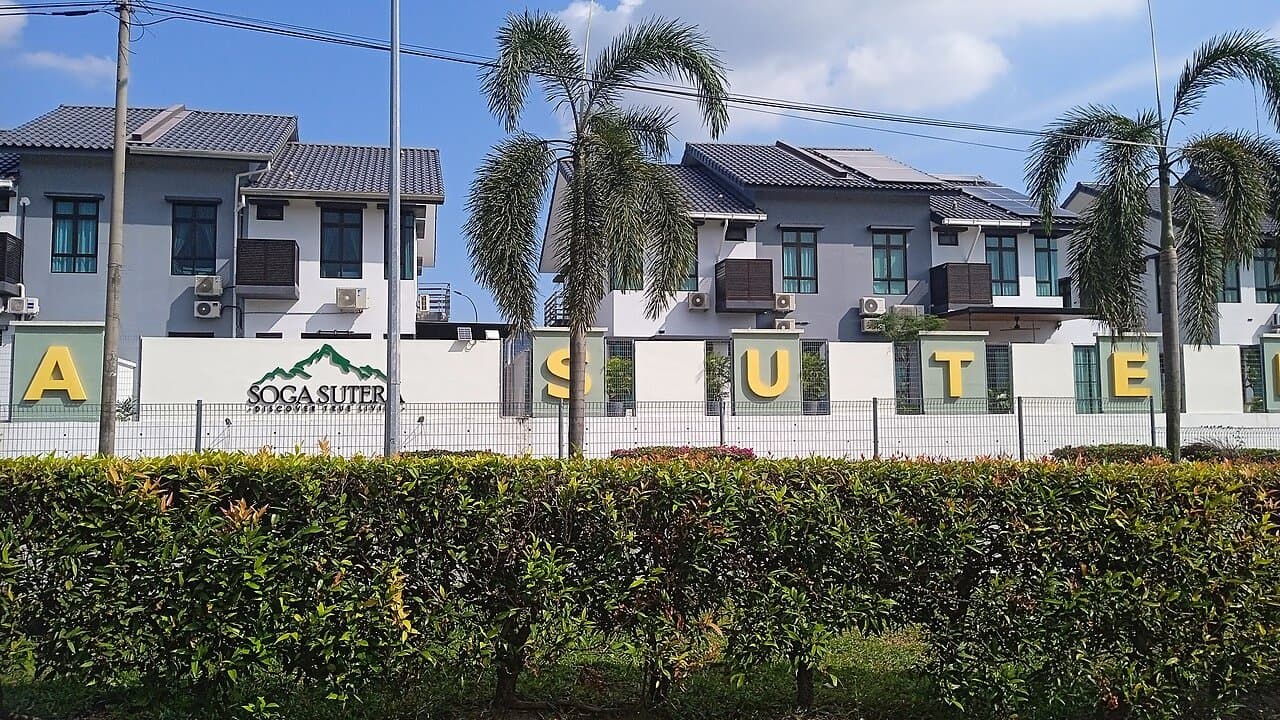
*Cover image: "Semi-detached house at Taman Soga Sutera, Batu Pahat, Johor" by Wiki Farazi, CC0, via Wikimedia Commons*
*Sources: LHDN, Garis Panduan Pengenaan Duti Setem (First Schedule, Stamp Act 1949); Ministry of Finance, Budget 2026 tax measures and speech (10 October 2025); Malaysian Bar Circulars 078/2024 and 128/2026; Solicitors' Remuneration Order 2023 [P.U.(A) 207/2023]; Bank Negara Malaysia; SJKP. Read on 15 September 2026. Confirm your own figures with your lawyer and bank.*