> Quick take: the rules that protect you have not changed, but the office that enforces them has. Since 1 August 2025 the Civil Aviation Authority of Malaysia (CAAM) handles air passenger complaints, not the Malaysian Aviation Commission (MAVCOM). The Malaysian Aviation Consumer Protection Code 2016 stays fully in force, including the September 2024 enhancement that turned a five-hour delay into a refund you can insist on.
Most Malaysians find out what they are owed while standing under a departure board that has stopped making promises. That is the worst moment to be reading a regulation, so here is what the Malaysian Aviation Consumer Protection Code 2016 (gazetted as P.U. (B) 305, and referred to as the MACPC) actually requires, and where to take it when the airline does not do it.
One thing to clear up first, because it now wastes people's time. MAVCOM's regulatory functions were transferred to CAAM on 1 August 2025 in what the government calls a rationalisation. CAAM's own complaints FAQ, dated 14 July 2025, says the MACPC "remain in force" and that there are "no changes to the scope of consumer protection". Complaints lodged with MAVCOM up to 31 July 2025 were transferred across, existing MAVCOM case numbers are still valid, and nobody has to resubmit anything. The consumer platform is unchanged: it is still FlySmart.
Two hours: food, and the notice the airline is supposed to be showing you
The Code's obligations start at a two-hour delay. Under paragraph 12 and item 3 of the First Schedule, passengers on a flight delayed two hours or more "shall be offered free of charge, meals, refreshments, limited telephone calls and internet access in a reasonable relation to the waiting time".
There is a second obligation at the same threshold that almost nobody claims. Paragraph 15 requires every operating airline to display a notice at its check-in counters, clearly visible, carrying these words: "If you are denied boarding or if your flight is cancelled or delayed for at least two hours, ask at the check-in counter or boarding gate for the information stating your rights, particularly with regard to compensation and care." If you are affected and you ask, the airline must hand you a written notice setting out the compensation and care due under the Code.
Five hours: a hotel, and the refund the airline has to put first
Item 4 of the First Schedule adds, at five hours or more, free hotel accommodation in cases where a stay of one or more nights becomes necessary, or where a stay additional to the one you intended becomes necessary, plus transport between the airport and the hotel.
The September 2024 enhancement is the part worth memorising. Speaking on 19 February 2025, MAVCOM's then director of consumer and public affairs Pushpalatha Subramaniam set out how the enhanced Code works: at five hours or more the passenger can take a refund, the airline must offer it in the original mode of payment first, and only after that may it offer alternatives such as travel vouchers or credit. The choice belongs to the consumer, not the airline. It applies whether or not the delay was within the airline's control, so weather and air traffic restrictions do not remove the refund option. And if you decide not to travel, the refund has to include fuel surcharges, taxes, fees, departure levies, passenger service charges and carbon fees, on non-refundable tickets as much as refundable ones.
That last point is the one airlines are most often argued out of. The fare may be non-refundable by its own terms. The taxes and charges collected on top of it are not.
Cancelled: 30 days, or a seat on another flight
For a cancellation, item 5 of the First Schedule gives you a choice, and it is your choice. Either reimbursement within thirty days of the full cost of the ticket at the price you paid, including taxes and fees, for the parts of the journey not made (and for parts already made if the flight no longer serves any purpose in relation to your original travel plan), or re-routing under comparable transport conditions to your final destination at the earliest opportunity, or at a later date at your convenience, subject to seats.
If the airline puts you on a flight to a different airport serving the same town, city or region, it bears the cost of getting you from that airport to the one you booked, or to another nearby place you agree on.
Paragraph 12(4) requires the airline to inform you of the cancellation, explain the reason, and tell you what alternative transport is possible. Under the enhanced Code, changes to departure times must be notified at least 14 days ahead.
Where "extraordinary circumstances" still bites
Paragraph 12(5) says an airline is not obliged to pay compensation where it proves the delay or cancellation was caused by extraordinary circumstances that could not have been avoided even if all reasonable measures had been taken. Paragraph 12(7) defines those as war, meteorological conditions incompatible with operating the flight, security risks, unexpected flight safety shortcomings, and strikes affecting the airline. Paragraph 12(8) deems an air traffic management decision that causes a long delay, an overnight delay or a cancellation to be extraordinary.
Read that carefully, because the word is compensation. Care obligations (the meals, the hotel) and the refund option under the enhanced Code are not switched off by bad weather. And paragraph 12(6) puts the burden of proof on the airline to show whether and when it told you.
Separately, paragraph 12(2) makes the airline liable for damage occasioned by a delay unless it proves it took all measures that could reasonably be required. Paragraph 12(3) caps that liability in Special Drawing Rights, the International Monetary Fund's unit of account rather than a currency you can look up on a money changer's board, converted at the rate applying when the claim is settled. Be careful with the number here: the gazetted 2016 text prints 4,694 SDR, but the 2024 amendment revised the liability caps upward, so confirm the operative figure with CAAM before relying on it.
Denied boarding, and the deadlines that quietly kill baggage claims
Paragraph 11 requires an airline that expects to deny boarding to call for volunteers first. Anyone then denied boarding gets free meals, limited telephone calls and internet access, hotel accommodation where a night becomes necessary and transport to it, plus the same choice between reimbursement within thirty days or re-routing. None of this applies where you were refused on reasonable grounds of health, safety, security or inadequate travel documents.
Baggage is where most claims are lost on a technicality. CAAM's current FlySmart FAQ puts the delayed-baggage limit at 1,288 SDR per passenger. The gazetted 2016 text still prints 1,131 SDR, because the 2024 amendment raised it, which is a good reminder that the PDF of the original Code is not the last word on any figure in it. A checked bag counts as lost if the airline admits it, or if it has not arrived 21 days after the date it ought to have. You can buy a higher limit by making a special declaration at check-in and paying a supplementary fee.
Then the trap. Paragraph 13(7) requires you to write and complain to the airline within 21 days for a delayed bag, counted from the date the bag was placed at your disposal, and within 7 days for a damaged bag. Paragraph 13(8) is blunt about what happens if you do not: "no action under this Code shall lie against the operating airline". A phone call to a hotline is not writing. Send an email and keep it.
How to complain, and what the regulator can do
The order is fixed. Complain to the airline, airport or aviation service provider first. If the complaint has not been resolved 30 days from the date you lodged it, take it to CAAM. There is an outer limit on the whole thing: CAAM's FlySmart FAQ states you must submit a complaint to CAAM within 2 years from the date of the incident. Older guides quoting one year are reading the Code as it stood before the 2024 amendment.
CAAM's channels are the FlySmart website at flysmart.my, the complaint webform at flysmart.my/make-a-complaint/, and the FlySmart mobile app. The consumer hotline is 1800-18-6966 within Malaysia and +603-7651 2777 from outside, open Monday to Friday, 8.30am to 5.30pm, excluding public holidays. Email is consumer@caam.gov.my. You will get an initial response within seven days, and you should allow up to 30 calendar days for resolution. You can track a case with its reference number, and an old MAVCOM case number still works.
The regulator is not a small claims court and will not award you damages. What it has is paragraph 22 of the Code, which allows a financial penalty of up to RM200,000 for non-compliance, and for a second or subsequent non-compliance, ten times the penalty imposed for the first. By February 2025 the regulator had cumulatively imposed RM4.85 million in penalties. CAAM has also taken over the airline and airport performance dashboard and the biannual consumer reports.
The short version to keep on your phone
Ask at the counter for the written notice of your rights. Keep your boarding pass, your booking confirmation and every receipt for food and transport you paid for yourself. Note the time you were told about the delay, because the airline carries the burden of proving that. If you are past five hours and you no longer want to fly, ask for the refund to your original payment method and do not let a voucher be presented as the only option. If a bag is damaged or late, put it in writing the same week.
This is a plain summary of published rules, not legal advice. Where a figure matters to your claim, the Code itself is the authority.
Related reads
- MyNIISe and MyBorderPass in 2026: which app actually clears you at the autogate.
- Renew Your Malaysian Passport Online: the step before any of this matters.
- Scammed in Malaysia: the other complaint channel worth knowing by heart.
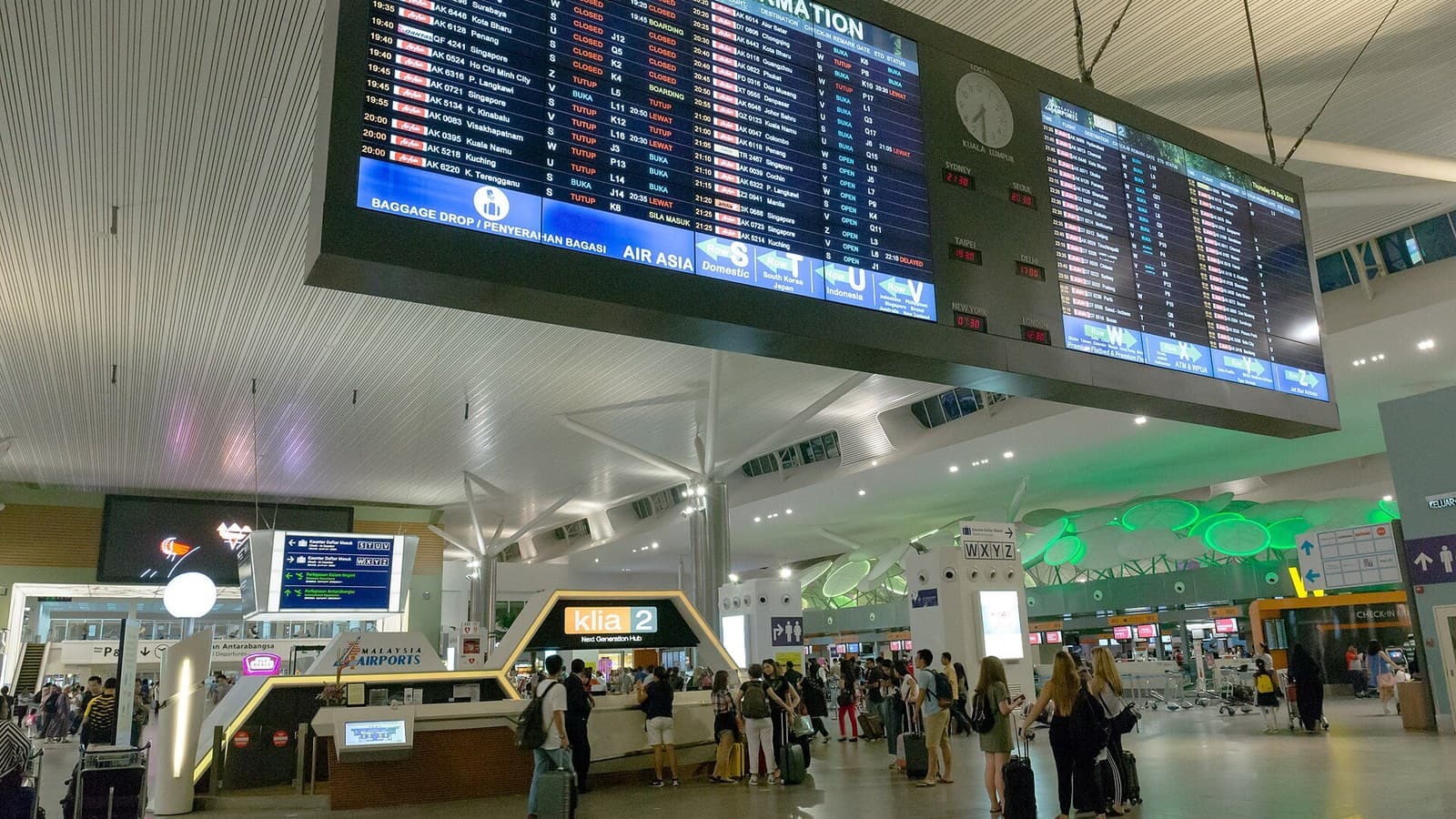
*Cover image: klia2 departure hall and flight information display, Wikimedia Commons, Morio, CC BY-SA 4.0*
*Sources: the Malaysian Aviation Consumer Protection Code 2016 (P.U. (B) 305) in full, read 21 September 2026, in particular paragraphs 10 to 15, paragraph 22 and the First Schedule; the CAAM complaints FAQ "Continuation of Regulatory Functions by the Civil Aviation Authority of Malaysia", as of 14 July 2025, published on flysmart.my; CAAM's make-a-complaint page at caam.gov.my; The Star's report of 19 February 2025 on the enhanced Code, quoting MAVCOM's director of consumer and public affairs; and CAAM's own FlySmart consumer FAQ at flysmart.my/en/faq/, read 21 September 2026, for the 1,288 SDR delayed-baggage limit and the two-year complaint window that the un-amended 2016 text does not carry.*