> Quick view: the "airport tax" on a Malaysian air ticket is really four separate charges set by three different bodies, plus a fuel surcharge that is not a tax at all. Which ones you pay depends on where you fly from, where you fly to and which cabin you book.
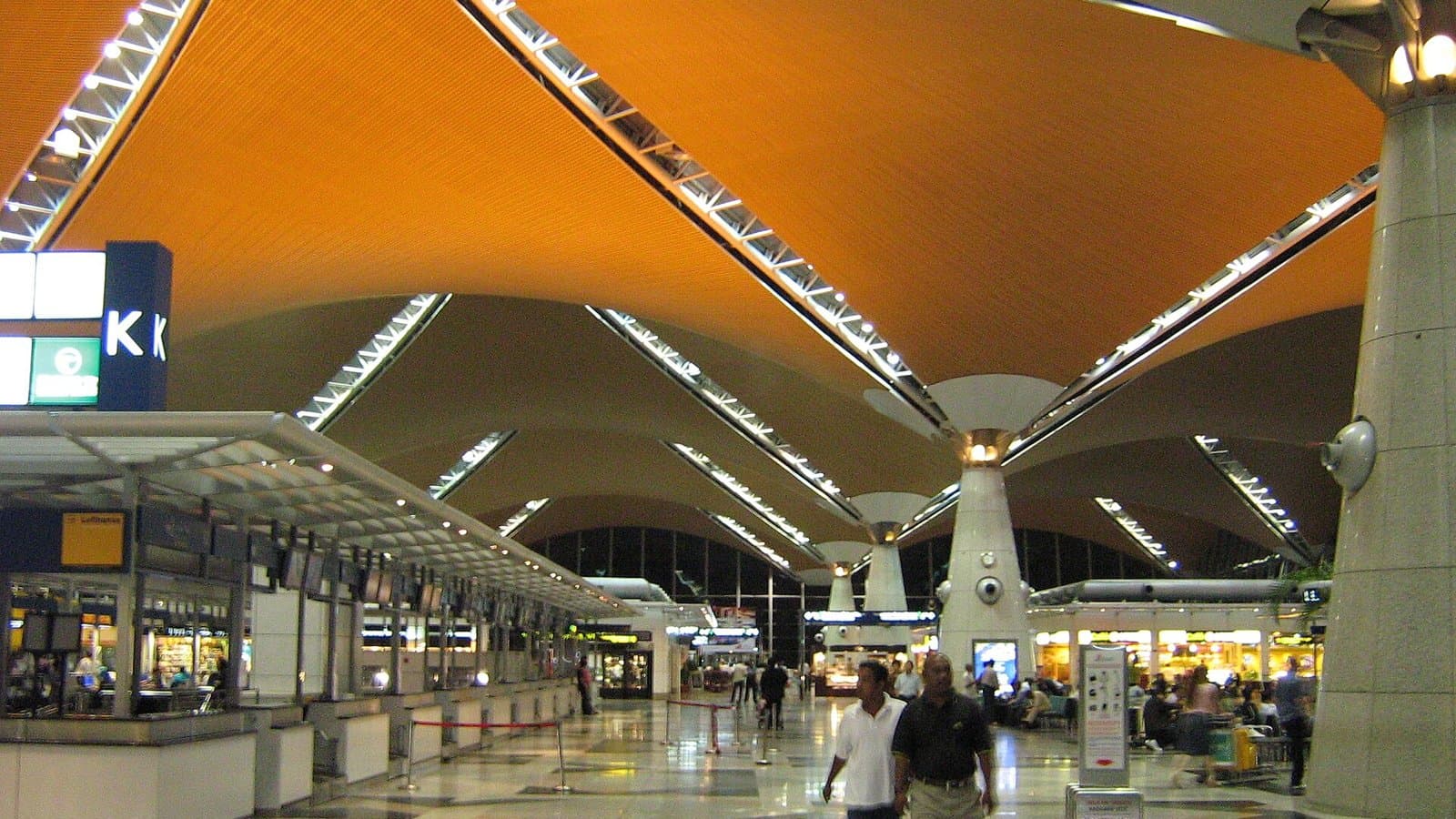
*Cover image: Craig / Wikimedia Commons (public domain), the check-in hall at KLIA Terminal 1.*
We read the Passenger Service Charges page on the Malaysia Airports (MAHB) site, the Civil Aviation Authority of Malaysia (CAAM) consumer pages and its September 2026 consultation paper, and the Royal Malaysian Customs Department's domestic-flight SST guide on 18 October 2026. We also priced two AirAsia flights for Wednesday 18 November 2026 up to the fare summary, to show the charges on a real ticket.
1. Passenger Service Charge (PSC)
This is the charge most people mean by airport tax. It pays the airport operator for terminal facilities and security. The airline collects it when you buy the ticket and passes it to the airport once you fly. MAHB's table, in force since 1 June 2024, has three rates per departing passenger:
- RM11 for a domestic flight from any airport
- RM50 for an international flight from KLIA Terminal 2 (klia2) and every other MAHB airport, including Penang, Kota Kinabalu and Kuching
- RM73 for an international flight from KLIA Terminal 1
Transfer passengers pay a lower rate: RM7 domestic, RM29 international via klia2 and other airports, and RM42 via KLIA Terminal 1. The June 2024 table removed the old discount for ASEAN destinations, so a flight to Bangkok now pays the same PSC as a flight to Tokyo. Senai in Johor is privately run and sets its own charges, so it is not on MAHB's table.
The practical point: the same international trip costs RM23 more in PSC from Terminal 1 than from klia2.
2. Departure levy
The levy is a government tax under the Departure Levy Act 2019, collected since 1 September 2019 and administered by Customs. It applies only to flights leaving Malaysia, so domestic flights, including to Sabah and Sarawak, do not pay it. The rates under the 2019 rates order are:
- ASEAN destinations: RM8 in economy, RM50 in other classes
- Everywhere else: RM20 in economy, RM150 in other classes
Infants under two, on-duty crew and transit passengers who leave within 12 hours are exempt. The levy matters most in business class: a non-ASEAN premium ticket pays RM150, against RM20 in economy.
3. Regulatory Service Charge (RSC)
A flat RM1 per departing passenger, created in 2018 to fund the former aviation regulator, MAVCOM. MAVCOM's functions moved to CAAM on 1 August 2025, and CAAM's transition notice says RSC payments continue until further notice. It still appeared as a separate RM1 line on both AirAsia fares we priced.
4. SST on domestic flights
Customs' guide for domestic flights says a domestic ticket is subject to service tax, now 8%. The tax covers the base fare and domestic add-ons such as baggage, seats, meals and the fuel surcharge. The PSC and the regulatory charge are outside SST. Two exceptions matter to East Malaysians: flights within Sabah and flights within Sarawak are exempt (Kota Kinabalu to Sandakan, Kuching to Miri), and so are rural air services. A flight between Sabah and Sarawak is taxed. International flights carry no SST.
What it looks like on a real ticket
AirAsia, klia2 to Singapore, 18 November 2026, total RM120.47: base fare RM43.47, PSC RM50, departure levy RM8, RSC RM1 and fuel surcharge RM18. Everything except the base fare comes to RM77, about 64% of the price.
AirAsia, klia2 to Kota Kinabalu, same day, total RM286.31: base fare RM201.99, fuel surcharge RM52, PSC RM11, RSC RM1 and service tax RM20.32, which is exactly 8% of the fare plus the fuel surcharge. No levy, because it is a domestic flight.
An economy ticket from KLIA Terminal 1 to London carries RM94 of Malaysian charges (RM73 PSC, RM20 levy, RM1 RSC) before the airline's surcharges and the UK's own taxes.
Fuel surcharge is not a tax
The fuel surcharge is set by each airline and changes with oil prices. It is part of the airline's revenue, which is why a sale fare can look cheap until the surcharge appears at checkout. Under CAAM's consumer code, airlines must show the full fare, including every charge and fee, before you pay.
A PSC change is coming in 2027
CAAM published a second consultation paper on regulating aviation charges on 9 September 2026, with comments closing on 23 September. It proposes a new long-term framework and states that a planned adjustment to the PSC would take effect from 2027. No new rates have been published, so treat any figure you see before CAAM gazettes them as unconfirmed.
Did not fly? Claim the taxes back
CAAM's consumer pages say airlines must refund all mandatory charges (PSC, government taxes and fees, fuel surcharge and carbon fee) on a ticket you did not use, for both refundable and non-refundable tickets. The refund is due within 30 days of your request, and on a non-refundable ticket the airline may keep a processing fee of up to 5% of those charges. On the Singapore ticket above, that is about RM77 back.
*Sources: Malaysia Airports, Passenger Services Charges page; CAAM consumer FAQ and refund-request pages; CAAM Advisory Information 09/2025; CAAM Second Consultation Paper on the Regulation of Aviation Services Charges (September 2026); Departure Levy Act 2019 and its 2019 rates and exemption orders; Royal Malaysian Customs Department, Panduan Penerbangan Domestik (30 May 2024); AirAsia fare summaries read on 18 October 2026.*