Signing up as an organ donor in Malaysia now takes a few minutes on your phone. Turning that pledge into an actual donation depends on something no app can do for you. This guide is based on the Health Ministry's organ donation portal (dermaorgan.gov.my), run by the National Transplant Resource Centre (NTRC), read on 27 October 2026, including its statistics panel labelled July 2026. It explains the process and is not medical advice.
The numbers behind the campaign
The NTRC's July 2026 figures show why it keeps pushing pledges:
- 20,254 new pledgers so far in 2026, and 436,642 pledgers in total.
- 83 actual deceased donors in 2026, and 1,140 since records began.
- 3,582 organs and tissues donated to date, and 3,728 transplant operations.
- 12,575 patients waiting for an organ from a deceased donor.
By organ, the waiting list in July 2026 was:
- Kidney: 12,228 adults and 307 children.
- Heart: 14.
- Liver: 9 adults and 7 children.
- Heart and lung together: 7.
- Lung: 3.
Nearly the whole list is people on dialysis waiting for a kidney. Fewer than three in every thousand pledgers have so far become actual donors, largely because donation needs a particular kind of death and a family's consent at that moment.
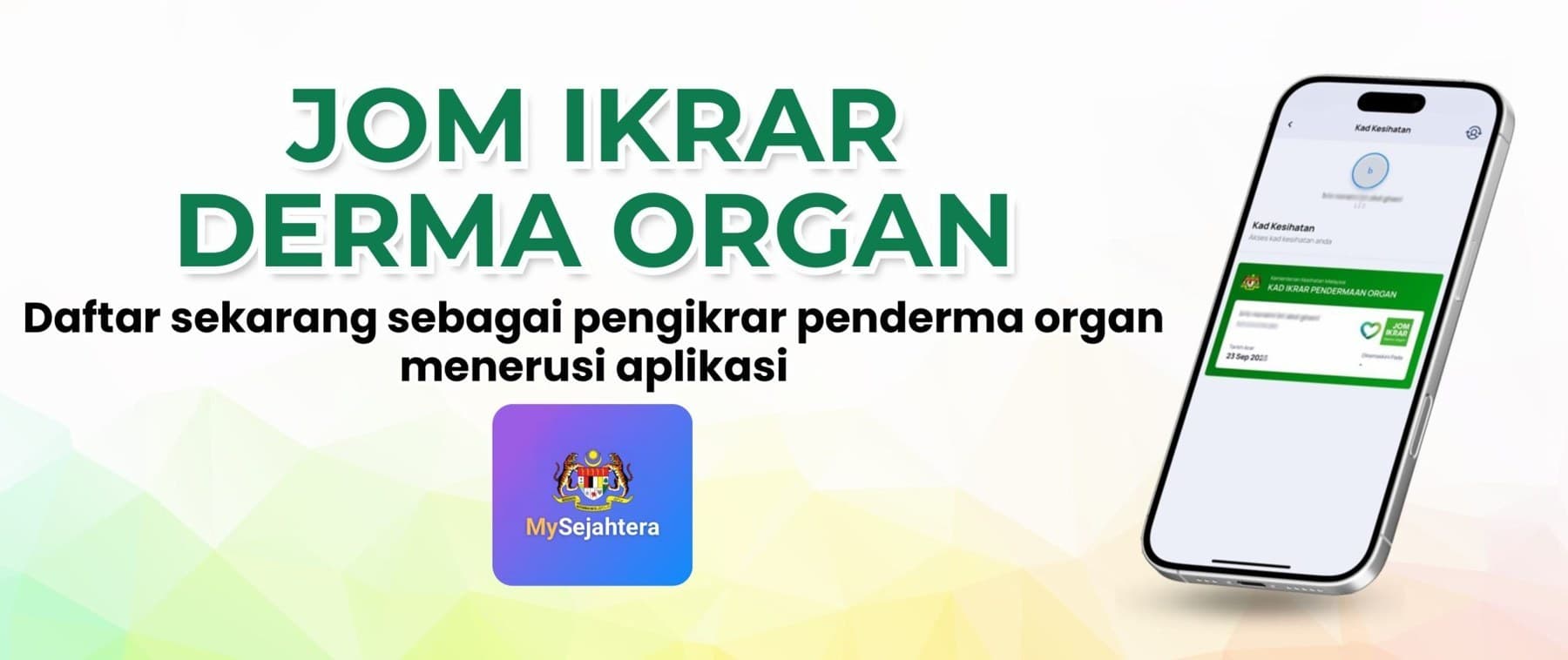
How to pledge in MySejahtera
The NTRC's own step-by-step graphic lists eight steps:
- Update the MySejahtera app.
- On the home screen, tap Lihat Semua (See All).
- Choose Ikrar Derma Organ.
- Tap Mula (Start).
- Fill in your next of kin's name, nationality, mobile number and relationship, then tap Hantar (Submit).
- You receive a confirmation that your pledge succeeded.
- Tap the profile icon on the home page.
- Your digital pledge certificate appears under Kad Kesihatan.
The NTRC describes the same menu as the place to update a pledge. For anything the app cannot handle, its free line is 1-800-88-9080, or email ntrc@moh.gov.my.
Who can pledge
The NTRC says people of every age can register, but anyone under 18 needs a parent's or guardian's consent. No health screening is required, and foreign nationals living in Malaysia can register as well.
Why your family decides
Malaysia uses an opt-in system under the Human Tissues Act 1974, unlike the opt-out systems the NTRC cites in Spain and Singapore. In practice, after a death the hospital asks the family, and the NTRC states that no retrieval surgery happens until the family or heirs give permission. A family that already knows your wishes is far more likely to say yes, and may even raise it with the hospital themselves. That is why the NTRC tells every pledger to inform their family.
When donation can actually happen
Organs can only come from someone confirmed brain dead while on a ventilator. Two qualified specialists must run the brain-death tests twice, six hours apart. A person whose heart has stopped can donate tissues but not organs, and only eye donation can be done at home or in a hospice. In medico-legal cases such as road accidents, the investigating officer and a magistrate must agree first.
The process is free for the family. Government hospitals waive the donor's hospital bill from admission, and at private hospitals the family is not charged for anything connected with donation once death is confirmed. The NTRC says retrieval does not disfigure the body, which is returned for funeral rites as quickly as possible. Selling organs is illegal.
Questions of faith
The NTRC cites a 1986 ruling issued at an OIC conference in Amman that recognised brain death as death, and the Health Ministry publishes a booklet on organ transplantation from an Islamic perspective. If religion is part of your family's decision, talk it through with them now rather than leaving it to a hospital corridor.
Living donation
A living person can donate only to a close blood relative or a lawful spouse. Anyone else needs approval from an independent panel appointed by the ministry. Living donors get first-class ward entitlement where available, a waived hospital bill and free treatment at Health Ministry facilities.
Related reads
- Blood donation in Malaysia: who can give and what you get
- Writing a will in Malaysia
- What happens if you die without a will
*Image: Ministry of Health Malaysia, National Transplant Resource Centre (dermaorgan.gov.my).*